The origin of the Amber Alert: A Texas radio listener’s idea saved children’s lives
READ MORE
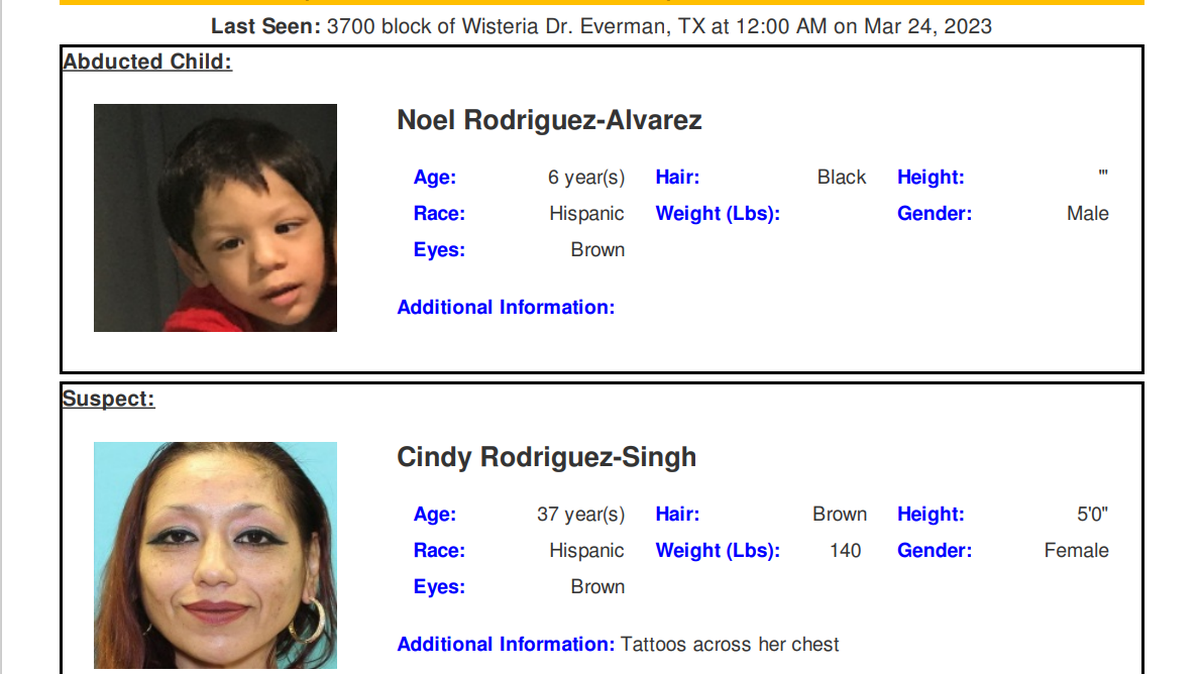
The search for missing Everman, Texas, child Noel Rodriguez-Alvarez
Here is what’s known about the investigation and the events that police have pieced together so far.
Expand All
(First published Jan. 14, 2016.)
Twenty years after 9-year-old Amber Hagerman was found dead in Arlington, a Hood County woman cried all over again.
“It got pretty emotional,” said Diana R. Simone, the massage therapist whose idea for Amber Alerts has rescued 794 children.
“I just wish something could have been done for Amber.”
Simone and a client, the late Rev. Tom Stoker of Fort Worth, were talking about the grim news and crying that day on the massage table in her Fort Worth studio.
In the early days of brick-sized cellphones, she wondered aloud if an alert could be sounded for missing children.
“Why not radio?” Stoker asked, popping up from the table. Simone called a KDMX/102.9 midday host, Kim Ashley, and the Amber Alert was born.
That year, seven local radio station managers from competing chains, including Dan Bennett and Tyler Cox of what is now Cumulus Media’s WBAP/820 AM and KLIF/570 AM, did the hard work to set up a local broadcast alert system, similar to those for thunderstorms.
“Now people say, ‘Oh, you’re the one who thought up those phone alerts waking me up at 2 in the morning!’ ” Simone said.
“But we’re away from radio more now. People listen to their own music. But they take their cellphones everywhere.”
The heroes are the police looking for these children, and the firefighters, and the people working in battered women’s shelters.
Diana R. Simone of Hood County
who suggested Amber AlertsShe used to say she never told anyone it was her idea because “it seemed to be working.”
It is. The incidence of child abductions by strangers has declined sharply since 1996, and the alerts also discourage family abductions that risk lives.
“It’s fantastic that it acts as a deterrent,” Simone said.
“It puts a million eyes on the lookout in a matter of minutes.”
Simone, now 70, is often held up as an example of the power of ideas.
When The Dallas Morning News’ Sharon F. Grigsby wrote a nice salute to Simone, the headline was: “Think ‘just plain folks’ can’t make a difference? This life-saving woman sure did.”
“In today’s world — which too often seems to be going to hell in a handbasket and in which scoundrels, posers and just plain jerks get too much air time — I wanted to make sure Diana Simone’s name was lifted up,” Grigsby wrote.
Simone was sheepish.
“It strikes me as so strange when people talk about me,” she said.
“The heroes are the police looking for these children, and the firefighters, and the people working in battered women’s shelters. I only did something, just one thing, one time.”
But it has worked 794 times.
Diana Simone’s January 1996 letter to KDMX/102.9 FM
As we discussed on the telephone Friday, January 19, concerning the Amber Hagerman tragedy, it occurred to me that in the vast majority of abduction cases we hear about, children are being put into vehicles and transported from the point of abduction, point A, to somewhere, point B.
Considering the population density of the metroplex area, that seems virtually impossible to complete without being seen by someone. In Amber’s case, for example, I’m sure a number of people saw her in that black pickup truck but simply did not know what they were seeing.
To remedy this, I would like to suggest an emergency system be set up so that when a verified 911 call is placed, all the radio stations in the area would be notified immediately and they would interrupt programming to broadcast an emergency alert, giving whatever information and descriptions that are pertinent.
In this way, thousands of people would be alerted within minutes of an occurrence, greatly minimizing the chance of successful escape. Naturally, citizens would be advised not to interfere, but simply call in any sightings of the suspect vehicle or persons.
Also, a great number of my colleagues and clients feel that this type of a response system may act as a strong deterrent, since possible perpetrators would be aware that virtually everyone on the roads, etc., would be looking for them.
I want to thank you and Kim Ashley for your interest and support of this idea. I sincerely hope this plan or something similar [can] be enacted so children of the Dallas-Ft. Worth area may experience their childhood as a time of joy, rather than [as] one of fear of apprehension.
If you are able to gather support for this Emergency Broadcast Plan, my one request is that it be known as Amber’s Plan.
Sincerely,
Diana Simone
This story was originally published January 14, 2016 at 8:32 PM with the headline "The origin of the Amber Alert: A Texas radio listener’s idea saved children’s lives."