Mayor Mattie Parker should listen to her own words as she faces her critics | Opinion
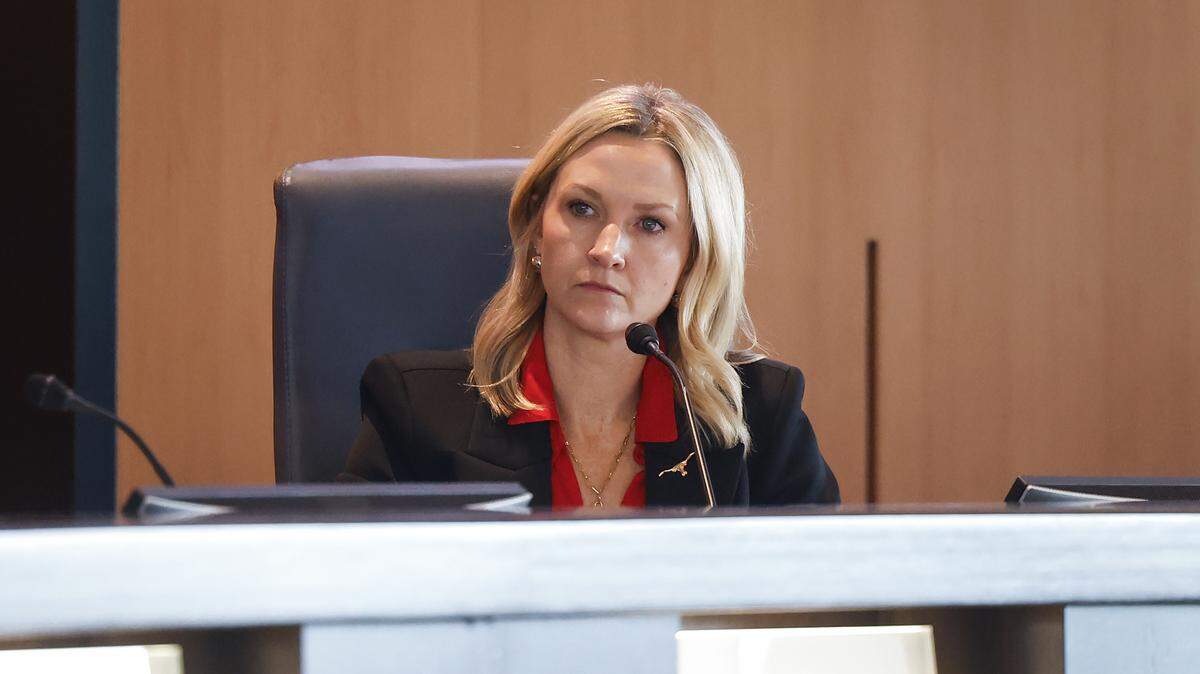
The best way to understand Tuesday night’s lengthy and angry gathering of Fort Worth citizens and their embattled mayor, Mattie Parker, is by listening.
You could listen to Chris Tackett, author of the Tarrant County politics newsletter See It. Name It. Fight It., as he methodically dissected, charts in hand, the consequences of reducing forums for members of the public to deliver direct feedback and criticism to their city council representatives. He framed it not just as a danger to democracy, but an inefficient impediment to bureaucracy.
You could feel entrepreneur EJ Carrion’s rage with Parker for appearing to forge an alliance with state Rep. Nate Schatzline, despite his authorship of numerous anti-LGBTQ bills. Carrion based his case on Schatzline’s report about a meeting Schatzline participated in with the mayor, county Judge Tim O’Hare, District 10 council member Alan Blaylock, and other local faith leaders.
Like many in attendance at Tuesday’s council meeting, Carrion critiqued what he sees as the mayor’s courting of Mercy Culture, Schatzline’s church, after also accusing Patrice Jones, a Black community activist and Fort Worth native, of leaving a casket on her lawn in 2022, first from her City Hall dais and again in a televised interview.
Though the mayor said she had “facts and proof” that Jones was involved in leaving the casket on her lawn, she’s yet to present the evidence she says she possesses. Police investigated the incident as a “terroristic threat,” and a police report released this week says Jones didn’t match the physical description of any people who dropped off the casket.
The report does note that Jones made a Facebook post a week before the incident saying, “Any funeral home willing to allow use of a casket for tomorrow? We also need some buses from some churches.” But police also wrote that the absence of evidence “makes it virtually impossible to say [Jones] committed the offense.”
Meanwhile, you should also listen to what Jones said and understand what she did at Tuesday’s meeting. Jones ceded much of her three minutes of allotted time to have a moment of silence for Atatiana Jefferson, a Black woman killed in her home by Fort Worth police in 2019. Though Jefferson was killed before Parker became mayor, racial justice advocates have criticized Parker’s opposition to creating a police review board that’s independent of the Fort Worth Police Department, which they argue would provide an additional layer of accountability for police misconduct.
Mattie Parker is her own best critic
Maybe you won’t listen to these citizens, dismissing their arguments as rants from left-wing zealots. That’s fine. Then I encourage you to listen to Mattie Parker herself, who turns out to be her own best critic.
In 2023, the University of Virginia’s Karsh Institute of Democracy thought so highly of Parker that it invited her to speak on a panel discussion platforming civil servants who epitomize our civic ideals.
Titled “Mayors: The Frontline Workers for Democracy,” the discussion included Levar Stoney, then the Democratic mayor of Richmond, Virginia, and Parker, a Republican known for distancing herself from the GOP’s obsession with stoking culture wars against minorities by centering good governance.
Parker played the part well, bemoaning the doctrinaire divisiveness plaguing politics. “To work on behalf of your constituents, the hyper partisanship just doesn’t really work,” said Parker. “In order for me to get anything done, I have to convince my other colleagues, who have very diverse backgrounds and perspectives.” She positioned herself as the type of mayor who would value input from communities fighting for criminal justice reform, the kind who would “acknowledge that not everyone’s experience or trust in police is the same.” Parker added that “especially as a white woman, there are times when I just need to listen and understand.” (This feels like the perfect time to mention the mayor did not return my repeated requests for comment and clarification in time for publication of this column.)
Further, Parker appeared to empathize with the voices of her constituents, frustrated with issues in this country and eager to confront their local leaders. “They want you to fix it. And they show up at City Hall fully expecting that you have the power to do that, because they have no way to access any other political leader that they are frustrated with.”
Again, she said this in 2023. The iPhone I used to watch Parker defend her constituents is older than the video itself. Had the version of Mattie Parker speaking in Richmond been present in Fort Worth, Tuesday’s meeting would likely have had a much different tone.
Parker’s constituents are catching on to the battle of Parker v. Parker.
Mendi Tackett, who co-publishes the See It. Name It. Fight It. newsletter alongside her husband, Chris, projected a picture of a 1991 Ku Klux Klan rally in Hico, Texas, Parker’s hometown, on the City Hall floor Tuesday. She cited the mayor’s passionate discussion of her shame over her hometown’s history of racism.
“You said your mother showed you photos when you were young so you could recognize racism and taught you your responsibility when you saw it,” Tackett said from the floor. “That story proves you know racism didn’t end after the Civil Rights Movement. It evolved.”
In America, that evolution includes the Republican Party’s courting of white racial conservatives and segregationist Democrats in search of a political home. The Republican operatives licking their electoral wounds during the Civil Rights Movement employed what they called the “Southern strategy,” which replaced battles against the explicit cause of racial equality with policy goals and rhetoric that reframed those liberal measures of Black advancement as an economic blight or threat to public safety.
Even as social and racial conservatives control the modern Republican Party, there are few who work in the party riding around on horseback burning literal crosses. (The millennial and under set, as Politico reported, prefers to trade slurs and Nazi jokes in their group chats.)
Procedurally, racial conservatives like county judge Tim O’Hare undermine minorities by strategically splitting voting districts, impeding their ability to form muscular coalitions capable of electing politicians who will pursue racial progress. Like Schatzline, they author bills that punish businesses that sell race and queer-friendly material under the guise of “obscenity.” Like Sen. John Cornyn, whom Parker just endorsed in his tight Senate primary race against Attorney General Ken Paxton, they treat Muslim Texans like terroristic threats and by requesting that the DOJ investigate baseless rumors that a mosque has conspired to impose its religion on their neighbors.
The modern GOP is somewhat more sophisticated and technocratic in the hostility it exhibits toward racial, religious, and sexual minorities. And, in 2023 at least, Parker appeared to know that.
“We’ve let the fringes create this dynamic,” Parker said then to the UVA crowd eager to hear dispatches from democracy’s frontline. “For the most part, the taboo nature of inclusivity is really from the far right. And I have told my fellow Republican friends, ‘What kind of tent are you building?’”
It’s a good question! One the mayor’s city is eager for her to answer.
This story was originally published October 17, 2025 at 12:45 PM with the headline "Mayor Mattie Parker should listen to her own words as she faces her critics | Opinion."