
Tarrant redistricting: Boosting conservatives or attempt to dilute minority voters?
Redrawing of precinct lines is always a political game, and the winner is based on which party is in control.
Political scientists at two Texas universities agree that Tarrant County’s commissioner precinct lines are questionable at best, though one said the new map from the Public Interest Legal Foundation is likely to be just as questionable.
Tarrant County commissioners voted 3-2 along party lines on April 2 to hire the Virginia-based law firm in the first step toward redrawing precinct lines.
The county has not responded to questions regarding when the new maps would be in place, but Brandon Rottinghaus, a University of Houston political science professor, said the new maps could be approved within a year.
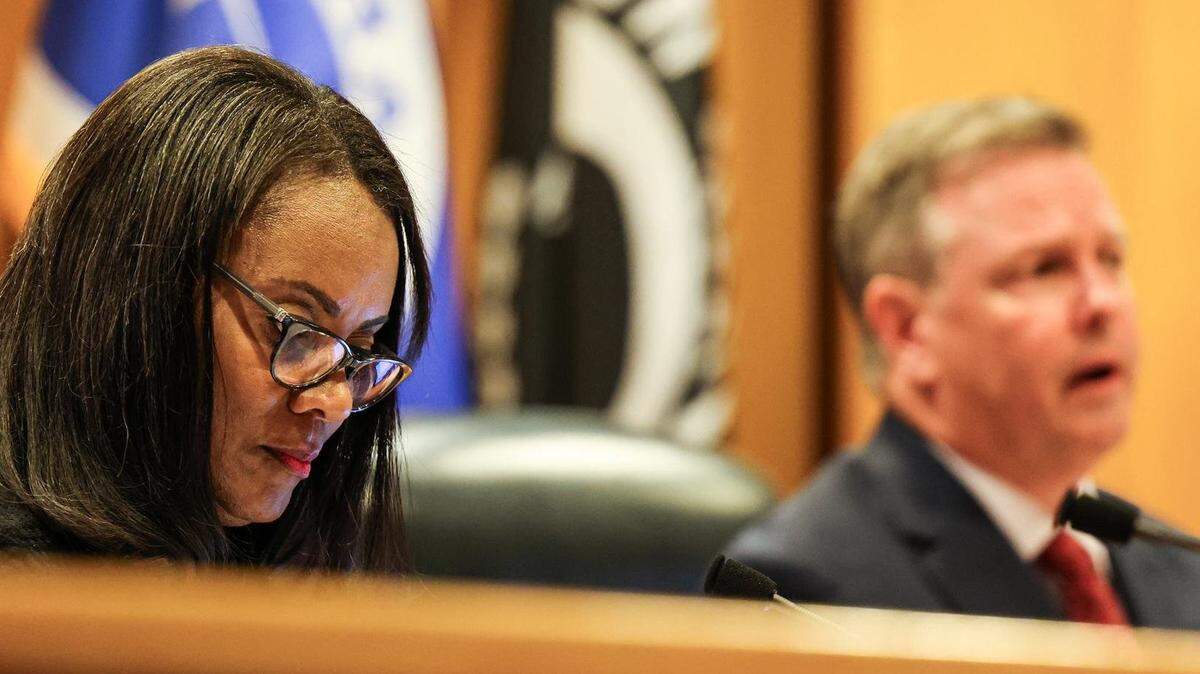
Republicans Tim O’Hare, county judge; Matt Krause of Precinct 3; and Manny Ramirez of Precinct 4, were in favor of the redistricting. Democrats Roderick Miles of Precinct 1 and Alisa Simmons of Precinct 2 voted no at the initial meeting, asking why now and why this firm?
Ramirez has said he wants to ensure strong conservative leadership continues to lead Tarrant County and wants lines that reflect the growth since the last redistricting in 2011. Neither Krause nor O’Hare responded to a request for comment.
Simmons said this redistricting is intentional discrimination meant to dilute strong minority voters. Miles told the Star-Telegram that he is committed to transparency throughout the redistricting process.
“Our community deserves a process that is rooted in fairness, one that reflects every voice and reflects the full diversity of the people who call Tarrant County home,” Miles said. “Lastly, I think it is dangerous to try and set a precedent of redistricting outside of the ten year census time frame.”
The law firm is to deliver Tarrant County with legal advice and potential maps with new precinct lines. Public Interest Legal Foundation defended Galveston County’s federally disputed 2021 redistricting for being unconstitutionally gerrymandered to dilute minority voters.
For this first phase of the redistricting, Public Interest Legal Foundation can be paid up to $30,000.
When Simmons challenged O’Hare at the April 2 meeting about why he handpicked this law firm, the judge responded that he wasn’t going to answer her questions and that he had done his own research on the group.
Simmons is now leading the charge to obtain county funding for legal advice for her and Miles, but had to postpone that motion until May 6. She will propose hiring Austin-based Brazil & Dunn. The law firm lists 12 legal specialties on its website, ranging from civil rights law to white collar crime.
Meandering precinct lines
The weekly Tarrant County GOP newsletter said the precinct lines are decades-old “blatant gerrymandering.”
The newsletter noted how Precinct 1 stretches from the southwest corner of the county, touches three other counties, and stops at the east border of Tarrant County. The precinct includes Forest Hill, Edgecliff Village, Crowley and Burleson, and has been represented by a blue commissioner since the 1960s.
Rottinghaus said that meandering plus the racial imbalance “could suggest a legally problematic district.”
Tarrant County’s population is 42.2% white, 30.5% Hispanic and 19.3% Black. The racial and ethnic makeup of Precincts 1 and 2 most closely compare to that of the county. Precincts 3 and 4 are 61.9% and 51.4% white.
Cal Jillson, a political science professor at SMU, said he’d have to agree with Rottinghaus and the Tarrant County GOP.
“There is no question that more geographically coherent district lines could be drawn than those currently in place or those likely to be put in place by the current Republican majority on the Commissioners Court,” Jillson said. “But geographical coherence will not be the goal when new lines are drawn because gerrymandering, drawing lines to secure the interests of the governing party, is now baked deeply into partisan politics.”
Jillson said since O’Hare is a deeply partisan figure, the new map is likely to be gerrymandered in favor of a Republican-majority Commissioners Court, especially with Democrats winning more seats. The issue for Democrats though, Jillson said, is they won’t have much of a case against it.
The Supreme Court ruled in 2019 that claims of partisan gerrymandering are not subject to scrutiny in a court of law.
“In Texas, Republican majorities always claim that they are drawing lines for partisan purposes and Democrats charge that the lines are an unconstitutional dilution of minority voters’, particularly Black voters’, right to select representatives of their choice,” Jillson said. “But because Black voters give 90% of their votes to Democrats, it is hard for journalists, political analysts, and the courts to distinguish legal political motivations for drawing particular lines from potentially illegal racial motivations for drawing those lines. So, unless the line drawers are stupid enough to explicitly admit racial prejudice as their motive for drawing lines, the courts are likely to let those lines stand.”
In three weeks, the Commissioners Court will revisit the redistricting if only to hear Simmons’s request to hire Brazil & Dunn, LLP.
Rottinghaus said having a second legal opinion will be costly, but likely worth the price if it remedies controversial decisions the Commissioners Court may make with the redistricting otherwise.
The legal service agreement states the law firm would not charge more than $30,000.
Traditionally, counties hire only one law firm for redistricting and the process takes between six months to a year. If Tarrant County brought in a second legal group, Rottinghaus’s guess is that it’ll slow the process down, which could benefit the Democrats if Republicans are trying to get a new map confirmed by the next election.
O’Hare, Simmons and Ramirez will be up for reelection in 2026.
This story was originally published April 18, 2025 at 5:50 AM.