Luck and loopholes: For some North Texans, rent relief isn’t enough to fend off eviction
READ MORE
Forced out: When rent relief isn’t enough to fend off eviction
Texas Rent Relief aims to keep tenants in their homes and landlords paid. But for some Dallas-Fort Worth residents, the rental assistance program hasn’t been enough to avoid eviction.
Expand All
Brittany Cervantes thought she had bought herself some time.
After waiting weeks for rent relief funds and appearing twice in eviction court before the justice of the peace in Arlington, Cervantes had finally paid her back rent. She had gotten a cashier’s check for about $3,500 made out to her landlord, who had cashed the Texas Rent Relief money even though she had not applied for the funds alongside Cervantes.
Cervantes thought that she and her four children were safe in their Arlington home. And they were — for about two weeks.
On Aug. 2, Cervantes’ front porch camera picked up movement: an officer pasting a red 24-hour notice to vacate onto her front door.
“WARNING,” the notice read. “Any time after 8/3, 2021 at 235 PM all remaining persons and personal property will be removed from the premises. Your possessions will be placed outside the dwelling at a nearby location.”
The Texas Rent Relief program, a federally funded rental assistance program, has multiple aims: It intends to help keep tenants in their homes during the COVID-19 pandemic, and to prevent “financial hardships” for both tenants and property owners, according to the program’s website.
But gaps in the rules and inconsistent enforcement have meant that some tenants face eviction hearings or displacement even after paying their landlords with rent relief funds — or while waiting for their applications to be approved. Luck of the draw plays a significant role, too, housing advocates and attorneys say. A more sympathetic landlord or judge, or access to legal representation, could be the difference between a tenant losing or keeping their home.
A spokesperson for Texas Rent Relief sent some program information over email, but declined repeated requests for interviews for this story.
Although the program stopped accepting new applicants in early November, thousands of tenants are still in the system, which will continue to operate until it runs through all of its $1.9 billion in funding.
In general, landlords and those who back them say that evictions are a last resort.
“Evictions are bad for business,” said Perry Pillow, the CEO of the Apartment Association of Tarrant County, the local chapter of a property owners’ lobby. “It costs time, it’s money. You want to keep a good resident there, somebody that’s going to pay. Evictions are typically a last resort because they are bad for business.”
But tenant protection measures such as the federal eviction moratorium helped to drop eviction rates, according to The Eviction Lab at Princeton University. Meanwhile, Texas’ protections, as the Star-Telegram has reported extensively, have been particularly weak — leading in some cases to landlords losing their income and tenants losing their homes.
Christina Rosales, the former deputy director of Texas Housers who now works on housing issues nationally, said the rent relief program and its “pitfalls” point to a central confusion about the role housing plays in society.
“What is housing? Is it a right, is it something that we need to keep people safe and the foundation for everything in our communities?” Rosales said. “Or is it a business?”
Twenty months into the pandemic, and nine months into Texas’ statewide effort to keep tenants housed, some North Texas residents are still facing down evictions that advocates say could have been avoided.
Landlords don’t have to participate
Cervantes, the Arlington resident, was laid off from her job as an office administrator in March 2020, she said. She made rent for a while, but it was tough.
With money running out, she said she asked her landlord, Virginia Quick, if they could apply together for Texas Rent Relief. Cervantes said her landlord declined to apply alongside her.
Quick told the Star-Telegram that she didn’t know about the program until the case went to court in early June. However, she also signed a court document in mid-May stating she had reviewed the Texas Eviction Diversion Program, a related program funded with rent relief money.
Either way, Cervantes applied for rent relief on her own — which is allowed but adds extra steps, because Texas Rent Relief attempts to reach the landlord first.
As Cervantes waited on her application, Quick filed an eviction against her, citing a month and a half of unpaid rent. The case was heard, then delayed for 60 days to wait for rent relief, according to court documents. Quick waited three weeks before requesting another hearing.
At the second hearing, on July 14, Cervantes said she told the justice of the peace that she had the money. Ready to go. Ready to pay that back rent.
Two days later, according to a receipt, Quick cashed Cervantes’ check for $3,451.64.
And, about two weeks after that, an officer pasted a notice to vacate on the door of Cervantes’ light blue house. Her landlord was moving forward with the eviction, even though Cervantes had paid the back rent, even though she’d paid with rent relief funds.
Jim Floyd — a Fort Worth attorney who often represents property owners, including members of the Apartment Association of Tarrant County — said landlords he’s worked with don’t want to evict tenants.
“Having someone have to leave their home certainly doesn’t help the person having to leave and it doesn’t help the owner or management company either,” Floyd said. “The owners and management companies are in the business of being as occupied as they can be, and obviously every family needs a roof over their [heads].”
Texas Rent Relief money is intended to help both landlords and tenants — so it comes with strings attached. By agreeing to participate, a landlord also agrees to drop any pending eviction case against the tenant, among other conditions.
But Cervantes and Quick were in something of a gray area. Because Quick had not filed for rent relief alongside Cervantes, and because the funds went to Cervantes directly, it wasn’t so clear that Quick had been paid with actual rent relief funds.
Quick said that, after Cervantes paid the back rent, she then didn’t pay the next two weeks’ rent. (Cervantes disputes the length of the back rent, although the judge who ruled in Cervantes’ case said at another hearing that she typically does not order tenants to pay future rent.)
And because Quick had not dropped the eviction case when she cashed Cervantes’ check — which would’ve been a requirement if she had applied for the funds alongside Cervantes — she was able to file for a writ of possession based on the ongoing case, according to court filings.
“What is she going to do, live there forever [for] free?” Quick said. “I’m 78 years old, I can’t afford to support anybody.”
After seeing the eviction notice, Cervantes said she called the courthouse, then one legal aid organization and then a second. Cervantes texted Quick directly, too. First, a long message, more than a little indignant, reciting the facts from Cervantes’ perspective. Then, another text, short, pleading.
“Can you please give me 2 weeks to move out? So I can make sure my kids ain’t homeless and leave the house clean, please,” she wrote on Aug. 2.
The next morning, Cervantes texted again, asking for a few more days to move out. On the same day, Cervantes filed an emergency motion asserting her landlord had “waived any right to continue with the eviction” when she accepted the back rent funds.
In Cervantes’ text message history, there’s no reply. In court documents, her emergency motion is “not considered.”
Late in the afternoon on Aug. 3, just after her 24-hour notice ran out, Cervantes stood outside her Arlington home, smoking a cigarette.
“I paid her,” Cervantes said, before addressing her soon-to-be former landlord. “I paid you almost $4,000 and you just kick me and my children out on the street.”
Stuart Campbell — an attorney at the Dallas Eviction Advocacy Center who helped Cervantes file her emergency motion — said cases such as Cervantes’ are relatively rare.
But he said there are more cases where landlords decline to participate in the rent relief program at all. They aren’t legally obligated to take the money, so some don’t, including some who participated in a first round of funding but decline to participate in a second.
“In these cases where rent relief is an option, it really is just an option,” Campbell said.
Some types of evictions still allowed
Colton Gregg used to work as a bartender — work that vanished when the pandemic began.
Gregg and his roommate Carla Holland made do for a while, they said, partially by buying and reselling the contents of storage units. But by late spring 2021, they needed more help paying the bills.
So Gregg, who lives in Farmers Branch, applied for Texas Rent Relief.
After one successful application, Gregg applied for a second round of assistance. But the application process was slow — two months after applying, the portal still showed Gregg’s application with the label “Additional Funding Requested.”
As Gregg waited, his landlord sought an eviction, citing “violations of the Lease” for allegedly “leaving trash and improperly storing items” at the property.
And while Gregg’s second round of rent relief hadn’t gone through yet, under the Texas Rent Relief rules, even a landlord actively receiving rent relief funds can evict a tenant for reasons related to “criminal activity, property damage or physical harm to others.”
Floyd, the Fort Worth attorney, said the exception is intended primarily to allow landlords to evict tenants who are posing safety risks to other residents.
“An owner or a management company has an obligation not just to the tenant who’s trying to pay rent or live in a property, but they have an obligation to the other tenants,” Floyd said.
Gregg and Holland aren’t actually opposed to leaving their apartment.
The ceiling of their apartment has caved in at least three places. They say the apartment manager won’t pick up their calls or answer her office door. (Representatives of Gregg’s apartment complex, Ventana at Valwood, did not return requests for comment.)
“If it was just the eviction, I’d probably be OK, but it’s because of everything else,” Gregg said. “It’s a constant burden.”
Although Gregg and Holland want to leave, to find somewhere with intact ceilings, they still don’t want to be evicted. Evictions often come with fines and fees, back rent or filing costs. And they also come with a black mark: eviction records are public, and other landlords may choose not to rent to a recently evicted tenant.
“I do worry about getting in somewhere else if this goes through,” Gregg said. “You can’t get an apartment with a month-old eviction.”
In late October, Gregg appeared in eviction court and was found not at fault — a win for him and Holland.
But Rosales, the housing advocate, said she’s seen other cases where tenants are evicted for minor infractions, such as taking in an out-of-work family member without landlord approval.
“There shouldn’t be much of a difference. Those tenants are still not causing major problems,” Rosales said.
For those tenants, as for Gregg, the outcome of their case comes down to the flexibility of a landlord and the discretion of a judge. And that, according to housing attorneys, is the core of another problem with Texas’ pandemic evictions.
‘It’s 100% luck’
With rent relief and eviction guidelines changing constantly, housing advocates say a tenant’s odds of staying in their home depend largely on the inclinations and legal knowledge of their landlords and their local court.
For instance, while the federal eviction moratorium was still in place, the Texas Supreme Court let its enforcement order lapse. For months, it was essentially up to each individual judge to decide whether to follow through on the federal rules.
Now, with the federal declaration vacated as of the end of August, that particular question is moot. But there are still plenty of lingering enforcement questions.
Judge Ralph Swearingin, Tarrant County’s Precinct 1 justice of the peace, said the state’s guidance for local judges has been detailed in some areas and lacking in others.
For instance, he pointed to a guided script included in a Texas Supreme Court emergency order, which tells justices how to discuss the Texas Eviction Diversion Program, which is funded through Texas Rent Relief, in court. But, the guidance doesn’t specifically address how some of those rules apply to county and city rental assistance programs.
“The truth of the matter is, there’s not much on process, procedure and guidelines for the judges other than the general overview,” Swearingin said.
“We’ve had to make our way through this based upon what we believe is just and right.”
The Texas Supreme Court emergency order, which tells judges how to deal with evictions and rental relief programs, has been updated throughout the pandemic. Over its seven versions from September 2020 to September 2021, the script has become more detailed and the rules for judges more clear.
Judge Al Cercone, of Dallas County’s Precinct 3-1 Justice Court, said the instructions from the Texas Supreme Court are bare bones — but he said he’s also found them straightforward.
“They’re not giving you that much guidance,” Cercone said. But the orders are “pretty self-explanatory. They’re not vague or they’re not that difficult to understand. And it’s clear what the purpose is.”
In any eviction hearing, Campbell said, the odds are low that all involved parties fully understand the law.
“The [self-represented] landlords — which is like 90-something percent of them in JP court — and a lot of the judges just don’t know. And it’s almost ridiculous to expect a tenant to know the ins and outs of this,” he said. “The legal structures are in place to prevent this; they’re just not being utilized to their full potential.”
With constantly evolving rules, and interpretation of those rules left to individual judges, the simple matter of which court district a tenant lives in could change the outcome of a case. Campbell said there’s “no uniformity” across the courts.
“It’s 100% luck,” he said.
Floyd said the inconsistencies are primarily between judges, not within one individual judge’s court.
“It would be nice … for the tenant and the owner or management company to know that the result was going to be the same from precinct to precinct,” Floyd said. “And sometimes that’s true, and sometimes it’s not. I think that makes it hard for everybody involved.”
And it isn’t all about what happens in the courtroom.
Besides the statewide Texas Rent Relief program, there are local programs, too, which can provide rental assistance to tenants. And sometimes, those smaller programs can act more quickly than the statewide program.
But many tenants aren’t sure which programs they qualify for — or don’t even know that other programs exist.
The city of Fort Worth’s Emergency Rental Assistance program, which is also federally funded, has gained more traction after a marketing campaign, according to Terrance Jones, the city’s interim neighborhood services manager. But there’s still confusion, especially because the state, city and county applications all use the same online platform.
Tarrant County assistant administrator Kristen Camareno, who oversees Tarrant County’s Emergency Rental Assistance Program, said the confusion and overlap with the state program has meant the county has struggled to distribute the available funds as quickly as officials had hoped.
“I would say we spend about 50% of our time here fielding calls from confused landlords, tenants … trying to ensure that we’re not duplicating (state efforts),” Camareno said.
The wait for a pending eviction
For tenants already wracked with stress over a potential or pending eviction, the process itself adds the cruelty of uncertainty.
While eviction notices list a specific time when the tenants are supposed to be out of the property, constables don’t always show up at that exact time. Tenants are left to wonder, and to make their own predictions.
Nearly 27 hours after she received a 24-hour eviction notice, Cervantes’ phone showed 5 p.m. and she figured she was probably safe for the evening. She told the Star-Telegram that she predicted the constables and her landlord would be at her door first thing the next morning.
She was right.
The constables showed up on the morning of Aug. 4 to oversee the eviction, more than 40 hours after the 24-hour eviction notice.
A video taken by Cervantes that morning shows four people crowded together in the house, one dragging a massive black garbage bag across the floor as another pulls items out of a cabinet and into a box.
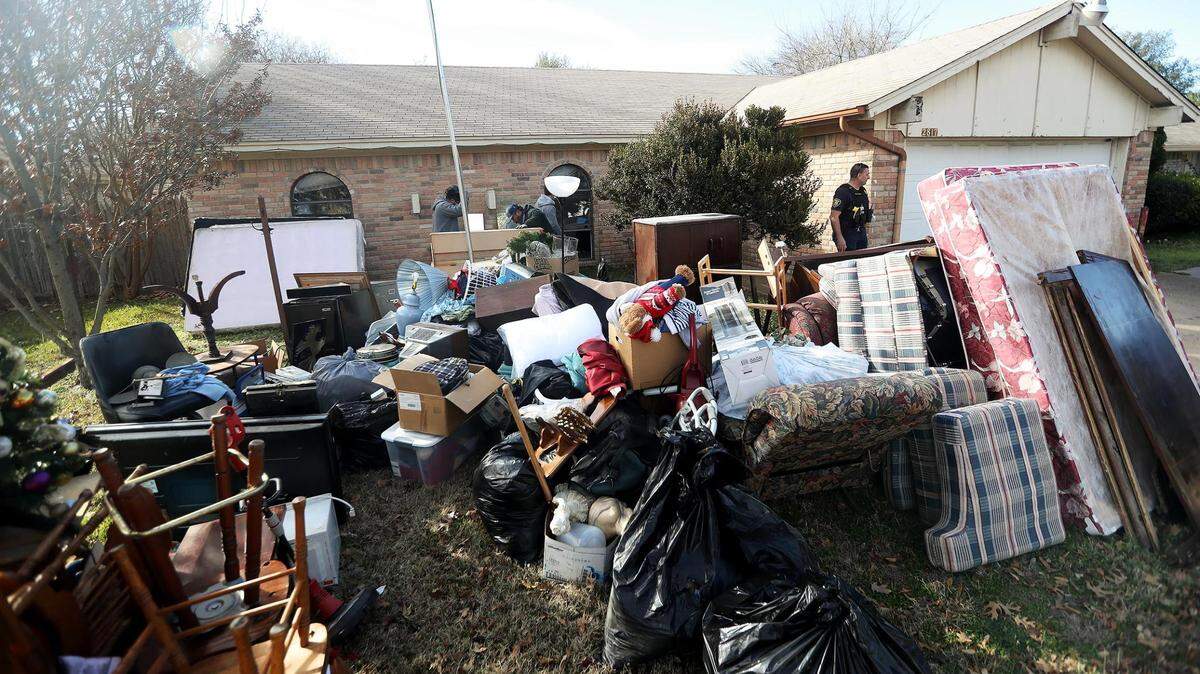
By about 11 a.m., they’d cleared out the house Cervantes and her four children had lived in for several years. Most of their belongings fit into the UHaul Cervantes had rented. But there was more, too. Furniture and odds-and-ends sat along the edge of the driveway, an uneven queue adding to Cervantes’ to-do list.
And nearest to the detached garage sat an arrangement of empty aquariums, whose former inhabitants had been evicted, too.
Four turtles had been moved to a pink tub. Two smaller turtles had been moved to a plastic pitcher. But Cervantes was most worried about an orange bucket, which had been filled with water and outfitted with an oxygen tube. Inside the opaque bucket, a hulk of a fish hovered.
His name is Shaq, Cervantes says. He’s a 5-year-old blood parrot cichlid, and she doesn’t know if he’ll survive the shock of the sudden move.
There are other worries, too, though, and more pressing ones.
“Where am I going?” Cervantes said, hours before the eviction. “I have no clue. Honestly, I have absolutely no clue.”
Three months later, at the beginning of November, Cervantes told the Star-Telegram that she and her four children had been living in a motel since the eviction.
This story was originally published November 28, 2021 at 5:16 AM.