
TCU students disappointed they won’t have Texas to kick around anymore
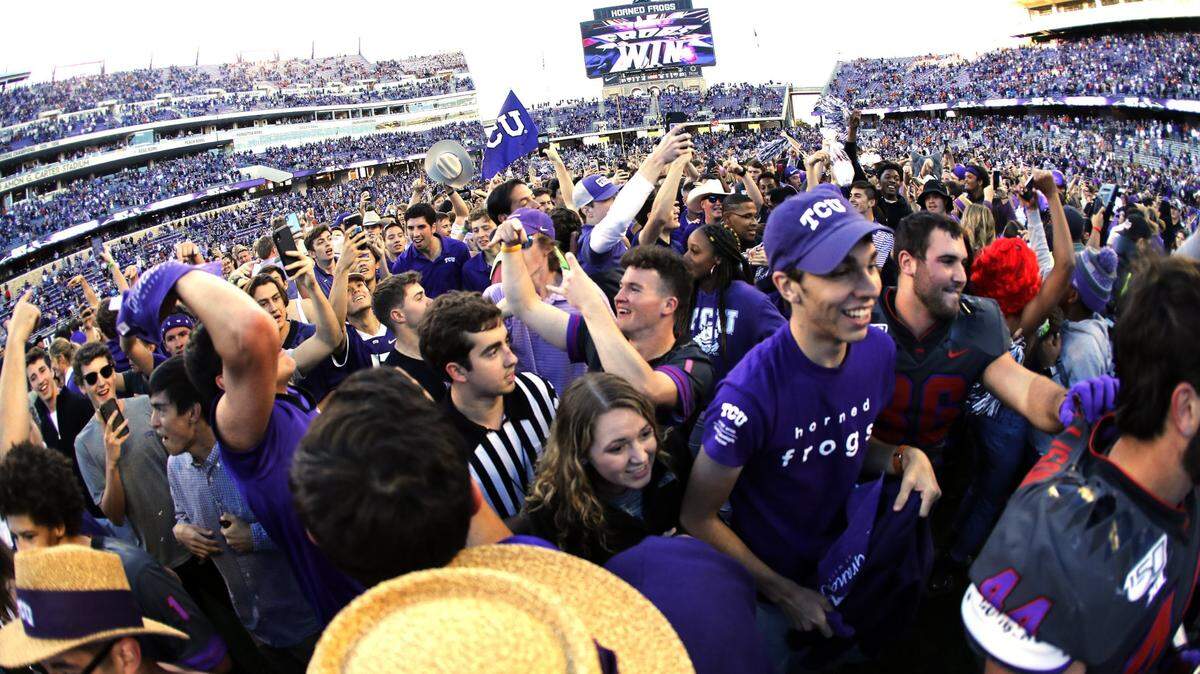
A wave of students jumped over the rails and stormed the field. Horns and yells pierced the air. “Frogs Win” lit up the big screen.
The Horned Frogs had just defeated Texas 37-27, but the fans’ on-field celebration earned the school a fine from the Big 12.
Some TCU students, recalling TCU’s last home game against Texas in 2019, said the moment was one of their “best memories.”
“I’m going to miss playing Texas,” said Michael Onyango, a sophmore political science major. TCU defeated Texas again in 2020, their seventh victory over the Longhorns in nine games since Horned Frogs joined the Big 12 in 2012.
“I’m going to miss beating them,” he said.
TCU faces the possibility of playing in another conference after Texas and Oklahoma announced they are leaving the Big 12 for the Southeastern Conference.
For TCU, the move to the Big 12 was followed by an increase in enrollment, a building spree and millions more in athletic department revenue. Students say the football team and the chance to see teams like Texas and Oklahoma visit Amon G. Carter Stadium were a reason they chose TCU.
Whether TCU joins a new conference or stays in the Big 12 with new teams, students say it won’t be the same without two of the nation’s most storied programs as conference rivals.
“A big part of the Big 12 was competing against Texas and OU, so, with them gone, it’s like ‘Oh no,’” Onyango said. “One thing we’re all going to miss is that rivalry between Texas,” he said.
Putting TCU on the map
TCU’s football program has helped put the school on the map.
“I basically heard of TCU through football, and I think that might be true for a lot of people,” said Griffin Johnson, a junior finance and accounting major, who said sports were a big factor in his decision to attend TCU.
Jonathan Weaver agreed that the athletic program influenced his decision.
“I wanted to be able to go to football games and have a good sports team,” said Weaver, a junior movement science major.
Cooper Guia, a junior English major, said he wanted to go to a small school that still had competitive Division I athletics, so TCU’s football program and the Big 12 were “definitely” a reason he chose TCU.
Echoing Guia, TCU cheerleader Sterling Silliman said she wanted to go to a small school with a big game-day feel. She said the changes with the Big 12 could make game day feel like a “small school game day” and that the change will take away from football season.
Senior sports broadcasting major Iman Suliman said going to a “big football school” was important for her future career. She transferred to TCU because she wanted to go to a school that was a part of the Big 12.
For other students, TCU’s game day is nostalgic.
Onyango said football played a role in his choosing TCU because he grew up watching former quarterback Kenny Hill and TCU football.
Sydney Short recalled attending games as a child, especially the ones against Oklahoma because she had family who went to OU. As a student, she said she loved going to the TCU-Oklahoma game because it reminded her of her childhood.
“I’ve been going to a bunch of TCU football games my entire life, and that is one of the reasons I chose TCU is because of my experiences as a little kid going to the games, and them being in a different conference will change that whole thing,” said Short, a junior business major.
Student body president Lau’Rent Honeycutt called TCU football a part of culture.
TCU issued a statement Monday saying the university will continue to make decisions in the best interest of the student-athletes, community and the long-term vitality of the athletic programs.
“Athletics are a part of TCU’s national reputation and build upon our core strengths of academic achievement, scholarly pursuit and an unparalleled student experience,” the school said. “We have nothing to announce at this time but have been engaged in deliberations with our conference colleagues and others and continue to support the Big 12 and its members.”
University growth after joining the Big 12
Since TCU joined the Big 12, undergraduate enrollment has increased 18% to 9,704 in 2020, and the campus has expanded to accommodate the growing student body.
Since 2011, the university has added 16 residential buildings, six academic buildings and expanded the Neeley School of Business. The Ed and Rae Schollmaier Arena, previously known as Danile-Meyer Coliseum, underwent a $72 million renovation before the 2015-16 season.
Athletic revenue increased from $68 million in 2011 to $114 million in 2019, the year before the pandemic interrupted athletic seasons, according to the figures the university submited to the U.S. Department of Education.
Students to ‘embrace’ last games against UT, OU
Short said it was “disappointing” that Oklahoma and Texas aren’t going to be a part of the Big 12 anymore.
Silliman, the cheerleader, said she will miss the game-day atmosphere during the Texas and Oklahoma games.
“It’s sad and disappointing that two of the bigger teams in the Big 12 are leaving just because I always look forward to playing UT and OU because the game day atmosphere is so fun and everyone always gets so involved,” Silliman said, adding “I think the overall experience will be different because the longer you play a team, the more the rivalry grows, so possibly having new teams enter into the Big 12 there won’t be as much of a rivalry there.”
Honeycutt also said he will miss the OU and UT rivalries.
“We all love game days against teams like those where we have deep roots,” Honeycutt said. “But no matter where things end up, TCU will always be a great place for student athletes and for fans.”
Some TCU faculty members don’t expect the change to have a big effect on the football program or students.
“I expect TCU football to continue to be competitive, I expect the student population to continue to enjoy the games and go to the games and I expect them to continue to be competitive for bowl game contention,” said Floyd Wormley, associate provost for research and dean of graduate studies at TCU. “At the end of the day, TCU is going to be TCU. They’re going to do what they need to do to be competitive and to represent the university well. Go Frogs.”
Some students said they were optimistic about the change.
“While it’s nerve-wracking for TCU students, it’s also pretty exciting that we could be realigned with some good competition that we haven’t seen in a while,” said Johnson, junior finance and accounting major.
Students said they plan to cherish the upcoming season, which could be the last time TCU plays Texas and Oklahoma.
Silliman said she plans to take a moment to stop and “look around” during the games to make sure she embraces every moment.
The Horned Frogs host Texas Oct. 2 and visit Oklahoma on Oct. 16.