
Focus on deportation, undocumented immigrants is history repeating itself in Fort Worth
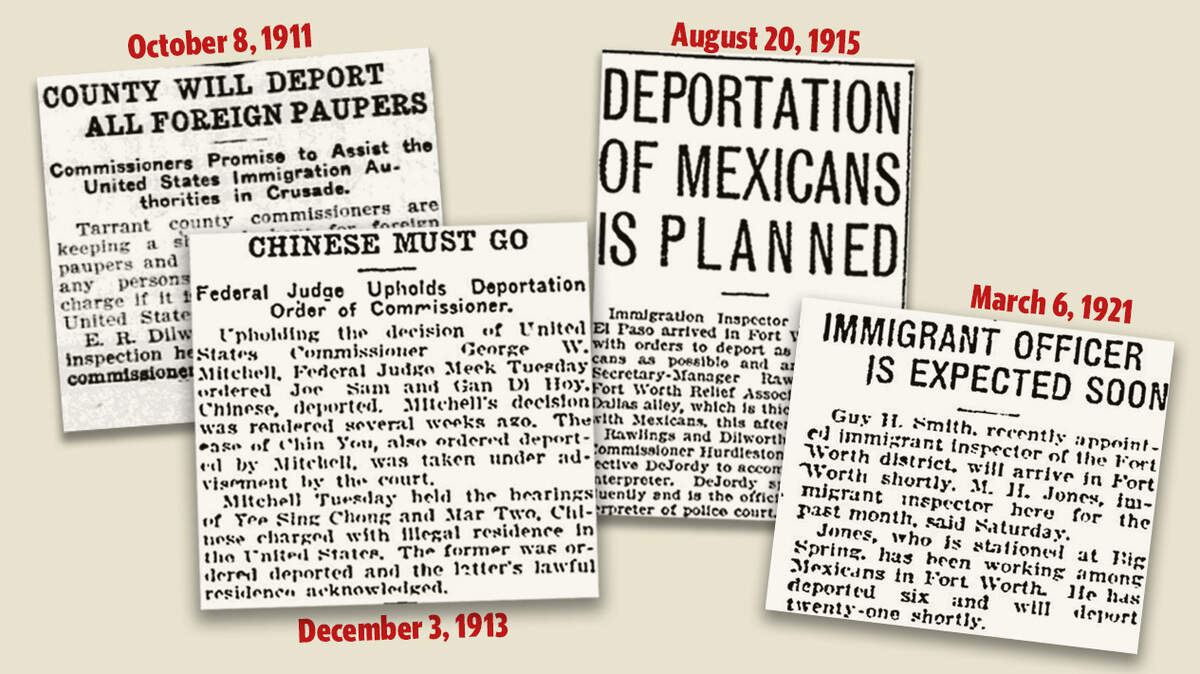
The current furor over mass deportation of the undocumented in this country has historical precedence in Fort Worth. Common accusations about the undocumented echoed in Fort Worth Star-Telegram articles from the early 20th century: aliens broke the laws, carried disease, burdened local charities, and took jobs from locals.
The Chinese were originally welcomed to work on intercontinental railroad construction and California gold mining in the 19th century. As their numbers steadily increased, local labor organizations viewed them as threats to white employees. Nativistic attitudes prompted the passage of the Chinese Exclusion Act in 1882, prohibiting Chinese immigration to the US with the exception of diplomats, teachers, merchants, students, and travelers, or those becoming citizens.
Newspaper reporters told of multiple arrests of Chinese people at the Texas & Pacific Railroad station as early as 1903. After jailing, they appeared in an immigration court before a U.S. Commissioner. In some cases, a local attorney fluent in Chinese would interpret. If acceptable documentation was not provided, the commissioner ordered deportation. A sheriff accompanied the deportees via train to San Francisco for boarding on a steamer bound to China.
An example is the case of Yee Sing Chong, 23. He immigrated to El Paso at age 7 with his father Yee Git Chong, a merchant. El Paso District Attorney W. C. McGown raised him in his household, sending him to local schools and calling him Charlie McGown. After his father and McGown died, Chong moved to Fort Worth and worked as a waiter at the Golden Eagle Café at 1110 Main St. Immigration Inspector Dilworth arrested him and testified since Chong was now a laborer, he was subject to the Chinese Exclusion Act. A reporter wrote on April 7, 1914, that Chong was unfamiliar with Chinese culture or writing. Federal Judge Meek ruled in April, 1915, Chong could stay in the US.
Common reporters’ references in the early 20th century for Chinese people included “Celestials” (referring to the name of China as the “Celestial Empire”) and other offensive terms.
The cataclysmic Mexican Revolution, 1910-1920, forced many Mexican people to flee to the United States in search of jobs, safety, shelter, and food. Immigration, police, and relief authorities kept close watch on the Fort Worth Latino communities on the North Side and Dallas Alley, located on East Victory Boulevard, in the early 20th century. The Star-Telegram reported in January 1912 that immigration agent I. B. Lewis and police spent a Saturday interrogating north side immigrants. Lewis reported 125 were not self-supporting. C. W. Woodman, an organizer for the American Federation of Labor, discovered 200 Mexican immigrants came to the area under contracts to work.
In October 1911, Tarrant County commissioners agreed to assist Immigration Inspector E. R. Dilworth in keeping a sharp lookout for foreign paupers in the area. If they were here less than three years, commissioners would cooperate in their deportation. An immigration agent picked up the Lesa family in May 1916 at the corner of 13th and Commerce and had them jailed to await deportation proceedings. Mr. Lesa was missing a right hand, preventing him from working, and his wife was described as wrinkled and bent. A “slim, sickly-looking girl of 12” with them wept all the way to jail. They were presumed to be paupers from Mexico, looking for charity.
Mexican residents targeted
In 1915, James Rawlings, secretary-manager of the Fort Worth Relief Association, persuaded U.S. immigration agents to investigate Mexican people living in Dallas Alley. Of the 150 they interviewed, Rawlings said, “How this bunch got into the United States I don’t understand. One of them has a crushed chest ... Several are diseased ... I believe where the government allows persons to enter this country who are proven to be undesirable aliens, the government should pay for their maintenance. They should not become charges of private or municipal charity.”
In March 1916, City Physician Webb Walker inspected Dallas Alley’s health standards. He concluded the Black people were cleaner than the Mexican people. His finding contrasts with the July 1916 investigation by Immigration Agent Robb with northside police of 250 Mexican families’ homes. He found the Mexican peoples’ homes sanitary and moral.
In 1921, Immigration Inspector G. H. Smith declared the migration of thousands of Mexicans to Fort Worth was the result of “The big companies that have imported these Mexican workmen for agricultural work had need of them no longer, and I have found hundreds of Mexicans in the past week who have been given tickets to Fort Worth by these companies.” He added he would work to deport quickly all the undocumented.
Europeans without proper immigration status were also subject to deportation. In 1914, Russian immigrant Ida Guss, 28, lived in Fort Worth and developed a relationship with another immigrant Felix Weinterman, a saloon owner at 13th and Monroe. She was arrested in 1915 and sent to New York for deportation for lack of immigration papers. Authorities intended to deport her to Russia as soon as the war was over.
On Feb. 4, 1915, Guss absconded, returned to Fort Worth, and married Weinterman in Cleburne on Feb. 11. Despite her protest that she was now married, Inspector Dilworth arrested her the next day and returned her to New York. Immigration authorities in Gotham released her to freedom.
Author Richard J. Gonzales writes and speaks about Fort Worth, national and international Latino history.