In 1879, Fort Worth faced crisis when new Western Trail competed with Chisholm
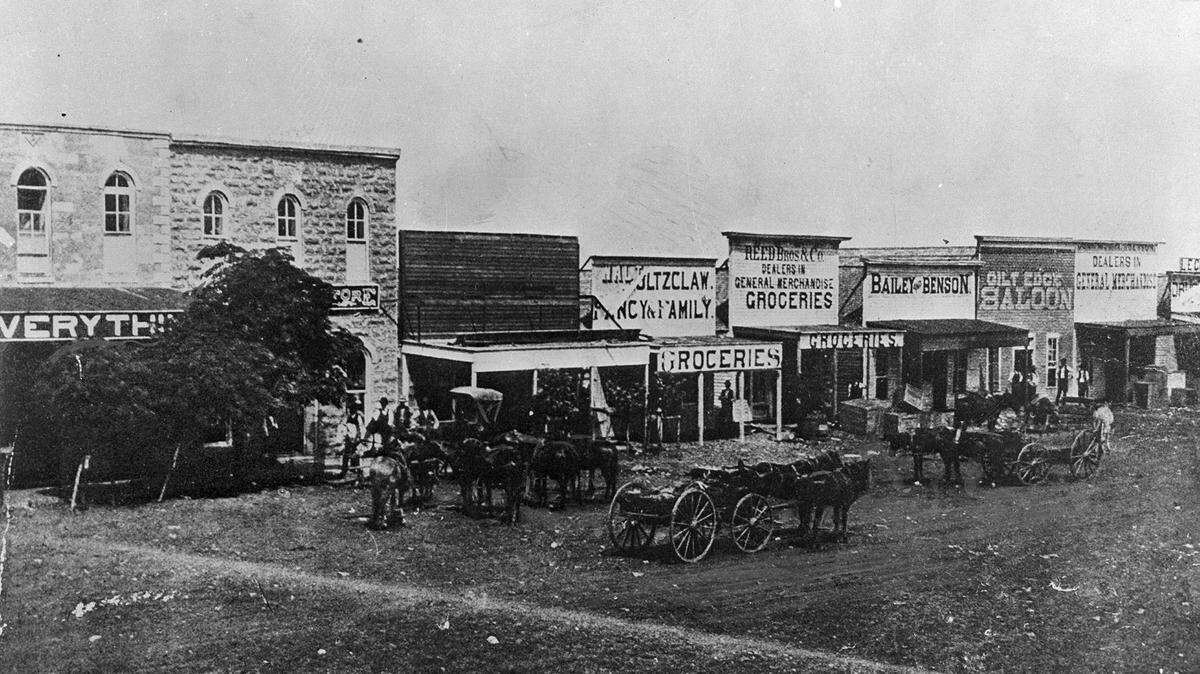
The first longhorn cattle drive came through Fort Worth in 1866 on the way north to the railhead in Kansas – Abilene first, later Wichita or Newton.
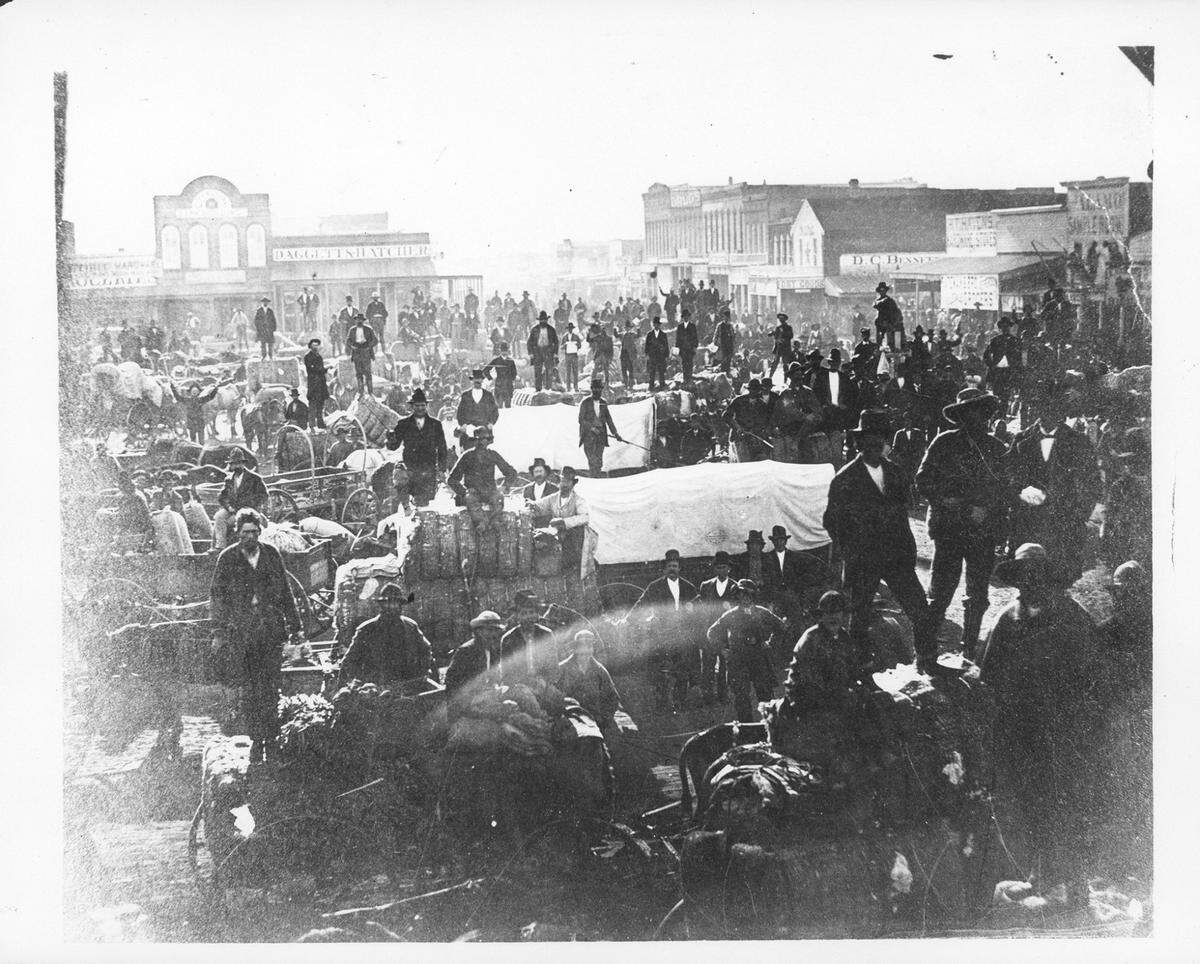
For the next decade, herds came through every season on what was variously known at the Eastern or McCoy Trail (or as the Chisholm Trail in Fort Worth legend). The annual cattle drives were the economic engine that fueled Fort Worth. The drovers spent money in town on the way north to the railhead, where they were paid off, and again on the way back south when they stopped over. The saloons, bordellos, honest merchants, and municipal court all raked it in on both visits.
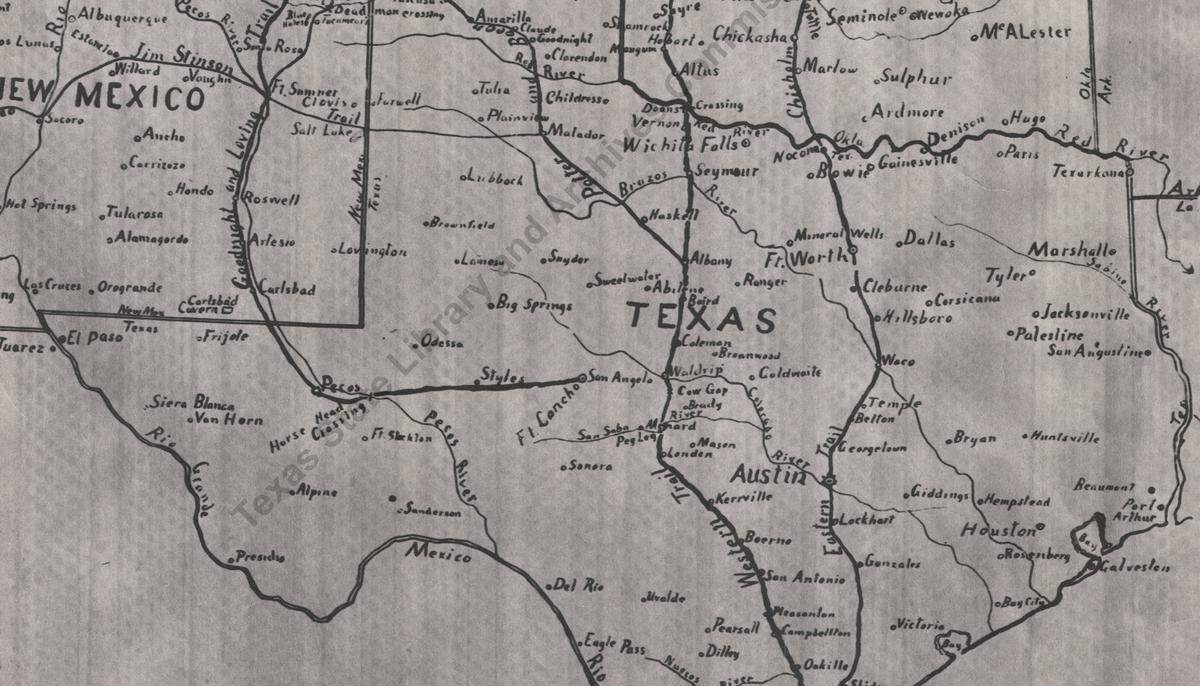
Then in 1874, the Western Trail opened about 130 miles west of Fort Worth as an alternative to the Eastern Trail, which was increasingly afflicted by barbed wire fences and angry farmers. The Western Trail made Fort Griffin (known as “the Flat”) on the Clear Fork of the Brazos a booming trail town, challenging Fort Worth’s supremacy.
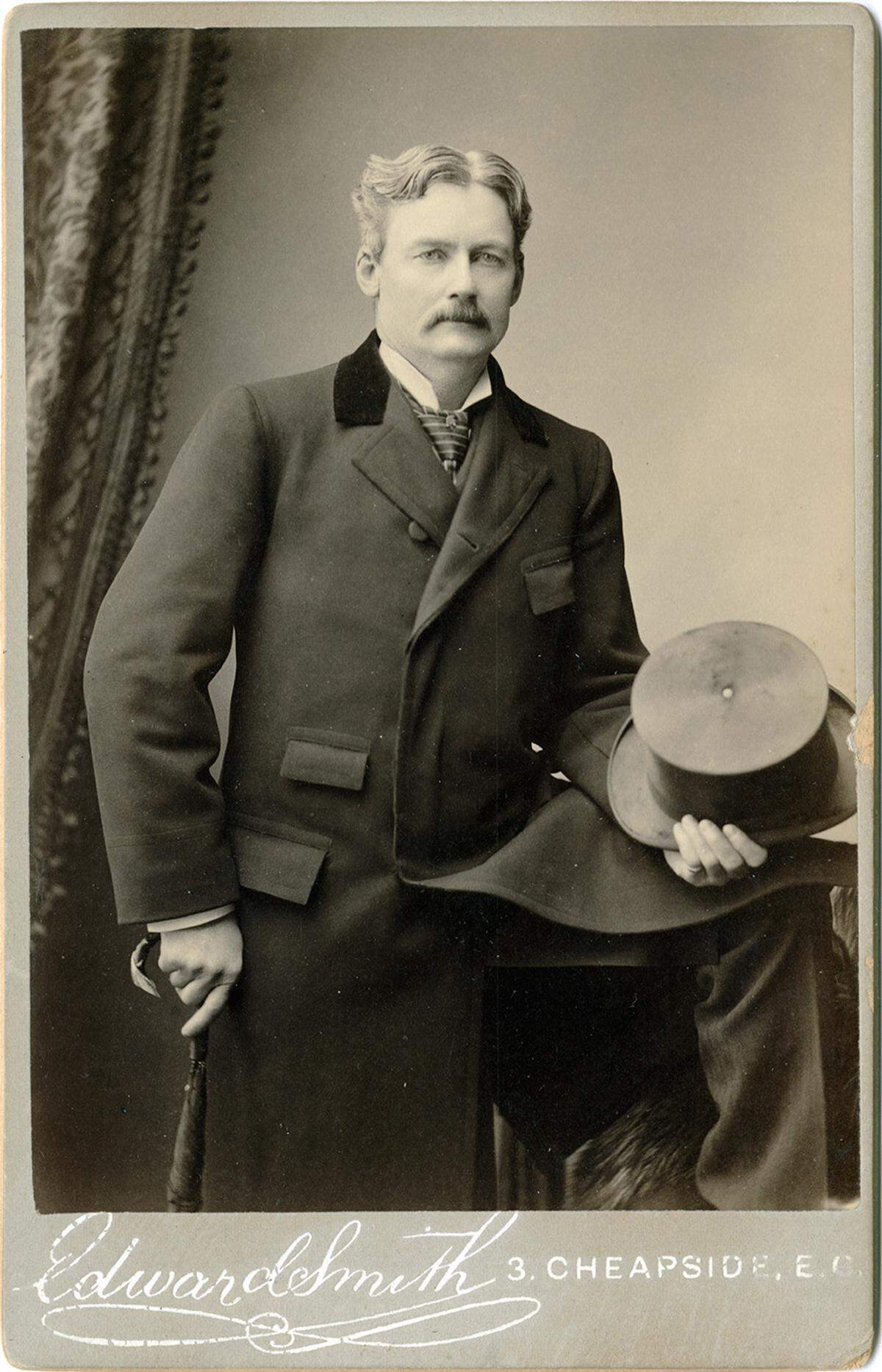
Fort Griffin’s challenge produced an economic rivalry and a heated newspaper feud between the Fort Griffin Echo and Fort Worth Democrat. The two editors, George W. Robson and B.B. Paddock, respectively, spared neither scorn nor printer’s ink in denouncing the other.
Because Fort Worth eventually won the Battle of the Cow Towns, Robson is barely remembered today. He was an “honest and highly respected frontier editor” who joined the Fourth Estate in 1875 and battled health and drinking problems until he retired in 1884.
Paddock, though, is a legend in Fort Worth history. Settling in Fort Worth when it was barely a wide place in the road, he began publishing the Democrat in 1873, which he used to promote the town in every way possible. He went on to serve four terms as mayor, write a history of the city, and live a long and productive life, dying in 1922.
Fort Worth got its own railhead in 1876 when the Texas & Pacific came to town and began shipping refrigerated beef the following year. An estimated seven-eighths of all Texas cattle drives came through Fort Worth by 1877. But that season brought more problems of farmer hostility and a Kansas quarantine on Texas cattle because of dreaded tick fever.
The Western Trail offered fewer problems en route to Dodge City, Kansas. In 1878 for the first time, more herds passed through Fort Griffin than Fort Worth. The latter was faced with losing thousands of dollars in revenue if a majority of the drives continued to bypass Fort Worth.
Paddock’s newspaper chastised his town’s businessmen for not aggressively promoting Fort Worth to the state’s drovers.
“We hope their eyes will be opened to their best interests next year,” he wrote.
The businessmen responded, hiring agents to spread the word in south Texas even before the start of the 1878 season. Things improved, with Paddock reporting in March 1879 that “no one was satisfied with the Western Trail who traveled it last year.”
With the start of the cattle season in April, Paddock reported, “The town is alive with the merry laugh and hilarious ‘whoopla’ of the Texas cowboy again,” and predicted only three or four herds would pass through Fort Griffin that year.
Cattle season was an amorphous term, describing a period roughly from April through September. No one could predict when the first herd would come up the trail or when the last one would pass through. It all depended on the weather and the intentions of the cattlemen who moved their herds from south Texas to Kansas.
Paddock’s feisty rival in Fort Griffin was not about to concede the battle to Fort Worth. Robson’s Echo newspaper threw down the gauntlet, offering to wager “$500 or $1,000” that more herds would pass through Fort Griffin than Fort Worth. The money, he said, had already been put up by merchants and would be deposited with a Dallas or Fort Worth bank once Fort Worth accepted the challenge. “Talk is cheap and money scarce,” he wrote, so the Democrat should put up or shut up.
That was just the first volley. Robson followed up in subsequent editions accusing Fort Worth agents of “misrepresenting” conditions on the Western Trail to cattlemen. Basically, he called Fort Worth folks a bunch of liars without honor. He backed up his accusations with figures, claiming in early April 1879 that more than 8,000 cattle had already passed through Fort Griffin.
And Robson did not confine his scorn to the town in general. He singled out Paddock in an editorial titled “Business vs. Bluff,” noting that the Democrat had raised the ante on the bet to $2,500 “trying to scare the Flat away from the deal.” Ha! Fort Griffin’s leading merchant, Frank Conrad, was ready to put up an additional $500 of his personal funds.
Robson also raised the stakes on the bet: The winning town would have to corner “three-quarters” of the drives in the 1879 season to collect the bet. He offered to put that in writing and challenged “Mr. Democrat” to put his money where his mouth was.
Paddock was not about to let such a challenge go unanswered. He fired back in a story on May 10 saying that two unnamed but “prominent and responsible cattle men” of Fort Worth were prepared to match Conrad’s offer and meet Robson’s terms that three-quarters of the season’s drives would “cross the Trinity on the Fort Worth trail.” He ended with this taunt: “Come now, pull down your vest, gentlemen, and put up or shut up!”
The Echo, speaking for the merchant Frank Conrad, responded that his money would be deposited in the bank and challenged Paddock to “send by mail as soon as possible the names of the two [Fort Worth] gentlemen” covering the wager.
Both editors kept careful track of the numbers of cattle passing through their respective towns that summer right up to the last herd in the fall. By late May, nearly 67,000 cattle had passed through Fort Griffin, a number that grew to nearly 88,000 by the first of June.
The numbers passing through Fort Worth in the same period were nearly 91,000 and 105,000, respectively, a larger number but nowhere near the goal of three-fourths of all the herds going north. The feud and the numbers-crunching continued all summer. At one point Robson commented nastily that the still unnamed Fort Worth gentlemen had never put up their side of the bet. If true, that did not keep the Echo and the Democrat from taunting each other mercilessly.
The good news was that both towns were “packed with cattlemen” all summer. Seemingly, there were plenty of herds to ring the cash registers in both Fort Worth and Fort Griffin. By the end of the 1879 season, more herds had crossed the Trinity in Fort Worth than the Clear Fork in Fort Griffin, but nowhere near three-fourths of the total, no matter who was counting.
It is significant, however, that 1879 was what historian Charles Robinson III calls “the last great drive on the Chisholm Trail (through Fort Worth).” Supremacy on the Texas trails had moved west to Fort Griffin.
Looking back and knowing something about B.B. Paddock’s love of ballyhoo, one has the feeling that the 1879 war of words between the two editors was more about town-boosting than Hatfield-versus-McCoy-style feuding. And such a feud had the added benefit of selling more newspapers, something both editors could agree on.