
‘We love each other.’ Texas women whose spouses have dementia bond through support group
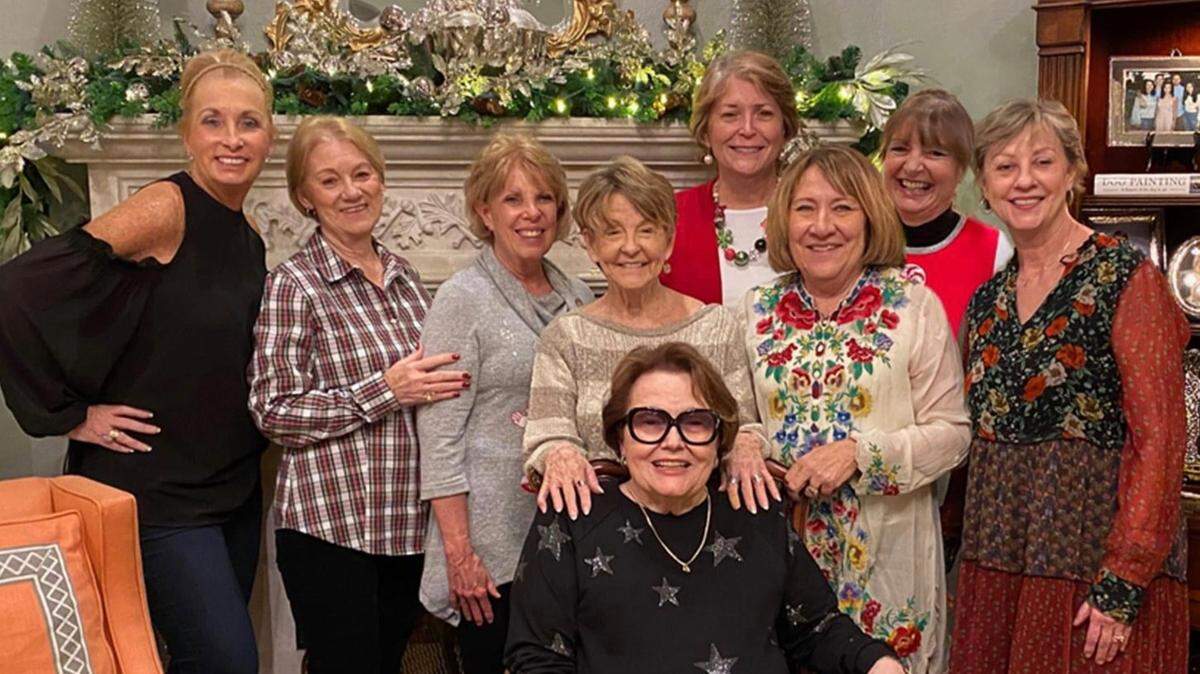
It is said there is strength in numbers.
A group of nine ladies in Tarrant County are providing strength for each other in a challenging circumstance they all share.
The Soul Sisters, as they call themselves, became a support group for each other about three years ago when it was discovered that each of them is/was married to a husband struggling with dementia. Though they went without an official name for a while, they adopted the name after participating together in the 2019 Walk for Alzheimer’s.
Dementia is a group of symptoms that affects mental cognitive tasks such as memory and reasoning. It can occur due to a variety of conditions, the most common of which is Alzheimer’s disease.
The group and their husbands include:
▪ Claudia and David Radford, Roanoke: David is on hospice and lives in a memory care facility.
▪ Carolyn and Tom Phelps, Southlake: Tom is living at home.
▪ Joyce and Frank Early, Colleyville: Frank was living in memory care on Hospice. Because of the COVID-19 pandemic, Joyce brought him home on Hospice so they could be together.
▪ Sherri and Jim Steele, Trophy Club: Jim is living at home.
▪ Debbie and Darrell Martin, Keller: Darrell is deceased.
▪ Penny and David Schlunt, Colleyville: David is deceased.
▪ Kathy and Jim Farley, Southlake: Jim is deceased.
▪ Judy and Jim Green, Grapevine: Jim is deceased.
▪ Julie and Bob McGuffee, Fort Worth: Bob is deceased.
The group began when Claudia, Joyce, and Debbie met at the memory care their husbands lived in. They were there every night eating with their husbands and decided that one night a week they would go out together and have a dinner together. One by one others joined them.
Steele learned about the group after visiting a memory care facility and asking about support groups.
“I was feeling desperate for answers and needed to talk it out with someone with real life experience,” she recalled. “I had tried a family therapist, but I found I was teaching him more about the disease than he knew. I needed help for my grief. I was scared of all the unknowns.”
Unbreakable bond
None of the women were close friends prior to meeting through this shared experience. Now, they share a bond they’ll keep for the rest of their lives.
“This group of women has been a lifeline for me. We laugh, we cry, we are there for each other no matter what. I know I can count on them and they can count on me,” said Farley, whose husband passed away one day shy of his 64th birthday after battling dementia for more than a decade. “This disease brings a whole new meaning to the word loneliness. Trust me when I tell you that you lose friends when your spouse is diagnosed.
“People don’t want to go out with you for fear of what might happen, a sudden outburst by your spouse, or an inappropriate conversation — or even worse, sometimes no conversation,” she said. “Silence is not always seen as pleasant when getting together with friends. There are things that you have to do as a caregiver that many people would shudder at. Not this group. We have all done it.”
The group, like the rest of the world, is struggling with the COVID-19 pandemic. One member tested positive and another is quarantined because her daughter tested positive.
The group went three years without missing a weekly Tuesday dinner together. They have tried meeting via Zoom, and while it does allow them to visit, it’s not the same and those have been put on hold.
“I was locked out of the memory care facility and not able to see my husband for about five months. Then they allowed me once a week to see him through Plexiglass,” Radford said. “Now I am able to go into his room but I have to keep a 6-foot distance and wear a mask.
“COVID has made dealing with the disease 100 times harder. Not being able to be with your husband and reassure him that he is loved is very hard.”
But don’t think for one second the group is breaking up. They’ve been through too much together, and they plan to someday get back to real hugs. Martin said the group saved her life after she lost her spouse of 51 years.
“Honestly, after my husband passed, I didn’t want to live. I think about him first thing in the morning and last thing at night,” said Martin, who actually moved into the memory care facility with her husband for several months. “No man could ever take his place. But I had stopped taking care of myself and wasn’t in the best health.
“My daughter made me go to the doctor, and the family tried to pull me out of my depression. The Soul Sisters never gave up on me. They understood. I didn’t have to explain how I felt. They just knew because they were living it too.”
Along with the regular care that comes with a spouse battling dementia are the terrifying unexpected moments, Steele said.
“My husband has gone missing twice. He has fallen more than 34 times this year. It’s very scary for me, too,” she said.
“Caring for someone with this disease is exhausting. You cannot take your eyes off of them,” Farley said. “I am thankful that my Jim passed away before COVID. I know I would not have done well with the imposed restrictions. Being a nurse myself, visiting him daily was also an opportunity for me to evaluate that he was being properly cared for.”
Farley faced her own similar challenge of a husband who wandered away. In fact, she was blamed for this, she said.
“In 2017 my world changed when I was reported anonymously to the Department of Adult Protective Services for elder abuse and neglect. Jim had gotten out of the house one day and was walking on Southlake Boulevard. I had done everything in my power to keep him safe, but at that point I knew I no longer could. I was basically told I had to place him in a safe and secure environment/facility or face criminal charges myself.”
Precious seconds
In some ways, dementia and Alzheimer’s can be harder on the caregiver than the patient, Schlunt said. It can be excruciating to have someone you have loved for so many years not recognize you and change before your very eyes even as you continue to love them with every inch of your heart.
“My husband had the biggest heart and he was so gentle, but Alzheimer’s changed him,” Schlunt said. “I became a stranger to him, sometimes his girlfriend, and other times his sister.
“Alzheimer’s is a horrible disease, losing your loved one first to the disease, then to death. It rears its ugly head and introduces you to someone you never knew, someone at times you fear.”
For those with spouses still living and whom can still participate with recognition, every second is precious, Steele said.
“I take my husband to lunch every day to get him out of the house and out of his chair. We go to the zoo and the Botanical Gardens. We take our cameras and take photos,” she said.
Amid the torment of watching them slip away are the glimpses of what their spouses once were, Radford said. It’s as if sometimes the disease gives them a mental break, and for a fleeting time they recognize the woman who loves them so much, the woman who will be by their side until the very end.
Radford’s husband is in the final stages. He fell last year and developed a brain hemorrhage, followed by a return to the memory care facility. He’s in a wheelchair now, needing someone to feed him, bathe him, etc. Still, there are moments when he seems to know when something special is happening, something that he enjoyed so much in his previous world, she said.
“Some of my favorite recent memories include watching him enjoy music and sing. He hardly communicates, but when I play music he likes, he sometimes starts singing,” Radford said.
While the group is tight-knit, they welcome others who might be in need of such support as well. Suddenly finding yourself in a dark world that was once filled with light and happiness can be made just a little less daunting by knowing others share your situation, as these ladies are proving.
“You are going to miss your spouse. There are dark days, but you will come out of it,” Martin said. “The support group helps me. They are my friends. I need them more than family.
“The ladies in the support group lift you up. They don’t need you to explain your feelings. They don’t try to advise you or tell you what you need to do. They listen and love you. The ladies let you cry. They tell funny stories and make you laugh too.
“We are better than family and we love each other.”