
This newsletter has a long history of reflecting Chicano voices at UT Arlington
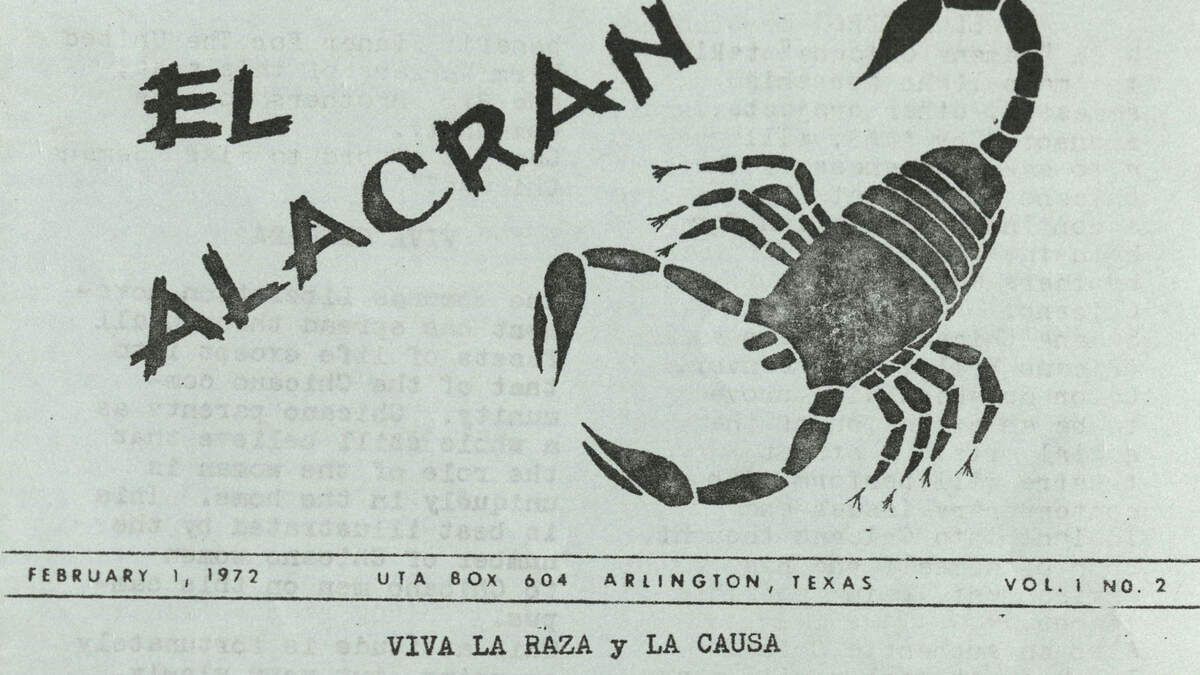
Laura Allen, a reporter for the University of Texas at Arlington’s Shorthorn newspaper, wrote an article on Dec. 1, 1972, titled, “Newspaper ‘Stings’ Readers, Association of Mexican American Students publishes ‘El Alacran.’” She interviewed Amado Soto, then the Association of Mexican American Students president, about the newsletter’s reason for existence.
By that time, El Alacran (The Scorpion) had existed for a year, spinning out Chicano-themed stories and allowing members to share their ideas on current campus and national issues. El Alacrán was the first student-produced publication on UTA campus, and probably throughout North Texas college campuses, dedicated to Chicano journalistic and poetic voices. The author chose the paper’s title to project an image that stories could sting readers with provocative news and viewpoints. Soto said the paper meant “to make people aware how and what we think, giving a broad view of los Chicanos.”
The issue Allen referenced criticized Student Congress President Bill Fleming’s endorsement of Senator John Tower, Wayne Duke, dean of student life, and outgoing UTA President Frank Harrison. The unnamed El Alacrán writer said the administrators were “afraid to cross ‘Cooper Street’ to associate with students.” The reporter also brought up the Association of Mexican American Students publication’s awarding Student Activities Director Carolyn Waddell the “Fickle Finger of Fate Award.” She had allegedly said, “We can’t pay Cesar Chavez as much as Max Rafferty since Cesar is not a national figure.” How many people today recognize the name Rafferty as compared to Chavez?
Soto may have felt anxious by the reporter’s questions concerning El Alacrán’s provocative statements. He said since the first issue with its “Viva La Raza” attitude, he had tried to “tone it down.”
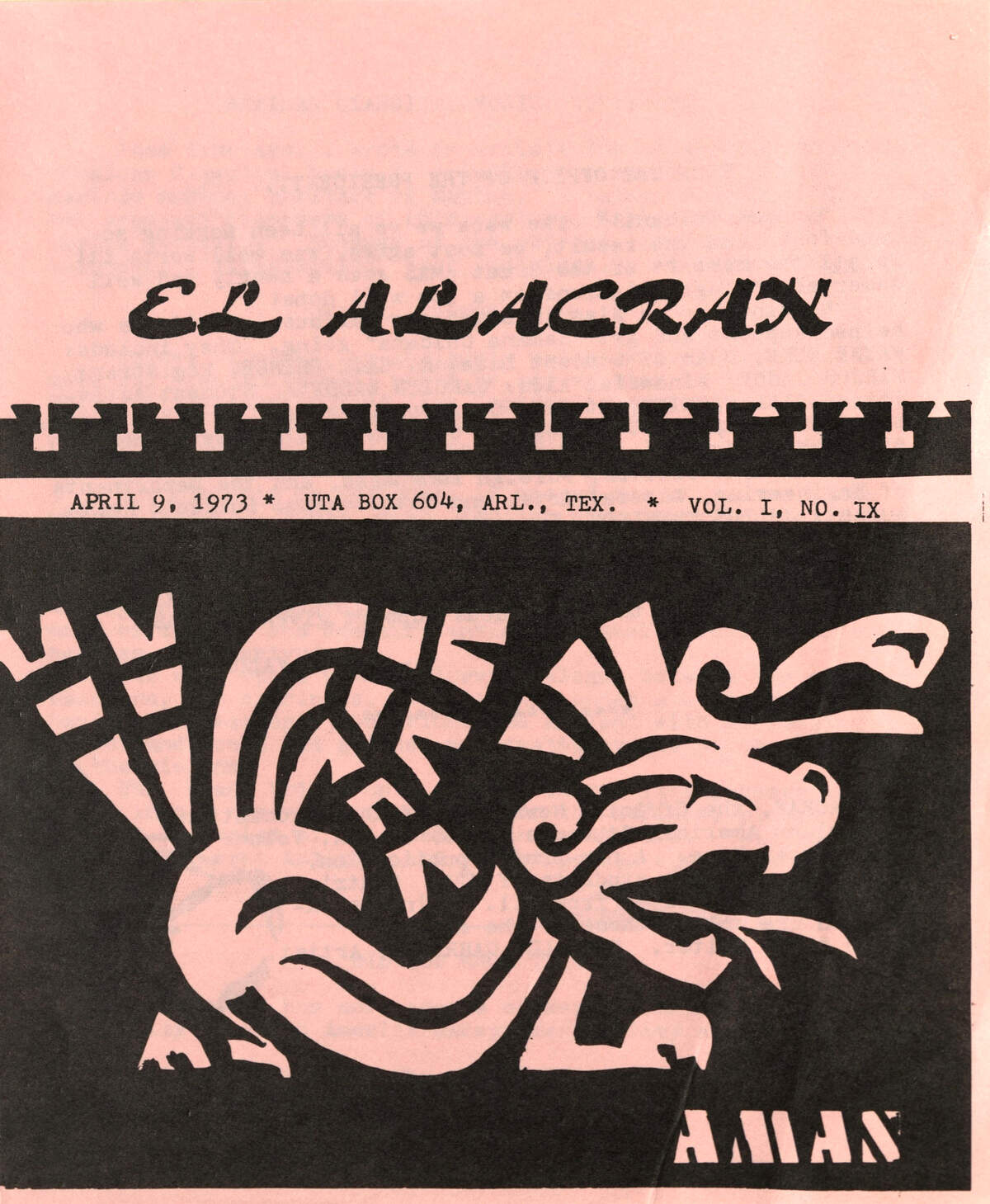
In addition to the Shorthorn, at least three other alternative student papers circulated on UTA’s campus in 1960s and 1970s: Free University Press (FUP), Spectator, and Rebel Rouser. FUP and Spectator focused on the Vietnam War, Women’s Liberation, environment, local and national political and economic issues. The Rebel Rouser continued to argue for the return of the Rebel theme to UTA, raising hopes the Stars and Bars would rise over the campus — nevermore.
Providing a voice to the marginalized
The author viewed El Alacrán as a pronouncement to the UTA campus that Chicanos would share their opinions with the greater community. No longer would Chicano students remain quiet, marginalized, and accepting of university policies and programs without their input and response.
In the Nov. 14, 1973, and March 17, 1975, issues, Association of Mexican American Students writers asked their members to assess their commitment to the Chicano movement and to remind them of their ethnic identity. Joel Cruz and Michael Ladin penned an article titled “What Is a Chicano?” They described how they initially thought the term was pejorative for Mexican Americans. After some thought, they viewed Chicano as an affirmation for their ethnic identity with positive connotations. They concluded, “The word may be defined as: An American of Mexican descent who attempts through peaceful, reasonable, and responsible means to correct the image of the Mexican-American and to improve the position of this minority in the American social system.”
A longer piece addressed the meaning of a Chicano ethnic identity with a focus on “machismo” and the obligations of male Chicanos to his community, family and self. The article titled “We Chicanos” by an anonymous Association of Mexican American Students writer reasoned the acceptance of a Chicano identity meant the creation of a “new meaningful identity, a new person, a new soul, and, con la ayuda de Dios (with God’s help) a new way of life and well-being.”
The writer observed many Chicanos felt dejected by a lack of acceptance by the Anglo majority despite their proud mestizo heritage. Instead of bemoaning this rejection, the writer recommended Chicanos live up to their familial responsibilities. He said, “When a Chicano stands on his own two feet, he is looked up to. This is his “Machismo” or manliness. ... A Chicano has “Machismo” if he has honor.”
The writer pointed out strength came from drawing on his Chicano culture. He detailed, “the priceless gift of an accent every time I speak ... the gift of our music ... our yells ... our religion ... our types of dress and our physical characteristics.” To excel in the American scene, the writer recommended Chicanos earn an education and garner political savvy.
Spotlighting the ‘Chicano Movement’ at UTA
The March 17, 1975, issue reflected Chicano student fervor still blazed. Association of Mexican American Students President Juan José Reyna wrote in his piece, “Where Are You in The Chicano Movement?” that enlightened Chicanos “should be tolerant, self-disciplined individuals: capable of showing patience to tapados (ignorant Mexican Americans).” He promoted Chicanos not to compete with one another as incited by “capitalistic indoctrination” but instead work on improving skills for the movement. He concluded with the call, “If you are not in the movement, get off your egotistical trip and Join. VIVA LA RAZA!!!!”
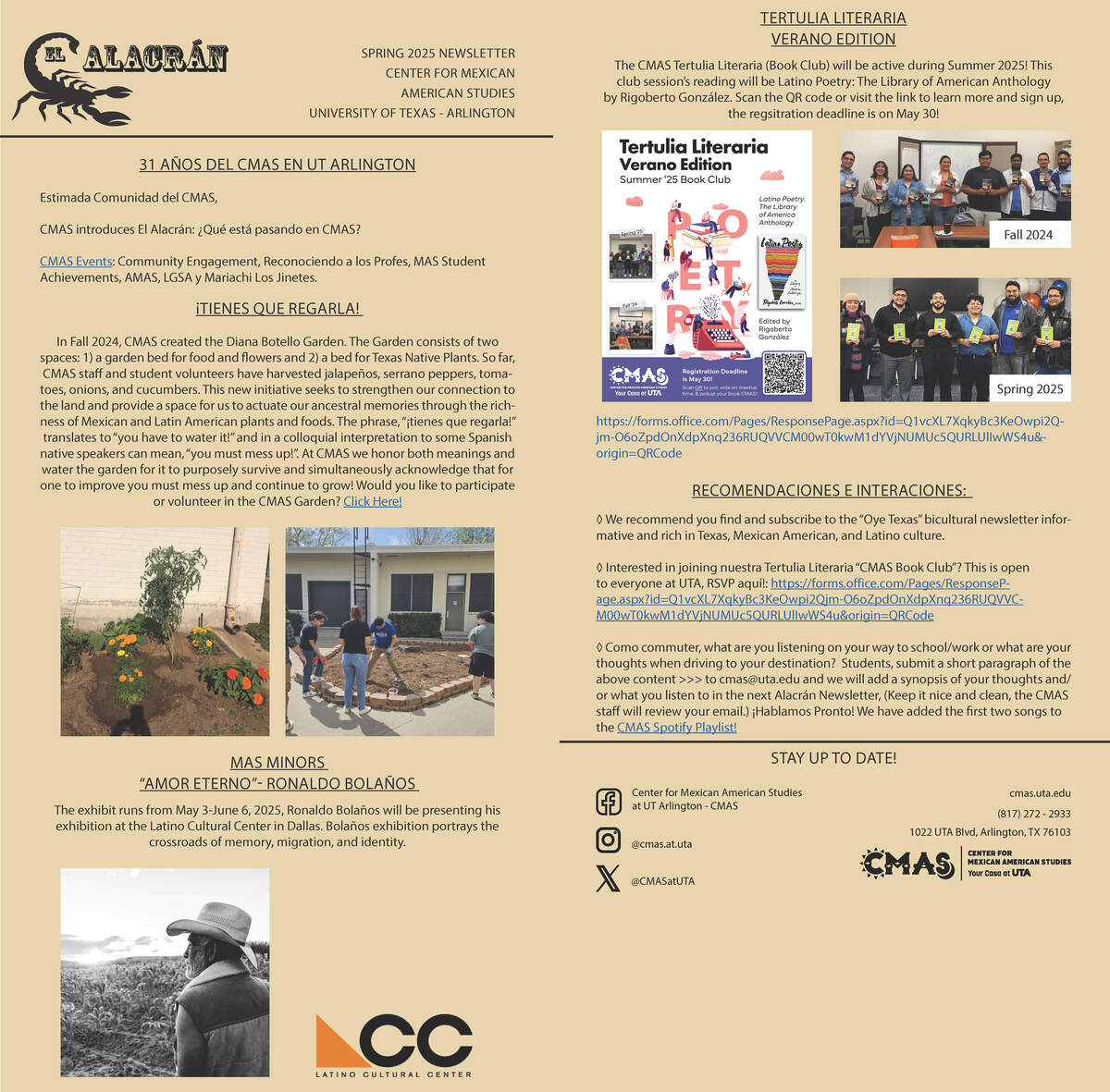
In the 1990s, Association of Mexican American Students (AMAS) members changed the newsletter name from El Alacrán to AMAS Newsletter. Casey Gonzales, AMAS staff sponsor, explained that since 1985 students no longer identified with the Chicano theme. The absence of Chicanismo, La Raza Unida Party, and Chavez’s La Causa stories reflected a generational change. AMAS and the newsletter had mainstreamed or perhaps not.
On May 19, 2025, the UTA Center For Mexican American Studies resurrected El Alacrán newsletter. The sting is in swing.
Author Richard J. Gonzales writes and speaks about Fort Worth, national and international Latino history.