
Former Rangers president: Current ballpark saved club from moving, made club relevant
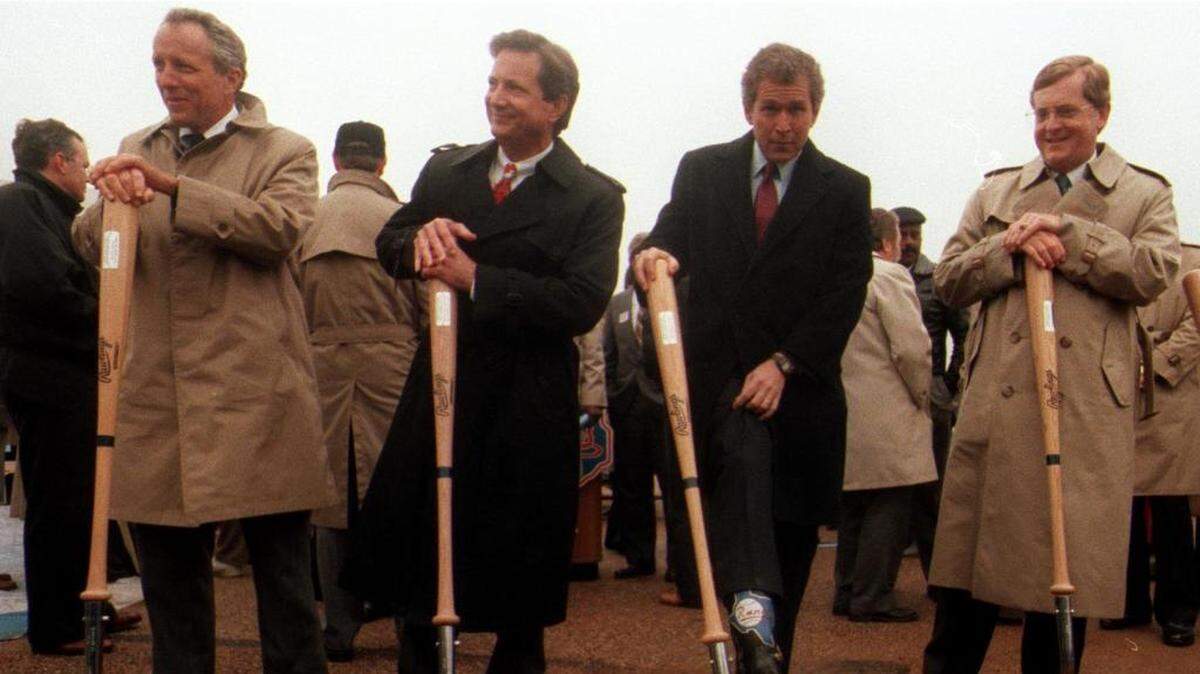
Tom Schieffer, whose vision, work, influences and fingerprints are all over the Ballpark in Arlington, had one reaction when he heard the Texas Rangers were building a new stadium: “It broke my heart.”
He understands these things happen, but no one invested as much time, emotion and energy into the construction of the Ballpark in Arlington more than Tom Schieffer, the former president of the club.
His heart should be broken. The ballpark is his baby.
“I don’t want to sound like a bitter old man because I’m not; I’ve led a charmed life,” he said. “I just loved that ballpark.”
Sitting in his office in downtown Fort Worth, Schieffer looks back at the inception and creation of the park as the single greatest professional enjoyment of a career that has been deep, varied and successful.
We have arrived at the final Opening Day of the Ballpark, which opened in 1994.
Whatever your thoughts are on the new park, the legacy of “the old place” is that there are no Texas Rangers without Schieffer’s efforts to design and build The Ballpark in Arlington. Without the Ballpark, the Rangers are the Oakland A’s ... if they are lucky.
“The stadium saved the team from moving, absolutely,” Schieffer said. “Eddie Chiles sold it to someone who was going to move the team to Tampa. When (their group) bought it, we spent more than anyone else had on an American League team; we paid $83 million for it.”
Per Forbes, today the Rangers are valued at $1.6 billion.
THE INCEPTION OF THE PRESENT DAY TEXAS RANGERS
When future U.S. President George W. Bush, Schieffer and a group of investors bought the Rangers, they had to borrow $50 million to complete the purchase in March ‘89.
At the time, the Rangers were one of the most irrelevant franchises in MLB. They signed veteran pitcher Nolan Ryan that off-season, which, more than any other move, started the franchise towards relevance.
“We had never really had a superstar like that, and he elevated us,” Schieffer said. “We had Ferguson Jenkins, but he didn’t have the aura of Nolan. He captivated the community in a way that nothing had done before.”
The Rangers then set out to build a new facility, and move out of Turnpike Stadium, which was later renamed Arlington Stadium, which was essentially a minor league park with an outfield section added to accommodate MLB standards. In 1989, the Rangers were so far behind the rest of MLB they could not compete with the top-tier clubs.
Bush asked Schieffer if he wanted to lead the project of building the new stadium, to which he promptly said no. He didn’t have the time.
Tom’s wife told him, “You may only get to build a big league ballpark once. You may want to figure out how to make time for this.”
The next day, Schieffer told Bush yes.
The City of Arlington was in for $135 million to build a new stadium, and the rest came from the ownership group.
After a long series of negotiations between the contractors and the architects, the franchise had a finished stadium ready in Feb. 1994. They had created a new park.
What they unknowingly also had created was their place in Major League Baseball.
“What the Ballpark was to us was joining the Major Leagues; it allowed us to have a major league payroll,” Schieffer said.
A PARK BUILT FOR 100 YEARS WITH ADJUSTMENTS
The reason Arlington will soon have a new baseball stadium is the “need” for a roof, so fans can sit in the greatest creation man ever invented: Air conditioning. Schieffer says neither he nor Bush wanted any part of a dome, or a roof, for their stadium.
“George grew up going to games at the Astrodome and we both felt like baseball should be played outside,” Schieffer said.
The design was for games to be played at 7:30 p.m., with enough openings around the stadium for wind and air movement. The team worked out a deal with MLB for Sunday night games, and limited day dates at the beginning and end of the season.
Shortly after Tom Hicks bought the team in the summer of ‘98, he added a club behind home plate. It eventually added a “ribbon” board that essentially encompasses the ring of the decks for electronic advertising.
“You could have done things to keep that park. It’s not a bad park; the air circulation is so much diffferent now,” Schieffer said. “That advertising ribbon generates an enormous amount of heat, and it comes right down on top of the fans. When we had those ‘slots’ around the stadium, the air moved and kept fans cool. And you just can’t play a day game there in June or August. Baseball is not an endurance sport.”
Other noticeable adjustments came a few weeks before the start of ‘94 spring training, when a few players came out to try out the park. The batters immediately noticed a problem, primarily the hill in center field was not tall enough. Fans walking on the hill around the concourse were in the batter’s line of sight, so an emergency adjustment was made.
Even though the team had run out of money, both the contractors and the architects doggedly worked to create the vision all parties originally shared.
It was/is a place that Schieffer wanted, a place to watch a game together to share an experience. For a park that is not Fenway, Wrigley, Yankee or Dodger Stadium, the Ballpark is as good as any new park can be.
“We were in the memory business; people love baseball and baseball is a three-generation sport,” Schieffer said. “Baseball is about community and family. It’s special. We wanted to build a building that is worthy of a kid’s first game.”
Schieffer, Bush, Arlington, then-Arlington mayor Richard Greene, the architects, and the contractors all did just that.
I will never forget watching my daughter gleefully whip a rally towel during Game 3 of the 2011 World Series, or run the bases after a Sunday game.
There are no bad seats in the place. It remains a great place to watch a baseball game, and everyone associated with the project should take pride in its inception and completion. The Ballpark’s run is far too short, but that decision is done.
Although he had to be talked into it, Tom Schieffer did it.
“Anderson Cooper wrote something about his father dying and he said that children that have a traumatic experience with a sibling or parent dying have an attitude after that all things are possible but nothing is forever. My father died when I was 10,” Schieffer said. “You can’t grieve over things you can’t control. I love baseball and I did the best I could to build the best ballpark I could and I’m satisfied.”
As he should be. In this case, a little heartbreak feels right.