
Rangers try to explain Hamels’ sudden turnaround with Cubs
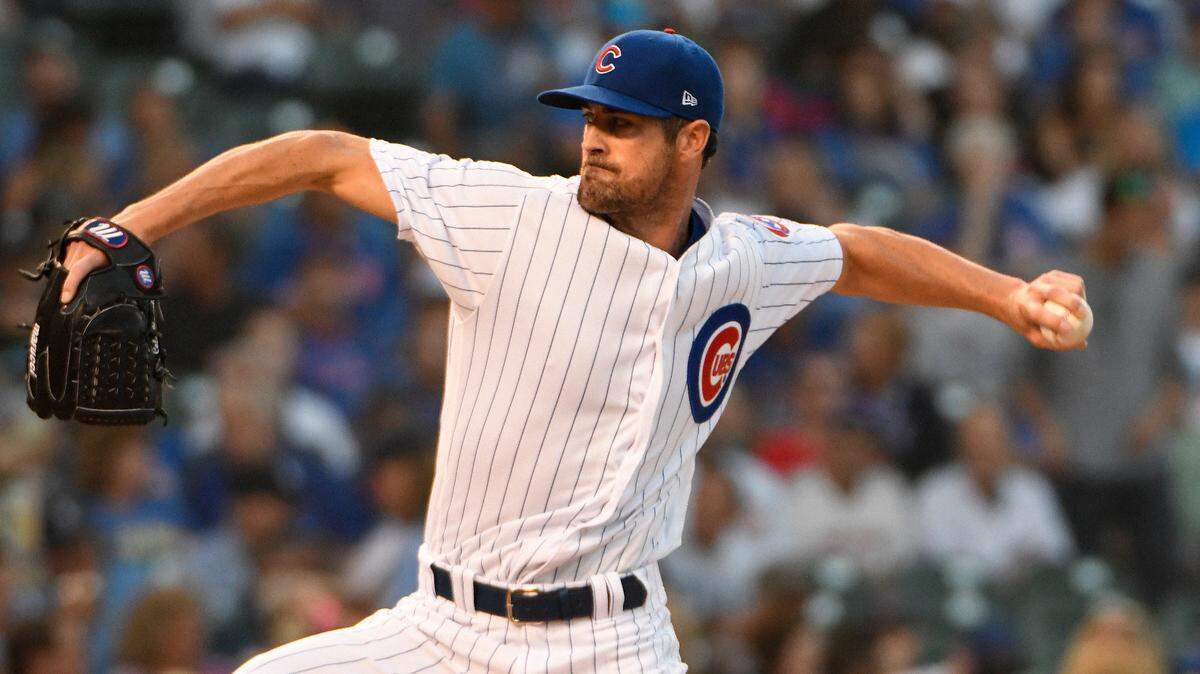
The following are the numbers of a certain MLB left-handed starting pitcher from his past 10 games.
The first five, from June 25-July 20: 22 innings, 37 hits, 25 earned runs, six walks, 22 strikeouts, 10.23 ERA.
The second five, from Aug. 1-Thursday: 34 innings, 24 hits, three earned runs, eight walks, 30 strikeouts, 0.79 ERA.
Any guesses? No, it’s not Jekyll or Hyde.
It’s Cole Hamels, the former Texas Rangers ace who limped his way to the trade deadline before a July 27 deal that has the Chicago Cubs doing cartwheels. His latest effort Thursday was the Cubs’ first complete game of the season and Hamels’ first in a year.
“To be a major-league pitcher, you’re going to have some tough times,” Hamels told reporters after the complete game. “You can’t give in.”
On the mound, Hamels has changed his pitch mix. He has flipped the usage on his two-seam and four-seam fastballs, going with the four-seamer far more to start at-bats with the Cubs and more in general. Hamels is also throwing more cutters to left-handed hitters and throwing slightly more first-pitch curveballs to right-handed hitters.
He’s throwing his changeup, his best off-speed pitch, more to lefty hitters and fewer to righties than with the Rangers.
The changeup has been made more effective by an uptick in fastball velocity. The upward trend started with the Rangers and has picked up with the Cubs, creating a bigger gap in speeds with the changeup.
“What impresses me now is he’s throwing 95-96,” catcher Robinson Chirinos said. “He has the stuff to do what he’s doing, so I’m happy for him. He’s done that before. He’s doing it over there now, but I wish he had done that here before.”
Hamels was capable of it, and had been pitching well before the stretch drive to the trade deadline. Once things turned, he said that he was trying to recapture his form from 2015 and 2016, his first two seasons with the Rangers.
After his 114-pitch effort Thursday, he talked about “going back to basics” to get back to the performances he was used to giving.
Not said is that he again is pitching in the National League, where he spent the first 75 percent of his career before the Rangers acquired him from the Philadelphia Phillies. He gets to face a pitcher multiple times again, though that alone doesn’t turn a 10-plus ERA into a sub-1.00 ERA.
It’s safe to say that the changes weren’t just physical.
Hamels was playing for a rebuilding team in the final year of his contract, knowing that a trade was likely but not knowing where he was going to go. No matter how robotic Hamels wanted people to believe he was, he was bothered by it.
The results on the mound and his temperature in postgame media sessions weren’t normal.
Maybe it was that he kept having to answer questions about his future, from reports and his family. Maybe his turnaround started once the trade went through and he knew where he was going to be pitching the rest of the season.
He also went from last place to first place, and the Rangers learned in 2015 how good he can be when pitching in meaningful games. General manager Jon Daniels said after the trade that he expected Hamels to perform well because of the boost he would get being back in the postseason hunt.
“After a couple months people knew we weren’t really a contending team,” left-hander Mike Minor said. “I think Cole’s a competitor. He’s been a winner his whole career. I think it plays up whenever he’s in it. I’ve heard his velocity has been up. He’s been striking out a lot of guys and working deep in games.
“Whether it’s baseball or any sport, the older you get, the more you understand there’s big games and there’s high-end competitors. Those guys usually step up. You see it all the time. When you’re that kind of guy and a competitor, it doesn’t surprise me. Everybody’s relying on him to be the guy to take Yu Darvish’s place and do well.”
But shouldn’t Hamels have been able to do what he’s doing for the Cubs for the Rangers, regardless of how well they were or weren’t doing? A professional pitcher should be able to put aside distractions and perform. Right?
As much as fans or numbers crunchers don’t want to believe it, players are affected by things off the field.
“There’s more to life than just baseball,” Minor said.
Minor also threw out something else to consider. Hamels felt disrespected by what the Rangers received for him. While Eddie Butler, Rollie Lacy and Alexander Ovellas might turn into nice players, one is a former prospect, another is at High A and another is playing in another country.
Hamels was always ultra aware of who he has been and can be.
“You could tell it bothered him that we didn’t get much back in return for him,” Minor said. “You could tell it bothered him that people didn’t really value him because of one bad half of a season.”
The good news for the Rangers is that if Hamels keeps pitching well and pitches well in the postseason, the Cubs might be motivated to pick up the $20 million club option for 2019. That would save the Rangers from having to pay his $6 million buyout.
Maybe that is motivating Hamels, too.
Who knows? But there are a lot of thoughts among the Rangers as to why Hamels has suddenly turned his season around.
“I’m just happy for him,” Chirinos said. “Hopefully he can continue to do it.”
This story was originally published August 24, 2018 at 9:35 PM.