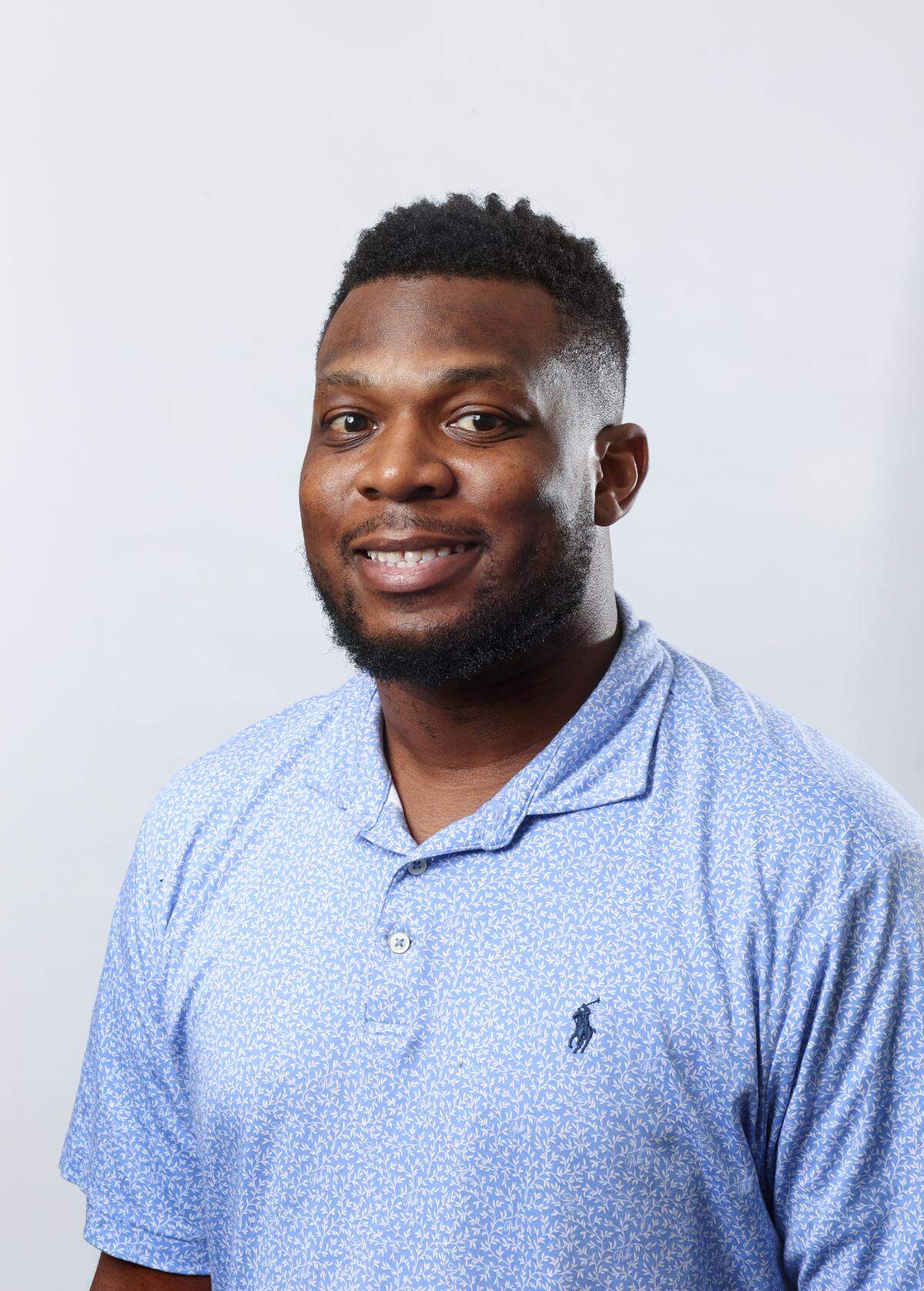
Why TCU’s new offensive coordinator says he couldn’t turn down the job
For Gordon Sammis, it was a no-brainer decision to come to Fort Worth to take the TCU offensive coordinator job under head coach Sonny Dykes.
From TCU’s tradition of success on the football field to the allure of living in a major city like Fort Worth, the Horned Frogs checked all the boxes Sammis was looking for in his next opportunity.
“Just watching them throughout the years play great football and win games, really for me it was the school,” Sammis said Tuesday. “Coach Dykes explained it to me when we spoke. He did a great job of just selling the area, selling the school. Even talking to guys who were former players that I knew or guys who grew up in this area, they just raved about the school. Honestly, I don’t think I’ve heard anything negative about the city.”
His arrival at TCU continues a rapid ascension up the coaching ranks. In 2022 Sammis got his first shot at the FBS level as an offensive line coach for UConn, where he consistently produced quality offensive lines.
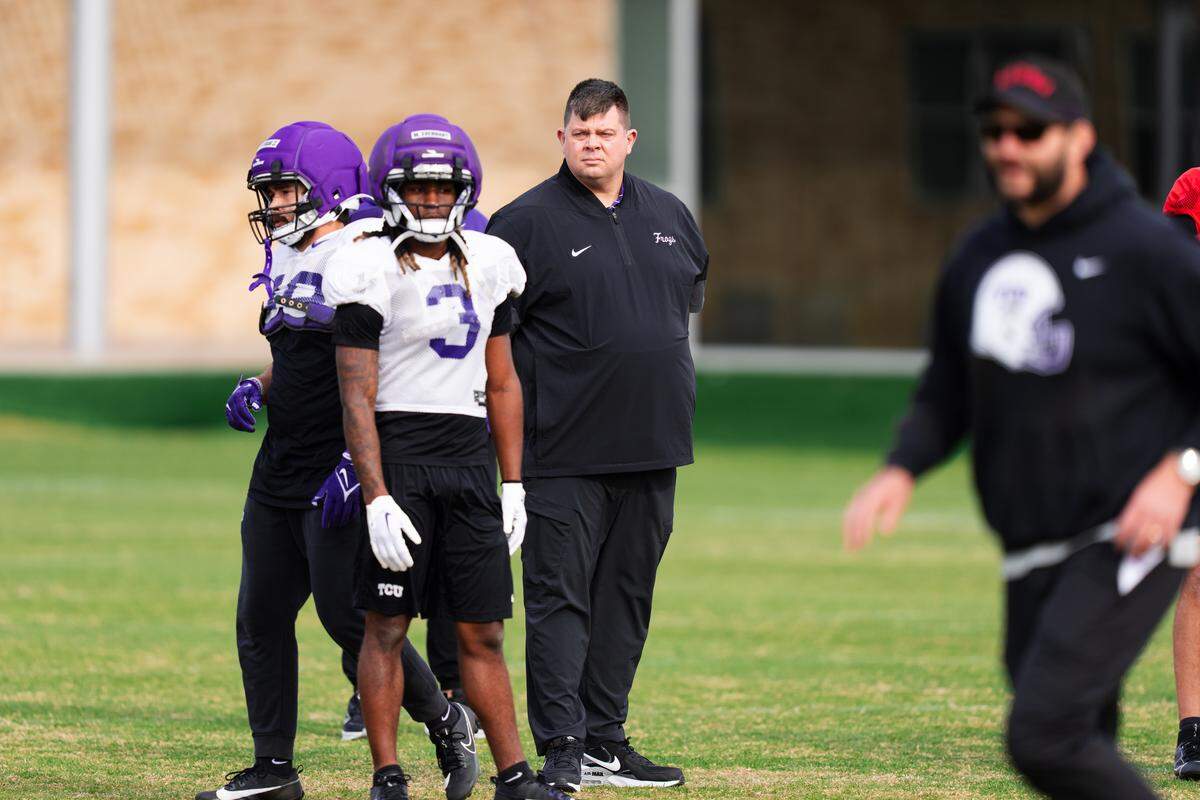
After two middling seasons, former head coach Jim Mora promoted Sammis to offensive coordinator in 2024 and helped turn the program around, as UConn won nine games in consecutive seasons for the first time in program history.
It can often be difficult to become an offensive coordinator without being a quarterbacks coach first. That’s why Sammis was determined to make the most of his opportunity.
“It was awesome. He took a chance on me,” Sammis said. “At other places there had been a chance, but people went with the status quo. You need a quarterbacks guy, and it was certainly disappointing. But at the same time I had been around enough good coordinators to learn, to figure it out, and I was always trying to stay ready if my opportunity ever came.”
Producing balanced offense at UConn
Sammis describes his scheme as a pro style offense that caters to his personnel more than his play sheet. In 2024, the Huskies were the definition of balance with 2,590 rushing yards and 2,579 passing yards.
This season, the Huskies maintained their prolific rushing attack, while quarterback Joe Fagnano had arguably the best season for a passer in program history. Wide receiver Skyler Bell was also voted an All-American.
The production and balance are what ultimately caught the eye of Dykes and the TCU staff. Many assumed Dykes would stick with a coordinator who was also experienced in the Air Raid, but Dykes wanted something different for the offense headed into year five of his tenure.
“It was a long conversation with Coach Dykes about how he wanted to play,” general manager Ryan Dorchester said. “What do you want to look like, you know? And I think we started with where are things that you want to improve?
“We wanted to be more efficient on offense. We want to run the ball more efficiently, and we want to turn the ball over less, right? So we were looking for people that did things efficiently, somebody that kind of did more with less. Outside of having outstanding pizza, I don’t know if Connecticut really has a ton of advantages when it comes to football.”
Dorchester said the run scheme used by Sammis and the Huskies really stood out when watching film. Cam Edwards rushed for 1,132 yards this season, and UConn averaged 5.1 yards per carry. TCU averaged just 3.9 this past season.
“The run schemes they run are different from what a lot of people hang their hat on nowadays,” Dorchester said. “There’s a lot of things to be intrigued about. Then you look up and he also had a quarterback that’s thrown only one interception. They have a 1,000-yard rusher, a receiver that was a Biletnikoff finalist, I would say that’s a pretty good profile.”
Gordon Sammis uses Bruce Lee philosophy
How was Sammis able to develop such a potent offense so quickly despite not having previous coordinator experience?
He used his time as a run game coordinator at Virginia Military Institute to test out early concepts, and he also took inspiration from martial artist Bruce Lee when developing his philosophy.
“A lot of places I was put in charge of the run game and they kind of let me do what I wanted,” Sammis said. “A lot of it was basing it off of what Air Raid teams did in the passing game in terms of being really good at really good concepts. I wanted to be really elite at certain runs, whatever runs were our bread and butter, have enough counterpunches to what a defense may try to use to stop it.
“It’s the Bruce Lee quote: ‘I fear the man that has practiced the same kick 10,000 times rather than 10,000 different kicks.’”
Sammis said he used the same approach when building out the passing game once he took over as offensive coordinator, but acknowledged the passing game can shift based on the quarterback he has.
As for his management style, Sammis said he aims for a collaborative process with his assistant coaches and wants them to be involved in the process.
“In my opinion, one person is not nearly as smart as everyone in that room,” Sammis said. “There’s a lot of shared experience, a lot of different experience, and it’s my job to get it moved in the right direction. We may have 28 different ideas, and it’s my job to find the five best that fit and give the defense issues and go from there.”
As for on game days, Sammis anticipates he’ll be on the sidelines calling plays.
“I like to coach from the sideline. It’s what I know, it’s how I see the game,” Sammis said. “I’ve never been in the military or anything like that, but I just call it being battlefield commander. I like being able to look guys in the eyes, feel it, see it, and I do think it’s a lot easier now to be able to do that with being able to see video on the field.”
There are still questions that need to be answered, like how does the system translate to the Power Four and how will Sammis recruit in the state of Texas?
But overall, Sammis is the exact type of candidate Dykes said he was looking for, and he is tasked with trying to elevate TCU’s offense from good to great in 2026.
This story was originally published December 16, 2025 at 3:31 PM.