Don’t be so quick to judge intent behind a casket left at mayor’s house | Opinion
On Thanksgiving weekend in 1995, a Fort Worth activist dropped a casket. Not as a threat of retaliation, but as a somber reminder of senseless violence and its consequences.
Mortician and minister Gregory W. Spencer tinted his coffin in blue and sprinkled on red chrysanthemums, the colors representing the Bloods and Crips warring throughout Stop Six. Casket in tow, Spencer spread his anti-gang gospel to residences such as the since-demolished JA Cavile Place housing projects — what he called one of the city’s “prime gang locations” — pleading with anyone watching to stop the violence.
“There’s blue, there’s red, there’s contention, there’s controversy,” Spencer said as he motioned toward the empty casket. “But in the end, when there is violence, this is the scene.”
Message received.
Three decades later, the city of Fort Worth is once again confronted with a symbolic casket.
Mayor Mattie Parker recently alleged that an empty coffin dumped in front of her home in 2022 could be intended as a threat to her family.
Protesting outside the mayor’s home was provocative, and I see how it could have put her on edge more than a march at City Hall, particularly looking at it now in the shadow of right-wing activist Charlie Kirk’s shocking assassination.
We don’t know who left the casket, which means we don’t have a statement from their own words about their intent. But I believe history can free us from being prisoners of the moment and provide a different perspective on the protesters’ possible intent.
Police review board, murder of Atatiana Jefferson sparked protest
One month after Parker voted against forming a citizen-led police review board intended as a check on police power, the activists responsible for the December 2022 casket drop spray-painted an important and deeply tragic name in recent Fort Worth history on their coffin: Atatiana Jefferson, a Black woman killed in her home while babysitting her nephew. (A jury found Aaron Dean, the cop who killed Jefferson, guilty of manslaughter. Dean was sentenced to nearly 12 years in prison.)
The activists also painted the well-known slogan #SayHerName, used to commemorate Black women slain by the police, and #FTP, an acronym that I gather stood for what Ice Cube and Dr. Dre named their infamous rap song about police. Further, protesters garnished the casket at Parker’s house in red paint resembling spilled blood and a target reticle.
Whose blood is signified and who was targeted really matters. Fortunately, the casket bears the clues.
The casket left in front of the mayor’s house listed the names of local people such as U.S. Army veteran Cody Seals, who police shot in the neck after saying they thought his flashlight was a rifle. And Philip Vallejo, whose wife says was shot in the back by an officer in front of a downtown restaurant, and Jermaine Darden, killed after a heart attack provoked by repeated tasings despite informing the cops he could not breathe. There were also people like Joe Williams, who engaged in a shootout with the cops outside a gas station, and Amari Malone, who aimed his gun at police before they shot him.
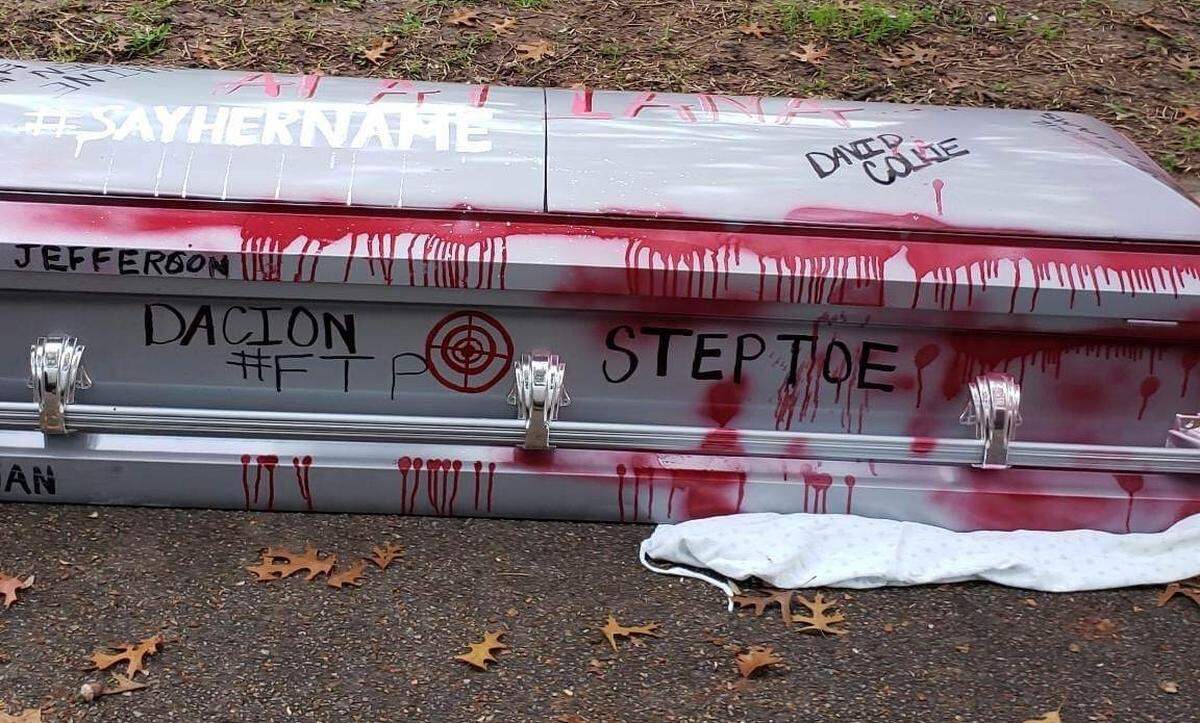
The circumstances around those killings vary, but every person lost contained whole universes to their loved ones. The collective police gunshots piercing through flesh, quite literally, formed a lot of spilled blood.
Spencer, the minister, accompanied his symbolic gesture with sermons that further explained his chosen imagery. Maybe a pastor’s oral exposition is necessary in a post-literate nation. But the message logically conferred by listing those police killings is a call for an end to violence, not a continuance.
The coffin pairs with the list as an uncomfortable, but crucial, visual aid. Instead of fading away like two-dimensional social media posts or discarded posters from a rally, it reminds us of 3D bodies and the real pine boxes Jefferson and others occupy.
Caskets frequently used as symbols protesting war, police killings
This empty casket’s message sent to the mayor wasn’t inscrutable on its own terms. Just as Spencer used his Bloods-and-Crips-colored casket to bring attention to gang wars, activists protesting Parker chose a coffin to make the same point about police violence. Knowing a little history makes it even clearer that it could have been a modern application of an established symbol built on decades of normatively non-violent activism.
Mock coffins were dropped in front of the Obama White House in 2015 in protest of the lingering Iraq War. Protesters marched a casket to the Dallas Police Department after an off-duty officer shot and killed Botham Jean in his apartment. An artist-designed casket covered in shattered mirrors was carried through the streets of Ferguson, Missouri, in honor of Michael Brown, fatally shot by an officer in 2014. The Smithsonian National Museum of African American History and Culture’s curators found the symbol important enough to join its Washington, D.C. collection.
Using the Star-Telegram’s archives, which is how I discovered Spencer’s ministry, you can read stories stretching back to the 1960s of Americans using symbolic caskets, sometimes in familiar circumstances:
- A 1965 article titled “Race Clime May Be Improved” reported on the women in Montgomery, Alabama, who walked alongside caskets that, similar to the Jefferson casket brought to Parker’s home, bore “the names of persons killed in the civil rights struggle.”
- “Symbolic Coffin Marks 6 Deaths” (1970) reads the headline about demonstrators who marched an empty coffin to Martin Luther King Jr.’s tomb. (Atlanta’s mayor, Sam Massell, commended protestors for showing “nobility and compassion for their fellow men.” )
- A 1969 dispatch from San Antonio’s anti-Vietnam War rally “led by youths carrying a small, empty coffin.”
- “Students carry symbol of young DWI victims” (1991), where Arlington Heights High School teens carried an empty casket representing 66 drunken-driving deaths across Tarrant County, including John McInnis, their team’s quarterback.
Should the casket, as a symbol, take on a different meaning than its historical place as an emblem opposing violence, because it was sent to the mayor’s home instead of being marched down the streets of Sundance Square? I’d argue that rather than broadly condemning police violence in the abstract, leaving the coffin at Parker’s doorstep directly identified her as someone the protesters believed had an outsized role in enabling police abuse - or being in a position to curb it.
Again, knowing some history helps.
Parker has consistently defended her opposition to an independent oversight board manned by civilians that, if created, would give police officers another check on their behavior and her constituents a greater role in reducing abuse. The mayor opposed a recommendation from the city’s Race and Culture Task Force, a racially diverse group of Fort Worth leaders assembled by the city to, in its words, “listen, learn, build, and bridge in order to create an inclusive Fort Worth for all residents.”
For some anti-police violence and criminal justice reform advocates, independent civilian oversight boards like what the task force proposed are inherent compromises when it’s impossible to change flawed public safety systems at their core. They don’t, by themselves, end the qualified immunity that typically shields cops engaged in misconduct. (When Aaron Dean killed Atatiana Jefferson in front of her 8-year-old nephew, taxpayers fronted the child’s $3.5 million settlement bill.)
This board wouldn’t shift tax dollars to alternative public safety programs, especially if the reinvestment involves small cuts from a $460 million law enforcement budget. When the implementation of a review board came to a City Council vote in 2022, the structure would have given it even less authority than initially conceived — strictly an advisory capacity. But for some, it was a start toward preventing a future need to #SayHerName.
So when Parker voted against the police advisory board in a 5-4 council decision, a vote she said she doesn’t regret, the mayor angered many of her constituents most proximate to the threats of police abuse. That sent a message, I’d say.
While Parker has almost certainly dealt with death threats, none of which she deserves, there is an ocean of a difference between “#SayHerName” and “You’re Next.”
The former is speech. Jarring when inscribed to a casket, but with ample precedent that the First Amendment should vigorously protect. Claiming that those activists called for her violence prods the police and public to interpret the symbolic coffin in a vacuum, separate from a history with direct ties to the Civil Rights Movement.
The precedent could empower anyone ignorant or cynical about this history, which is very much Black history, to manipulate provocative speech as acts of terror. The problem cuts both ways. When state Rep. Nate Schatzline posted a video urging his followers to support Parker at City Hall, he relied on the good-faith assumption that the video titled “RALLY THE TROOPS” used a common, non-literal metaphor separate from conducting armed warfare at a government building, despite our nation’s very recent history of political leaders inciting that exact kind of violence.
I asked the mayor whether she would be open to a conversation to hear what I had learned about past uses of symbolic caskets and have a chance to offer evidence that this action fell short of protected speech. If she was unable to or unwilling to hop on the phone, I also offered a list of questions.
Parker never responded to my inquiries. Message received.
This story was originally published October 31, 2025 at 4:28 AM with the headline "Don’t be so quick to judge intent behind a casket left at mayor’s house | Opinion."