Can Gov. Abbott really cut school funding over ICE walkouts? What the law says
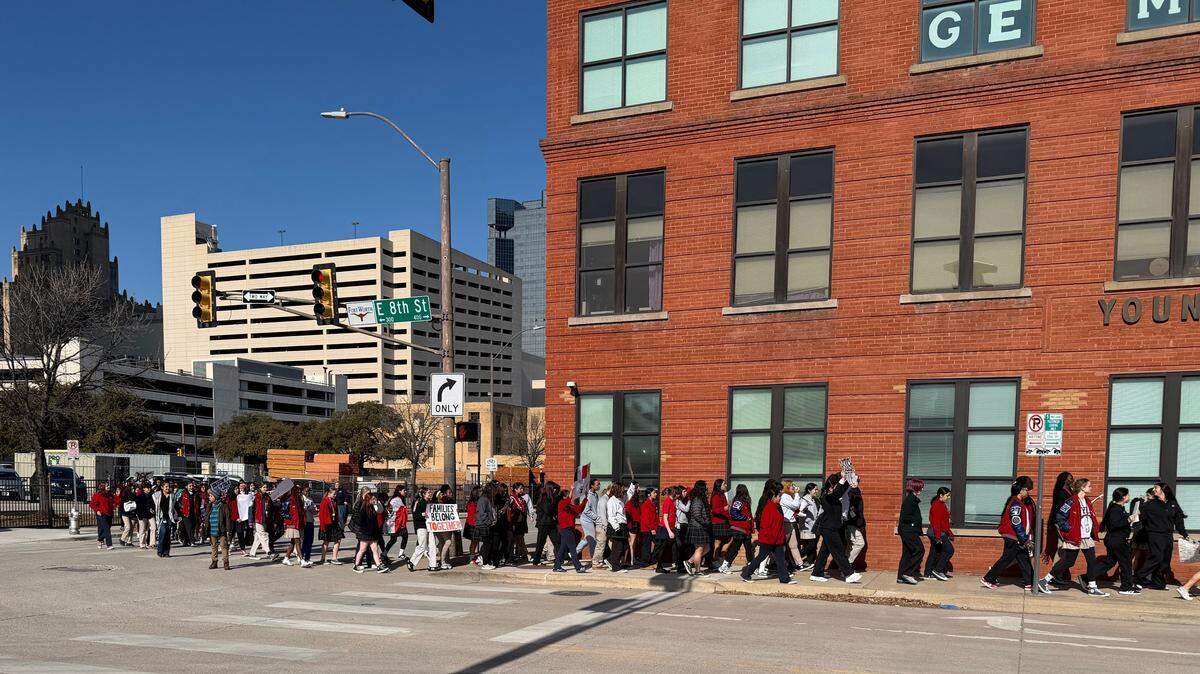
Gov. Greg Abbott’s comments about cutting school funding over student walkouts have added new urgency to a wave of protests happening across Texas.
Students have been leaving class to speak out against immigration enforcement, and families are trying to understand what rights their kids actually have during the school day.
Can students walk out without violating the First Amendment? What consequences can schools enforce? And what power does the state really have in this situation?
To help break it down, we asked two First Amendment experts to explain what the law allows and what families should do before a walkout happens.
Here’s what to know.
What exactly did Gov. Abbott say about student walkouts?
During a recent news conference, Abbott said students do not have the right to leave class for a protest.
“If you are a student, you have a job and that is to go be in a classroom,” he said. “Protests by leaving a school is not allowed by law.”
Abbott also warned districts about the financial impact of walkouts.
“Schools receive funding from the state in part based on average daily attendance,” he said. “If kids are skipping class and going out protesting, those schools are not going to be paid for that day, for those students who are skipping class.”
He added that school leaders could be held “legally responsible” if a student is injured during a demonstration.
In response to claims that walkouts are protected speech, Abbott said the law is more complex than that.
“You don’t have freedom of speech to say and act any way you want to, anywhere you want to, anytime you want to. The Supreme Court has been very clear about free speech to students, and that free speech of students does not include leaving the school to go protest.”
Abbott also instructed Education Commissioner Mike Morath to review how districts handled the demonstrations and determine what consequences might apply.
He said the state is evaluating “the extent to which the school could lose funding because a student was not present for school for that entire day.”
What does TEA require schools to do when students walk out?
Following Abbott’s directive, the Texas Education Agency released guidance reminding districts that compulsory attendance laws still apply.
The agency told schools they must mark students absent if they leave class for a walkout, and that districts risk losing daily attendance funding if they allow or encourage students to participate.
The TEA also warned that teachers who facilitate walkouts could face investigation and possible license revocation, and that school systems that support or enable walkouts may be subject to state sanctions.
Fort Worth ISD echoed that guidance in a notice sent to parents. The district wrote:
“Consistent with guidance from the Texas Education Agency, Fort Worth ISD will continue our current process of marking students that walk out with an unexcused absence. Students who leave class or campus without authorization to participate in a walkout must be marked absent, and unexcused absences may carry attendance consequences.”
Chip Stewart, a First Amendment expert and media law professor at TCU who has a child in Fort Worth ISD and shared the district’s guidance with the Star-Telegram, said the message was clear.
“My understanding, as a parent who received their note, is that students who left class for any reason, not just to engage in protest, would receive an unexcused absence and not be able to make up their work for that period just like any other absence, he said. “So to that extent, yes, students have a right to walk out, but they will suffer the same consequence that anybody else who left for any reason.”
Stewart said districts can legally enforce this rule as long as it’s enforced consistently.
“They cannot treat people any differently for the reason that they leave school,” he said. “If it’s not excused because they leave to engage in speech or protest, or because they just want to leave, and if it’s not a school-related function or some other reason that might be excused, they can absolutely do that.”
Do students have a First Amendment right to walk out during school hours?
Yes, but that doesn’t mean it won’t come with consequences, Stewart said.
“Students do not surrender their First Amendment rights at the schoolhouse gates as long as their activities aren’t disruptive to the educational environment. That’s the classic ruling in Tinker v. Des Moines,” he said.
In Tinker v. Des Moines, the Supreme Court sided with three Iowa students who wore black armbands to protest the Vietnam War. The school suspended them for what it called a distraction, but the court found their silent protest was “passive, non-disruptive expression” protected by the First Amendment.
The justices said schools can restrict student speech only when it creates a substantial, material disruption, meaning a physical event that prevents normal school operations.
Adam Goldstein, vice president of strategic initiatives at the Foundation for Individual Rights and Expression, explained why walkouts fall under that “disruptive” category.
“Nothing is more disruptive than not being there. That’s the ultimate disruption of school because you’ve successfully thwarted the core concept of school by leaving,” he said. “That’s why walkouts are always going to be substantial disruptions under the Tinker rule, which means the school will always have the ability to disincentivize them and to punish them when they occur.”
Goldstein said students can still express their viewpoint in many other ways during the school day.
“Take it back to Tinker, they were wearing an armband. I think T-shirts are the new armbands,” he said. “I really wish that the state looked at this through its lens of its responsibility to educate students by saying ‘Hey, here are some options for how you could express yourself that don’t involve walking out of the school, including, obviously, protesting outside of school hours, but also writing op-eds, wearing T-shirts, or even writing independent student newspapers.”
Can Texas legally punish school districts for student walkouts?
Stewart said no, the governor does not have that power.
“The government cannot punish expressive activity by students or citizens because they disagree with the content of their speech.”
He said Abbott’s threats raise First Amendment concerns because they appear aimed at silencing a specific viewpoint.
“The First Amendment forbids that. The government cannot silence critics.”
Goldstein said the same principle applies at the state level. Retaliation that targets the message rather than the conduct is unconstitutional.
“When you peg funding to attendance, the reasons for not being there never play into the decision,” he said. “So if the reason for this walkout were to play into the decision here, that could look like the state trying to punish speakers, creating a chilling effect or disparate impact.”
He added that if the state responds more aggressively to this protest than to others, it suggests viewpoint discrimination.
“So let us say hypothetically, there were protests three months ago where students were walking out over something else, but it did not particularly offend the state for whatever reason,” he said. “If the state did not lean on schools to stop those protests, choosing to lean on schools to stop these protests starts to look like viewpoint discrimination.”
Stewart said districts could win a First Amendment challenge, but the process would be long and expensive.
“The First Amendment should triumph in these situations but only after paying tens or hundreds of thousands of dollars to defend you,” he said. “That’s the burden people have to pay to protect their First Amendment rights.”
What rights do parents have if they support the protest?
Goldstein said parents have more control over this issue than they realize.
“Parents have the ability to sign their kids out of school. If the parent decides it is important for their kid to go to a protest, they can sign them out just like for the dentist or visiting grandma,” he said. “The state cannot say the child is truant when the parent takes charge of them.”
Goldstein added that 18-year-old students can also sign themselves out legally.
He said families should talk openly about the consequences of walking out.
“I would never tell somebody do not protest,” he said. “If this is something your child feels strongly enough about to suffer the consequences, talk through what those consequences are and make a decision that makes sense for your family.”