Senate map ‘cracks apart Tarrant County’s Black, Latino, and Asian voters,’ lawsuit says
A Tarrant County senator and six Texas voters are suing the state over a newly drawn Senate District 10 map that stretches into rural counties, arguing the map is racially discriminatory.
Every decade after the census, state lawmakers draw political boundaries for state legislative districts, Congress and the State Board of Education. The process wrapped up in October, with major changes to North Texas’ Senate District 10 represented by Burleson Democrat Beverly Powell.
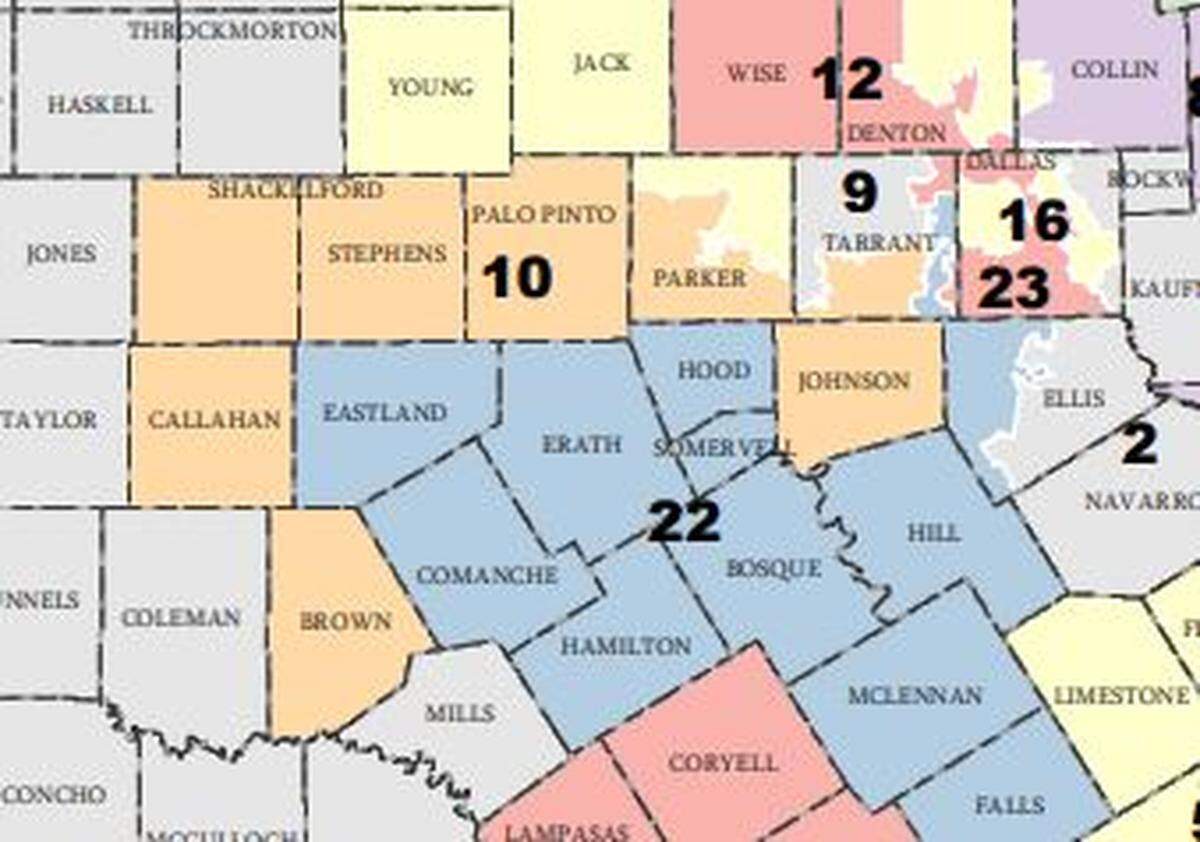
The district had been contained entirely within Tarrant County, but the map signed by Gov. Greg Abbott on Oct. 25 spans into part of Parker County and all of Johnson, Palo Pinto, Stephens, Shackelford, Callahan and Brown counties, sparking outcry from opponents who say the changes dilute the voices of Black, Latino and Asian voters.
Powell and voters who will reside in Senate Districts 9, 10 and 22 filed a lawsuit Wednesday in federal court in Austin.
The new map “cracks apart Tarrant County’s Black, Latino, and Asian voters and submerges them in Anglo-dominated districts in which they will have no opportunity to elect their preferred candidates,” the lawsuit reads.
“Leaders in Austin have made clear that they don’t respect the law nor the rights of our citizens in Tarrant County or anywhere in Texas,” Powell said in a statement. “They’ve left us no choice but to fight back with every ounce of our energy. I’m proud to fight side-by-side with my courageous friends who have joined in this crucial fight for justice for all of Tarrant County.”
The suit names Abbott and newly appointed Secretary of State John Scott as defendants. Neither of their offices immediately returned a request for comment.
Powell and the other plaintiffs contend the district was drawn to intentionally be racially discriminatory and asks the court to block elections from being held in the district under the new map.
During floor debate, Sen. Joan Huffman — a Houston Republican who authored the redistricting bill — said the Senate map was drawn “blind to race” and maintained it’s lawful under the Voting Rights Act.
The District 10 seat has switched between Republicans and Democrats in the past but would be more likely to lean Republican under the more rural boundaries, according to an analysis of election data.
The district would have a population that’s 49% Anglo, 28.2% Hispanic, 17.7% Black and 3.4% Asian. As drawn now, it is 39.5% Anglo, 32.2% Hispanic, 21.5% Black and 5.7% Asian.
A number of other lawsuits have been filed related to the maps, including two filed Wednesday by the Mexican American Legislative Caucus.
One of the challenges filed in state court focuses on the House map, specifically in Cameron County. A federal lawsuit challenges the plans for Texas congressional districts, state house districts and the State Board of Education.