Texas lawmakers near the finish on redistricting. Here’s how Fort Worth is affected.
Editor’s Note: This story has been updated to include additional information about the proposed congressional map.
Texas lawmakers are nearing the end of the redistricting process in the final days of the special legislative session.
Every 10 years the state legislators are tasked with creating new maps for the Texas’ House, Senate, State Board of Education and congressional districts, a process that ultimately affects Texans’ representation in government.
Texas lawmakers have completed drawing three of the four maps they’re tasked with crafting. The boundaries for the state House, Senate and State Board of Education were sent to Gov. Greg Abbott for approval Friday. A compromise version of a congressional map was filed Sunday night after the Senate didn’t agree with a version passed out of the House. The new map must be approved by both chambers before going to Abbott.
Here’s how the maps affect districts in the Fort Worth-area.
Texas Congressional Districts
Texas gained two congressional seats, more than any other state. Those two seats are going to the Harris and Travis county areas in the compromise map formed by a group of House and Senate lawmakers called a conference committee. The districts were also placed in the areas in previous drafts, despite North Texas having been considered as a potential contender for a new seat by experts.
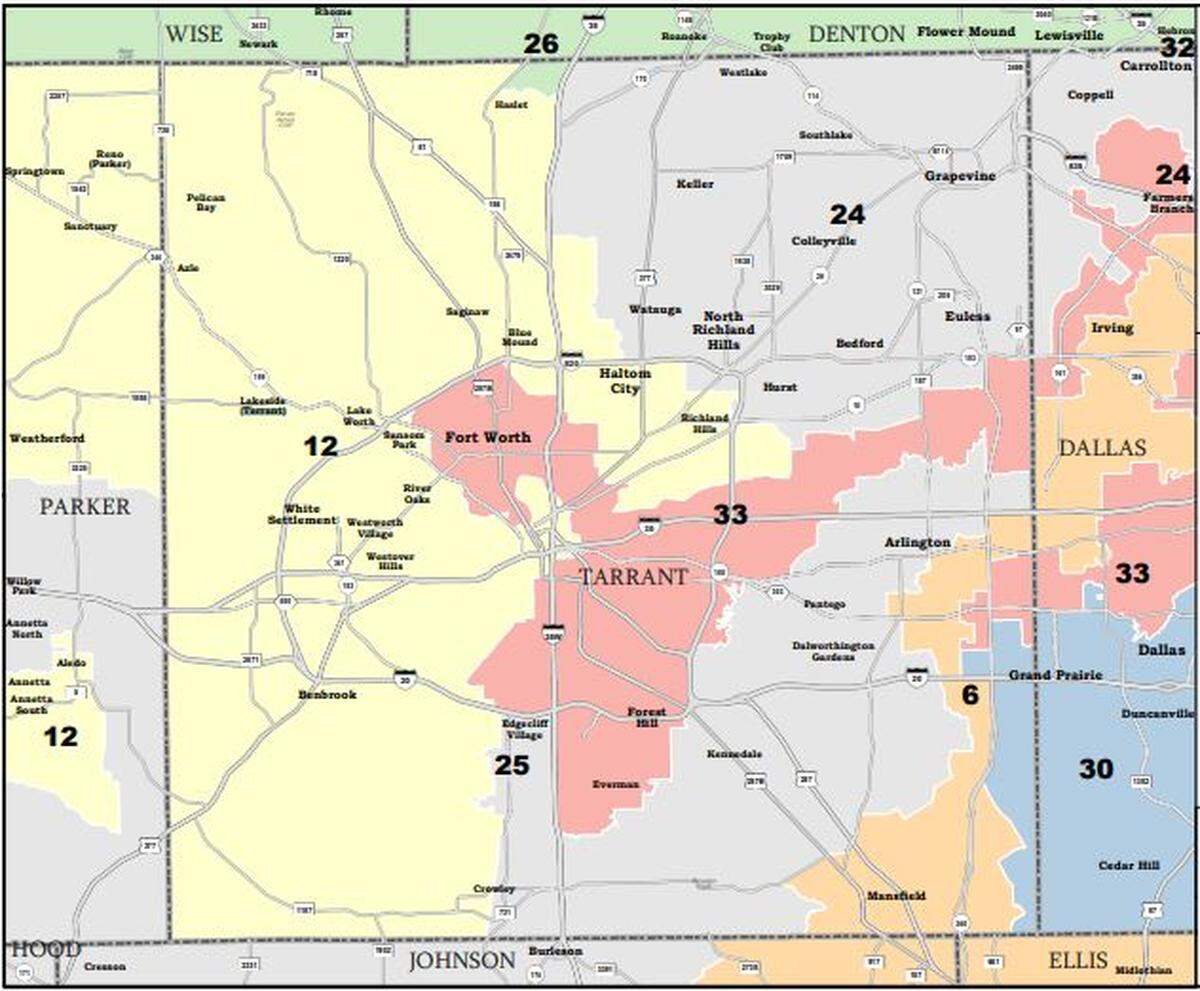
Parts of seven congressional districts would fall within Tarrant County under the proposal: Districts 6, 12, 24, 25, 26, 30 and 33. Congressional District 30 held by Democrat Rep. Eddie Bernice Johnson currently falls entirely within Dallas County. A small portion of Congressional District 26 held by Republican Rep. Michael Burgess would remain in Tarrant County, however the county’s portion of the district doesn’t include any residents, according to data from the Texas Legislative Council.
Several Fort Worth neighborhoods, including White Lake Hills, Meadowbrook, Handley and Ryanwood, would be in Congressional District 33, represented by Democratic Rep. Marc Veasey. Under the Senate’s version, they fell in either Republican Rep. Kay Granger’s Congressional District 12 or Republican Roger William’s Congressional District 25.
Five of the seven districts would have elected Republican U.S. John Cornyn over Democrat MJ Hegar in the 2020 Senate race, according to data from the Texas Legislative Council. Of the seven districts, five have populations that are majority Anglo, one has a population that’s majority Black and one has a population where Hispanic residents make up the majority.
Texas Senate Districts
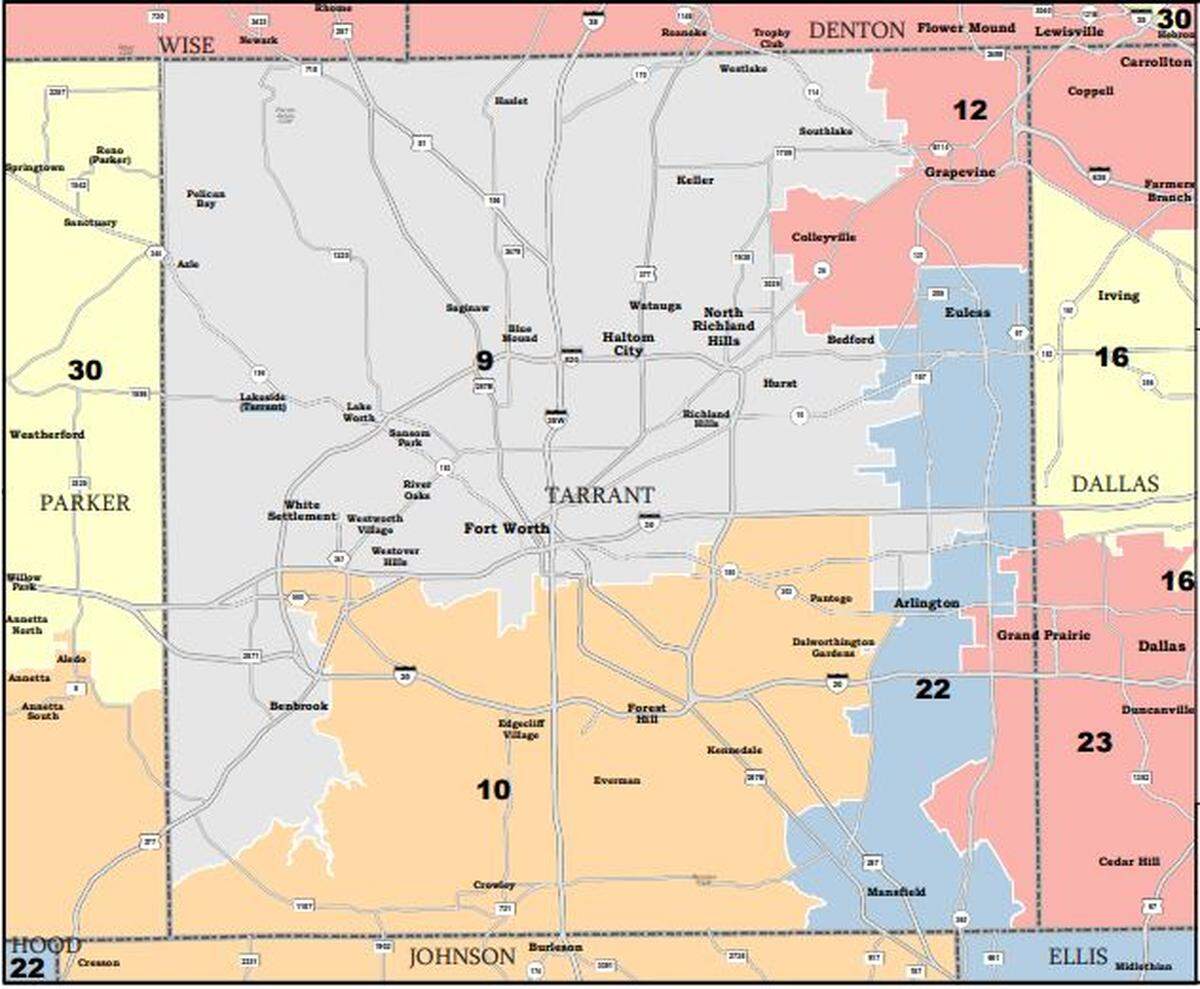
One of the biggest changes to Tarrant County’s state Senate seats is in Senate District 10, a seat held by Democratic Sen. Beverly Powell of Burleson. The seat that has flipped between Democrats and Republicans in the past would be more likely to vote Republican under the new boundaries, stretching the district outside of Tarrant County and into rural counties. Opponents of the change have criticized the redrawn district for diluting the vote of people of color who live in the district.
House Democrats from Tarrant County tried to restore the district through floor amendments, but were unsuccessful in altering the new boundaries. Typically the House and Senate do not change each other’s maps.
“There are things much more important than tradition, such as voting rights and fair representation,” Powell said in a tweet.
Tarrant County is divided between five Senate districts under the proposed map, with Senate District 9, held by Rep. Kelly Hancock, R-North Richland Hills, covering nearly half of the county. A portion of Dallas Democrat Royce West’s Senate District 23 seat would fall in the county’s southeastern edge.
Texas House Districts
Tarrant County would have 11 representatives in the state House, the same as it does currently.
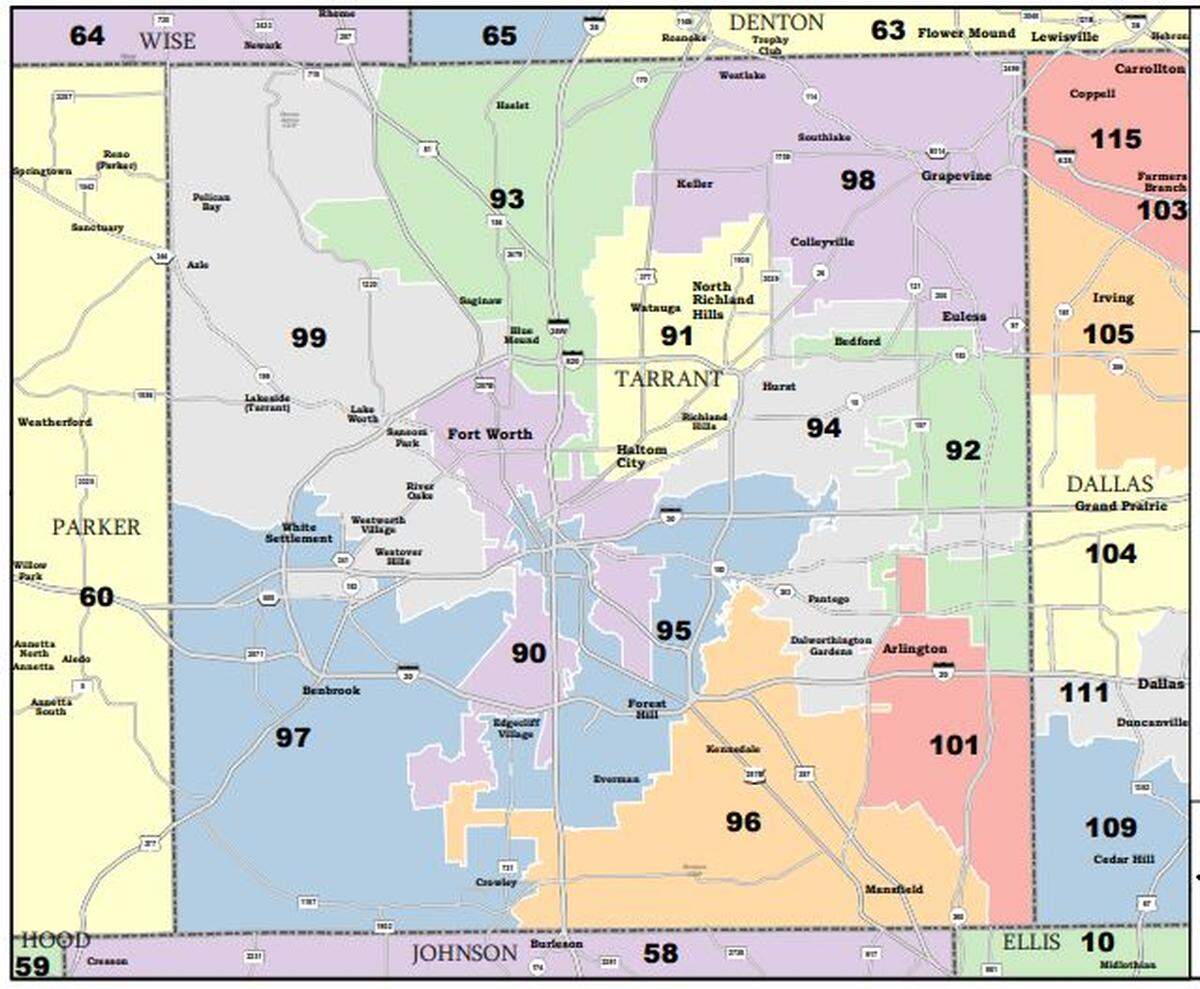
The House map headed to Abbott includes a House District 92 seat in east Tarrant County that is more likely to flip blue than as currently drawn, according to an analysis of election data. In the new map, much of Bedford, Euless and Hurst are cut out of the district currently represented by Republican Rep. Jeff Cason of Bedford.
House District 90 represented by Democratic Rep. Ramon Romero Jr. of Fort Worth sees a decrease in the number of Black and/or Hispanic voters under the new map. The U.S. Supreme Court previously found that the district was racially gerrymandered.
Most of Fort Worth would be divided between House Districts 90, 93, 95, 97 and 99.
Statewide, the map decreases the number of districts where Hispanic and Black voters make up the majority voters, and increases the number of districts where white voters make up the majority, according to The Texas Tribune.
State Board of Education Districts
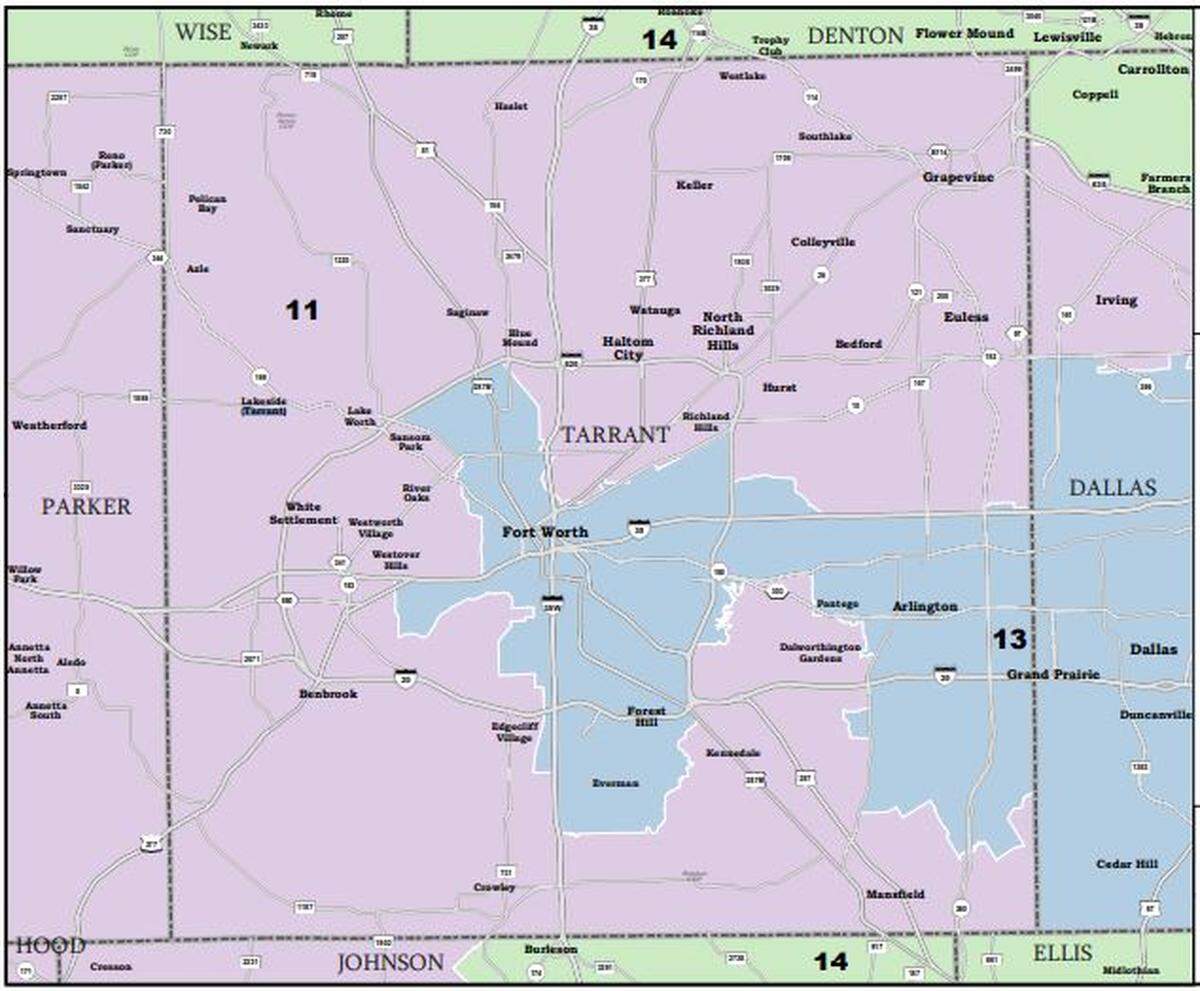
Tarrant County would continue to be split between State Board of Education Districts 11 and 13 under the version of the map headed to Abbott for approval. The bulk of the county (71% of people) would be within District 11, which covers much of Tarrant County’s suburban areas. District 13 includes part of Fort Worth, as well as much of Dallas County.
District 11 would likely continue to be a Republican district under the proposed map, and District 13 would likely remain blue, according to an 2020 election data for the U.S. Senate race.
The population of District 11 as proposed is about 54% Anglo, 23% Hispanic, 13% Black and 8% Asian with the proposed boundaries. The population of District 13 is roughly 19% Anglo, 48% Hispanic, 29% Black and 4% Asian.
This story was originally published October 18, 2021 at 5:00 AM.
CORRECTION: An earlier version of this article misstated that several Fort Worth neighborhoods were moved from Congressional District 12 to Congressional District 33. The districts were moved from either Congressional District 12 or Congressional District 25.