This red Texas House district in Tarrant suburbs could shift blue under map proposal
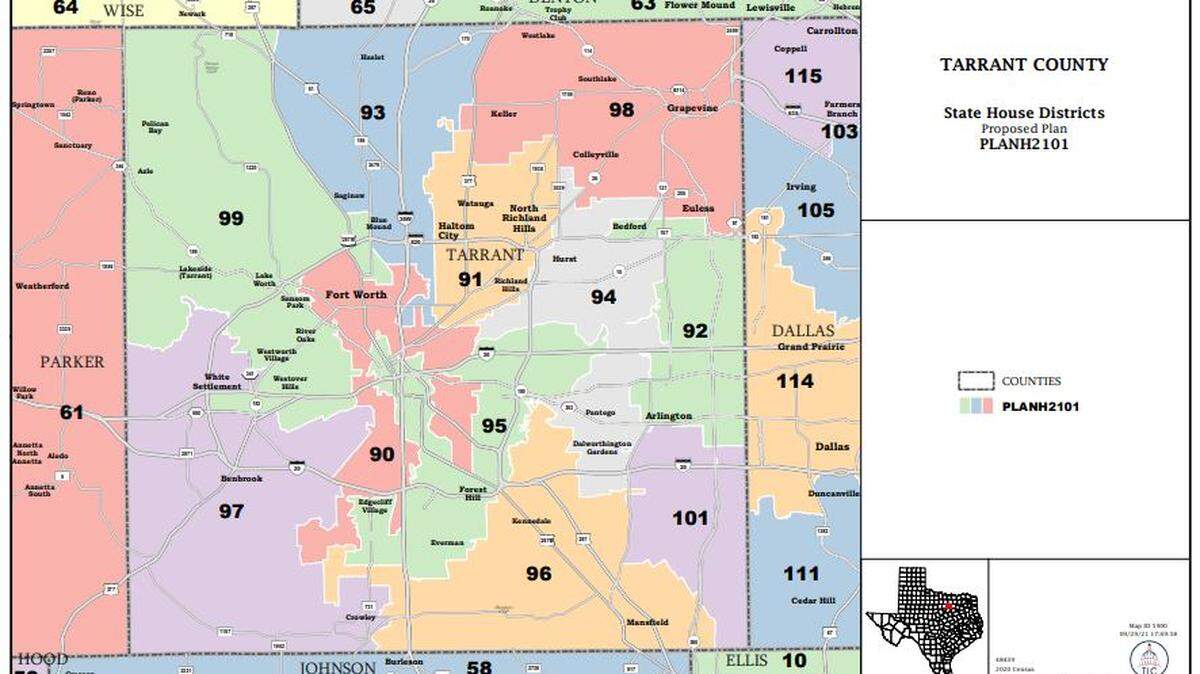
A House district in east Tarrant County held by Rep. Jeff Cason, a first term-Republican, could flip blue if maps proposed in the chamber Thursday are adopted.
The House District 92 seat encompasses Bedford, Euless and Hurst. The proposed boundaries shift the district east, pushing Hurst into House District 94 held by Rep. Tony Tinderholt, R-Arlington, and cutting out much of Bedford and Euless. The district, which was previously held by firebrand Republican Jonathan Stickland, is at risk of switching party affiliation under the proposed map filed by Corpus Christi Republican Todd Hunter, chair of the House Redistricting Committee, according to an analysis of election data.
Election data from the 2020 U.S. Senate race shows that Republican U.S. Sen. John Cornyn won the district with about 51% of votes. As drafted for House consideration, Democrat MJ Hegar would have won the election with nearly 60% of votes. Under the current map, former President Donald Trump narrowly won the district with 49.2% of votes, but the proposed map has President Joe Biden, a Democrat, winning with nearly 63%.
University of Houston Political Science Professor Brandon Rottinghaus described House District 92 as “a sacrificial lamb” as suburban Tarrant County becomes increasingly more competitive.
“The Republicans are clinging to the few districts they have left in suburban DFW, and they basically, completely cannibalized the strength, the Republican strength in 92 to give 94 and Representative Tinderholt a better shot of holding that seat,” he said.
Cason and Tinderholt did not immediately return requests for comment on the proposed maps.
The House’s initial draft of political boundaries is expected to change as the proposal makes its way through the Texas Legislature. A committee hearing on the map when the public can testify in person or virtually is scheduled for Monday.
Under the proposed map, House District 92’s population would be 35. 1% Hispanic, 28% Black, 26.1% Anglo and 9.8% Asian. Tarrant County as a whole has become increasingly diverse.
The district as offered Thursday is a “purple district leaning toward a blue district,” Rottinghaus said.
“It’s going to be hard for the Republicans to hold onto that seat with those numbers, even with a head start, the incumbent and a money advantage,” he said.
Generally, the most protected districts are longer-term Republican incumbent districts, Rottinghaus said. The proposed map shores up Tinderholt’s seat for Republicans for the time being, but it may not last, Rottinghaus said.
“There’s a good chance that despite trying to hold ... onto 94, that the demographic changes will outpace the Republicans’ ability to hold that,” he said. “So that’s a district which now is a Republican district but won’t be that way in two cycles.”
Statewide, the proposed map bolsters Republican strength and creates six additional districts where white residents are the majority of eligible voters, according to The Texas Tribune. The state would lose three districts where Hispanic voters make up the majority and three where Black voters are the majority of eligible voters, the new outlet reports.
In House District 90, Fort Worth Democrat Rep. Ramon Romero in a statement said he’s “deeply concerned the proposed House District 90 dilutes minority voting strength in the only District the Supreme Court of the United States found was racially gerrymandered during the last round of redistricting.”
The district’s population as submitted would be 64.5% Hispanic, 17.8% Anglo, 14.6% Black and 2.9% Asian. Under the current map, the district is 73.4% Hispanic, 13.1% Anglo, 11.3% Black and 2.1% Asian.
“While people of color fueled 95% of the population growth in the last decade in Texas, this intentionally discriminatory map reduces the number of districts with Hispanic or Black majority electorates across Texas.,” Romero said.