Senate approves proposed Texas districts, including more rural Tarrant County seat
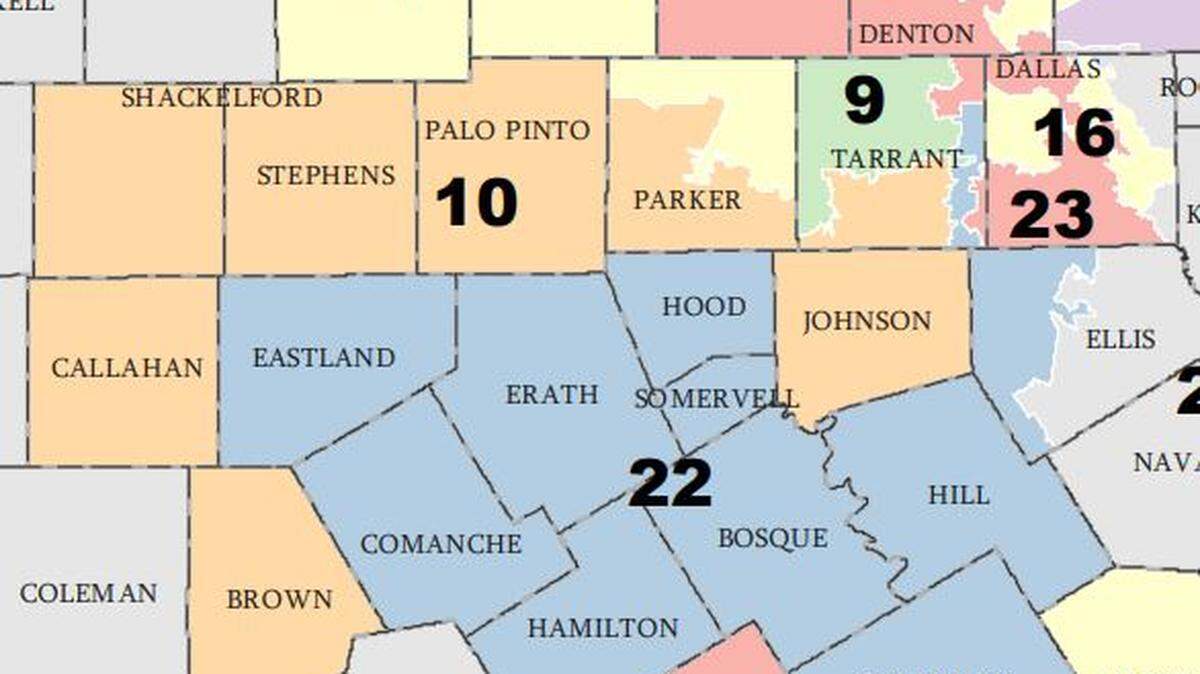
The Texas Senate late Monday approved a map that stretches a Tarrant County Senate district into rural parts of the state.
The proposal for Senate District 10, held by Democratic Sen. Beverly Powell of Burleson, expands from Tarrant County into part of Parker County and all of Johnson, Palo Pinto, Stephens, Shackelford, Callahan and Brown counties.
The district would be less diverse and more likely to vote Republican than the current version, according to an analysis of election data. Opponents have said the new lines would dilute the voice of voters of color.
Powell described Senate District 10 as a “crossover district” — one where “a coalition of minority voters come together to elect their candidate of choice, with some Anglo voters as well who join that minority in support of a candidate.”
Answering questions posed by Dallas Democrat Sen. Royce West, Powell said the district has seen a trend of people voting more Democratic and is seeing more Black and Hispanic candidates elected to office.
“Do you believe that your district is being intentionally targeted for elimination, as it being a Democratic trending district?” West asked.
“Absolutely,” Powell replied.
The district is part of a statewide proposal for new Senate districts as part of the redistricting process done by the Legislature every 10 years after the census. The proposed map, which could still change, must make its way through the House and get approvals from both chambers and Gov. Greg Abbott. It passed out of the Senate on a 20-11 vote.
The map’s author, Sen. Joan Huffman, told lawmakers her goals included equalizing population across districts, preserving districts’ core and compactness, as well as preserving communities with common interests and accommodating incumbent priorities when possible.
Powell spent roughly an hour questioning Huffman on the boundaries of Senate District 10 and how they were drawn. The district has flipped between Republicans and Democrats in the past. During the floor debate, Powell raised concerns about how the boundaries affect Black and Hispanic voters and separate communities of interest. She questioned the district being less compact and overpopulated under the proposed map.
Huffman said she relied on population data and election data in crafting the map. She said it was drawn “blind to race” without the consideration of racial data and maintained the map is lawful under the Voting Rights Act.
Two amendments proposed by Powell failed. One would keep the district’s boundaries intact. Powell’s second amendment aimed to show “how it’s possible to change the boundaries while still maintaining a Tarrant County-based district where African-American, Latino and Asian-American voters can continue to unite and elect candidates of their choice.” She said the proposed amended map would keep together communities of interests, such as the Como neighborhood and historically Black neighborhoods in southeast Fort Worth.
City Council members representing majority-minority districts wrote to Huffman on Sept. 23 asking that District 10’s boundaries remain unchanged.
“If the committee feels that changes must be made, Fort Worth’s densely populated African American and Hispanic communities, such as the Como neighborhood, the greater Northside community, and the Lancaster corridor, which are currently drawn outside SD10 should be included in a newly drawn district,” the letter reads. “Any attempt to dismantle majority-minority legislative districts in Fort Worth will be correctly seen as an attack on the communities we serve.“
The letter was signed by council members Elizabeth Beck, Chris Nettles, Jared Wiliams, Gyna Bivens and Carlos Flores.
Huffman said she opposed the amendment because it changes multiple Dallas Fort Worth districts without the agreement of all those affected, it overpopulates area districts and proposes a “race-based draw without a legally sufficient justification.”
An amendment passed by Huffman keeps more of Mansfield together than previously proposed, but places most of the city in District 22, which as drafted covers Bosque, Comanche, Eastland, Erath, Falls, Hamilton, Hill, Hood, McLennan, Somervell and parts of Tarrant and Ellis counties.
“The Senate’s map that passed today is fair and legal, and passed with bipartisan support,” Lt. Gov. Dan Patrick said in a statement. Patrick oversees the Senate. “This map illustrates our commitment to making sure every Texan is well-represented in their state legislature and their voices are heard.”
This story was originally published October 4, 2021 at 8:14 PM.