After 20 years of research, an exhibit honors a forgotten Fort Worth neighborhood
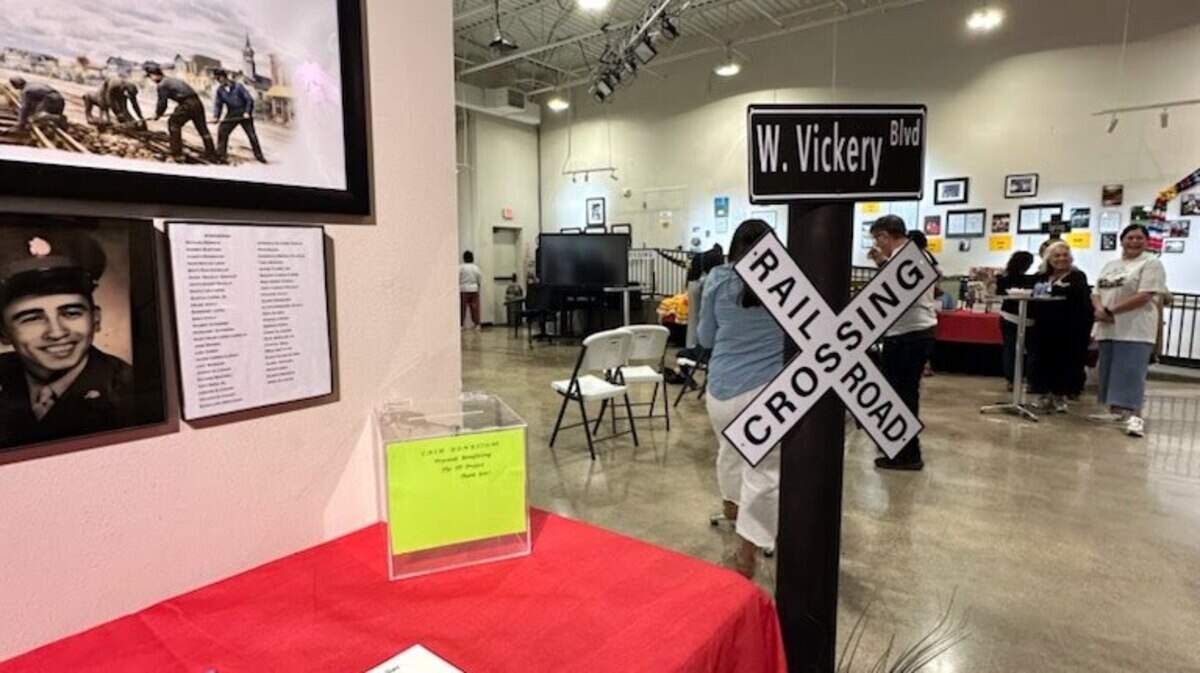
A once-vibrant Hispanic community in west Fort Worth, dismantled by freeway construction, is now on view in an exhibition in the Northside.
“El TP: Memories of the Past” is curated by Chris Contreras, and will be shown until April 25 at Artes de La Rosa Cultural Center for the Arts, 1440 N. Main St.
Contreras spent more than 20 years researching El TP, named after the Texas and Pacific Railway Company. Her research was an opportunity for the people who lived there to come together around a place that may be gone, but still holds strong memories.
The neighborhood lies south of the westbound lanes of Interstate 30 and north of Chisholm Trail Parkway. Its borders were Montgomery Street on the west, West Freeway on the north, Pulido Street on the east, and West Vickery Boulevard on the south.
“I was doing this for the people of TP,” Contreras said. “The people who live there and are still living for their children and for their grandchildren.”
The history of El TP
The exhibit features a timeline that tracks the neighborhood's development from 1930 to 2026. It includes maps, family photos, and oral histories from residents. The San Mateo Chapel of Ease, which older residents remember as San Mateo Catholic Church, was the center of the neighborhood, hosting jamaicas — church fundraising events — that featured food, music and entertainment. The church still stands there today.
Contretras' home was off Lovell Avenue. She remembers the dust from the dirt roads, the sounds of the trains filling the neighborhood and the abundance of small, independently-owned businesses and restaurants.
The community was composed of men who had trades or worked for the Texas and Pacific Railway Company and the Missouri-Kansas-Texas Railroad. Contreras' grandfather and uncles worked on the railroad while her father worked at the steel mills, and her mother owned a beauty shop.
As the years passed, the expansion and construction of freeways along the Chisholm Trail, I-30, and the Rosedale Street bridge uprooted the community. El TP was gone, and its residents moved across the city or left Fort Worth entirely.
Contretras left home in 1972 but stayed in Fort Worth. In the late ‘90s, a friend named Richard Bermejo showed her a map of the homes and families that once stayed in the community that he had created.
Years later, she received a copy of the map again and began her own research by visiting the Fort Worth History Center, gathering photos, interviewing more than 25 former residents of El TP, and combing through Census records.
She spent years researching and conducting interviews, and her work continued through COVID and as she taught for more than a decade.
But she always knew her passion project was waiting for her.
When she was finished and ready to present the information about El TP, a small committee of friends helped her find a place to display it.
‘I wish it was still here’
Artes de la Rosa Executive Director William Girón said he wanted to host the exhibit because it aligns with the organization's mission to preserve, promote and interpret the art, lives, history and culture of the Hispanic community.
When Contreras first approached Girón about her project, she wanted it to be a weekend exhibit, but he knew this could help out people in more ways than one.
“My hope is that this sparks interest in the other communities to create an exhibit of their own, so that people learn more about their communities,” Girón said. “She created a blueprint for other communities and even current communities.”
Emerico Perez grew up with Contreras and remembers the jamaicas. riding his bike with friends and watching movies at the drive-in theater across the railroad tracks. He recalled El TP being the neutral ground between the Northside and Southside Hispanic communities, where everyone came together and found mutual understanding. He helped Contreras’s project by scanning and making copies of photos of the people they interviewed.
After years of work that brought back memories and had him relive his childhood, he feels at peace with what they accomplished. “A lot of people I talked to wish we were back in that neighborhood,” Perez said. “Every time I go past I-30, I look over there, and I just remember, man, I wish it was still here.”
The Artes de La Rosa Cultural Center for the Arts is open from Tuesday to Friday from 11 a.m. to 5 p.m. and after 5 p.m. by appointment. Times vary on the weekend, but contact the center for more information.