
Fort Worth upstaged Dallas to celebrate this famous pilot’s record-breaking flight
Fort Worth has been at the center of aviation history since the very beginning. From the first “powder puff” air race to the setting of the endurance record for time in the air, and from the visit by the dirigible “Shenandoah” to the first round-the-world flight, Fort Worth has been in the vanguard.
In 1927, Fort Worth scored another historic moment when it welcomed pilot Charles Lindbergh and his airplane, “The Spirit of St. Louis.”
The man known as “Lucky Lindy” and the “Lone Eagle” was just back from his history-making New York-to-Paris flight in May 1927. Now a colonel in the Army Air Corps, he set off on a cross-country tour to visit all 48 states, paid for by the Daniel Guggenheim Fund for the Promotion of Aeronautics and backed by the U.S. Army. The stated objectives of the tour were: 1.) to celebrate the feat of flying across the Atlantic; 2.) to allow people to get to know “Slim” Lindbergh, the man; and 3.) to hold him up as a worthy role model to the nation’s children.
The tour started in New York City on July 20, to return to its starting point on Oct. 26. Lindbergh would fly “The Spirit of St. Louis,” the airplane he flew across the Atlantic, which was nearly as famous as its pilot.
Lindbergh was quite familiar with Texas, having spent two years doing his pilot training at San Antonio’s Kelly Field. He flew into Fort Worth from Abilene on Monday, Sept. 26, and spent that night.
He landed at Fort Worth’s municipal airport (the future Meacham Field) at 2 p.m. to be greeted by a throng estimated at 15,000. Crowd control was in the capable hands of 50 Fort Worth police officers, 60 Texas National Guard mounted troops, 100 Boy Scouts, and “several hundred” members of high school ROTC programs.
Fort Worth parade honored Lindbergh
After a meet-and-greet at the airfield, the plan was to give the guest of honor a parade up North Main to Panther Park, home field of the Fort Worth Cats baseball team. The grandstand there could seat 4,000, with extra chairs placed on the field. Admission to the event was restricted to Fort Worth schoolchildren who had been given the day off from school.
The parade would then continue up North Main past the courthouse, down Houston to 13th, over to Main and up Main to Eighth, where it would halt at the Texas Hotel. The presidential suite had been booked for Lindbergh, and a banquet in his honor was to be held in the Crystal Ballroom that evening. The evening would end with a grand ball at Casino Park (Lake Worth), open to the public, followed by a fireworks show over the lake.
On Sunday, Sept. 25, Mayor Pro Tem A.E. Thomas (acting for Mayor William Bryce who was on vacation) proclaimed Sept. 26 “Lindbergh Day.” According to the proclamation, city offices would shut down and businesses would close from 3 to 4 p.m. so the people of Fort Worth might devote that time to “patriotic thought and reverence [for the nation’s progress in aviation].”
The city pulled out all the stops for arguably the biggest celebrity in the country, more popular than the president or any movie actor. One Boy Scout, 15-year-old Tom Gibson, had the singular honor of being allowed to sit at Lindbergh’s table at the banquet. (Lindbergh himself had been a Boy Scout growing up.) Young Tom had been one of the first in Texas to win an Aviation Merit Badge. On top of everything else, Record-Telegram columnist Kenneth E. Taylor composed a poem, “Lone Eagle: The Lone Star State Salutes You!” for the occasion.
A who’s who of celebrities came to town for the event, including Gov. Dan Moody, U.S. Sen. Morris Sheppard, and Congressman Fritz G. Lanham. In addition, most of the nation’s tiny air force flew in from San Antonio. The crowd watched expectantly as “The Spirit of St. Louis” appeared in the western sky, banked to the south and came in for a perfect, three-point landing. As soon as the propeller stopped spinning, Lindbergh emerged waving. The crowd responded with a cheer, crying in unison of “It’s Lindy!”
After a few words of welcome, everybody piled into cars and headed up Decatur Road to North Main. Besides the cars, the parade included a mounted cavalry escort and 50 cowboys representing the Southwestern Exposition and Fat Stock Show.
The stop at Panther Park was only 15 minutes. The “school children,” defined as anyone from 10 years up to college age, were accompanied by teachers and parents. For one of the very few times in Fort Worth school history to that point, Black and white children were in the same place, though they were seated in separate sections. Lindbergh told them about the bright future of aviation, then hopped back in the car.
A wildly enthusiastic crowd lined the parade route through downtown to the Texas Hotel. The doors to the Crystal Ballroom swung open at 6 p.m. to allow more than 800 invited guests to find their places while a few uninvited attendees squeezed in to stand in the back of the room.
‘Lucky Lindy’ visited Fort Worth before Dallas
The Lone Eagle was used to enthusiastic welcomes by this date and had collected a railroad car of gifts already, but Fort Worth came up with a gift that put everyone else to shame, presenting him with an oil portrait of his mother, Evangeline Lindbergh, a Detroit high school teacher. The work had been arranged and paid for by lawyer and civic leader Walter B. Scott, who flew to Detroit in early August. There he persuaded the lady to pose for Chicago artist Carl Bohnen by sitting each day after class for more than a month to produce the “three-quarter-size” portrait.
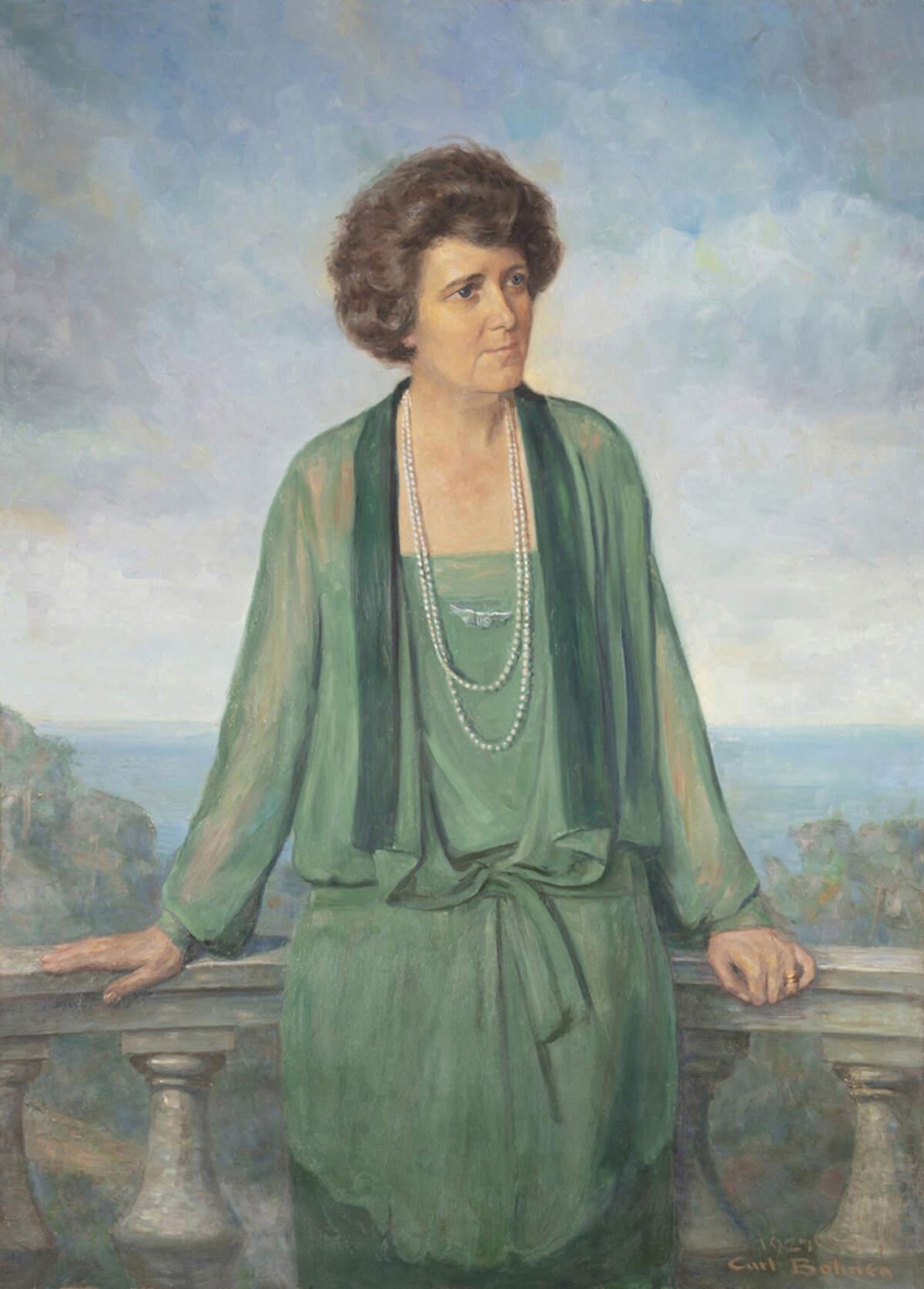
After he got home, Lindbergh sent a note to Walter Scott, thanking him and all of Fort Worth for the kind gift. He wrote, “I shall always treasure this portrait along with a grateful memory of all the hospitality and goodwill shown me by the people of Fort Worth.”
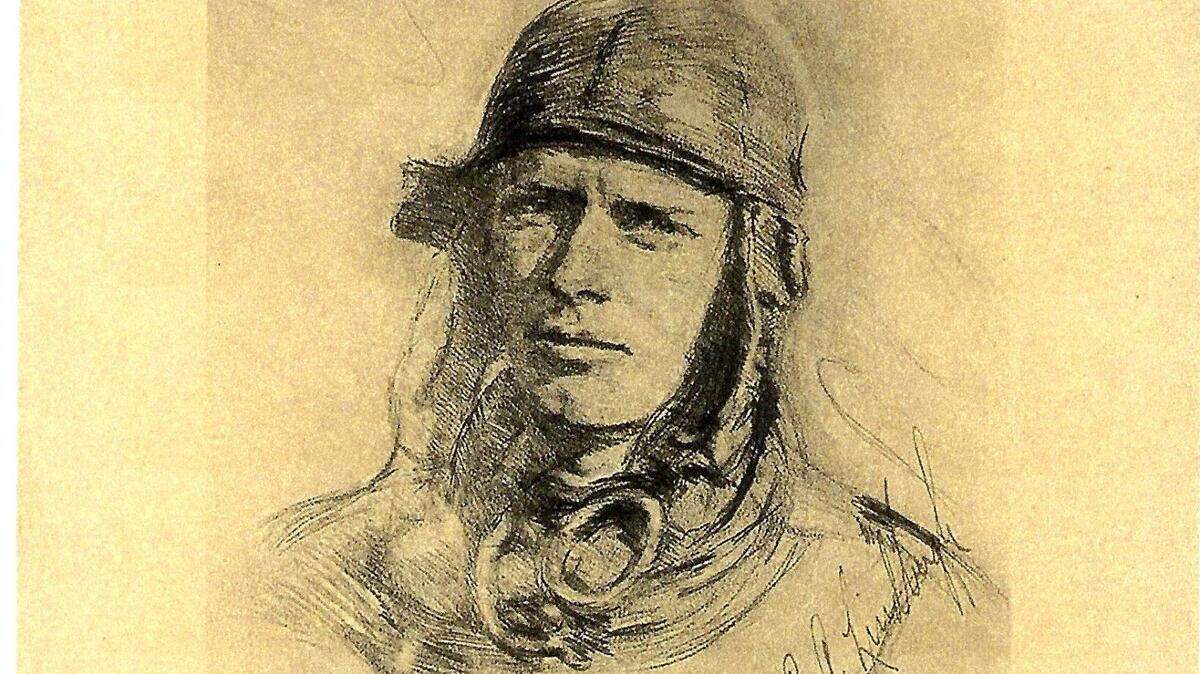
Bohnen was not the only important artist to memorialize the Lone Eagle’s Fort Worth visit. Nationally known artist Edna Hoadley did one of her “pencil portraits,” titling it, “The Man of the Air.” It was reproduced as a popular lithograph print that sold well. One of those lithographs may have been the “Lindbergh portrait” presented to Charles E. Nash Elementary by Mrs. Nash, to be hung in the school auditorium.
By any definition Lindbergh’s Fort Worth visit was a huge success. The “largest turnout” in the city’s history had welcomed him, said the newspaper, bigger even than the crowd that welcomed Teddy Roosevelt in 1905 and 1911. Nor was it overlooked that Cowtown had won out over Dallas by hosting Lindbergh first. Sure, Dallas turned out in force to greet him upon his arrival at Love Field and gave him a “short reception and dinner” that night.
Lucky Lindy returned to Fort Worth a little over a year later, on his way home from a hunting trip in Mexico. There was no big welcoming party this time, just a change of planes before returning y home to St. Louis.
Author-historian Richard Selcer is a Fort Worth native and proud graduate of Paschal High and TCU.