
He fostered Latino entrepreneurs in Texas. His father lived the American dream in Kansas
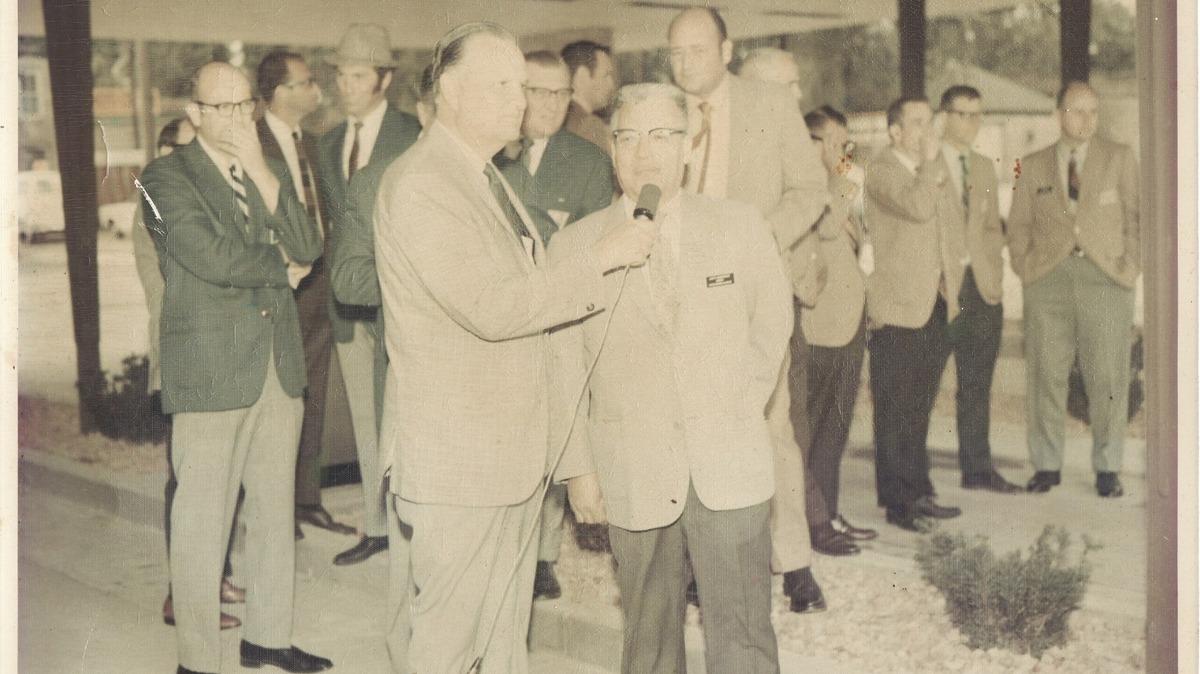
Julian Martínez, director of program development for SER Jobs for Progress National Inc., was the first Latino on the DFW International Airport board in 1984-1988.
As an SER employee, he promoted Latino/a entrepreneurship through the development of Hispanic Chambers of Commerce in Texas. He helped to reorganize the Fort Worth Hispanic Chamber in 1990 and convinced Victor Puente Sr., founder of Southwest Office Systems, to win profitable, newsstand concessions at the airport.
Julian’s business locomotive drive was inherited from his father Santiago Felipe Martinez, born in 1907 in La Piedad, Michoacán, Mexico. Santiago’s parents Jesús and Luisa Ramirez Martínez, immigrated to Kansas in 1911, where Jesús worked on the Santa Fe railroads as a traquero. Santa Fe recruited experienced Mexicans for the U.S.’s expanding railroad industry to work on gangs repairing and laying tracks.
Santiago learned English in school up to the third grade and returned to Mexico in 1915 after his parents earned enough money to purchase a ranch. During the Mexican Revolution, armed rebels and federals forced boys 12 years and older to fight for their side or die. To avoid their son’s forced recruitment, Santiago’s parents gave him $150 in 1924 and directed him to return to Kansas. With two other young men, 17-year-old Santiago walked and rode the rails, when they weren’t kicked off, across the border.
Some Mexican American families along the tracks marked their houses with an X in the corner, offering frijoles and rice to travelers like Santiago. They also furnished shoes and changes of clothes under railroad bridges. Santiago never forgot their compassion in this Mexican Underground Railroad to economic freedom.
While Santiago urinated in bushes in Austin, police with drawn guns forced his companions to lie face down. Santiago told the police in English, “You can’t do that. This is the United States of America. You have to have a reason. We haven’t done anything wrong.” The chastised police released them. In Fort Worth, thugs beat and robbed them, forcing the trio to seek medical assistance. As they recovered in the hospital, Santiago overheard police talk about pinning a murder rap on the injured Mexicans. Santiago stirred his companions from their hospital beds and sneaked out. Oklahoma residents threatened them with guns and dogs and ordered them to keep moving.
Back in Kansas, the feel of a nickel in his pocket stirred him to seek work. After 19 years of toiling on the railroad throughout Kansas, marriage, five sons and five daughters, he left the rail gangs and worked as a machinist in local factories. During World War II, his employer assisted Santiago, now called Jim P. Martínez, to earn his citizenship and to obtain exemption from military service because of his skills. President Truman awarded Jim a commendation for his production of castings for ships.
He took engineering correspondence courses, rode his motorcycle to Indiana to attend classes, and moonlighted with a Sears press in his basement with his sons’ assistance. By 1943, Jim’s machinery business boomed and allowed him to open Martínez & Sons Inc., eventually becoming one of the biggest employers in Hutchinson. His business savvy and innovative machine designs earned him the respect of city elite.
Never forgetting his immigrant roots, he translated government letters, wrote responses in English and Spanish, and navigated the citizenship process for fellow Mexicans. He joined the American G.I. Forum, a Latino civil rights organization, became a 4th degree member of the Knights of Columbus, and served on many civic organizations. As president of the Mexican Representative Society, he organized fund-raising dances, attracting Mexicans from throughout Kansas. The proceeds went to indigent families to buy clothes and to pay funeral expenses.
Julian, born and raised in Hutchinson, recalled discrimination his family endured in restaurants, theaters, and public swimming pools. Mexicans were allowed to swim only on Thursday — the day they drained the pool. Despite historical prejudices, gregarious businessman Jim ran for a Hutchinson city commissioner office in 1969. A daughter was embarrassed that he dared to seek a seat, convinced he had no chance. After wearing out two pairs of shoes canvassing for votes, he won. In 1970, he was elected mayor, the first Latino to hold the office in Hutchinson. One of his first mayoral actions was to eliminate the Mexican-only Thursday swimming rule.
.jpg "Jim Martinez and Family (3).jpg")
Jim P. Martínez died in Hutchinson on July 4, 1994, his long trek for the American Dream over. Today, Hutchinson residents bike, jog, and walk on the Jim P. Martínez Sunflower Trail. The Reno County Museum curates a display for “impactful individuals,” including a Martínez exhibit.
His legacy lives on in his sons, daughters, and immigrants riding America’s freedom train.
Author Richard J. Gonzales writes and speaks about Fort Worth, national and international Latino history.