‘Texans deserve to know’: Do design flaws on I-35W put Fort Worth drivers in danger?
READ MORE
Deadly pileup: Victims and their families are still waiting for answers
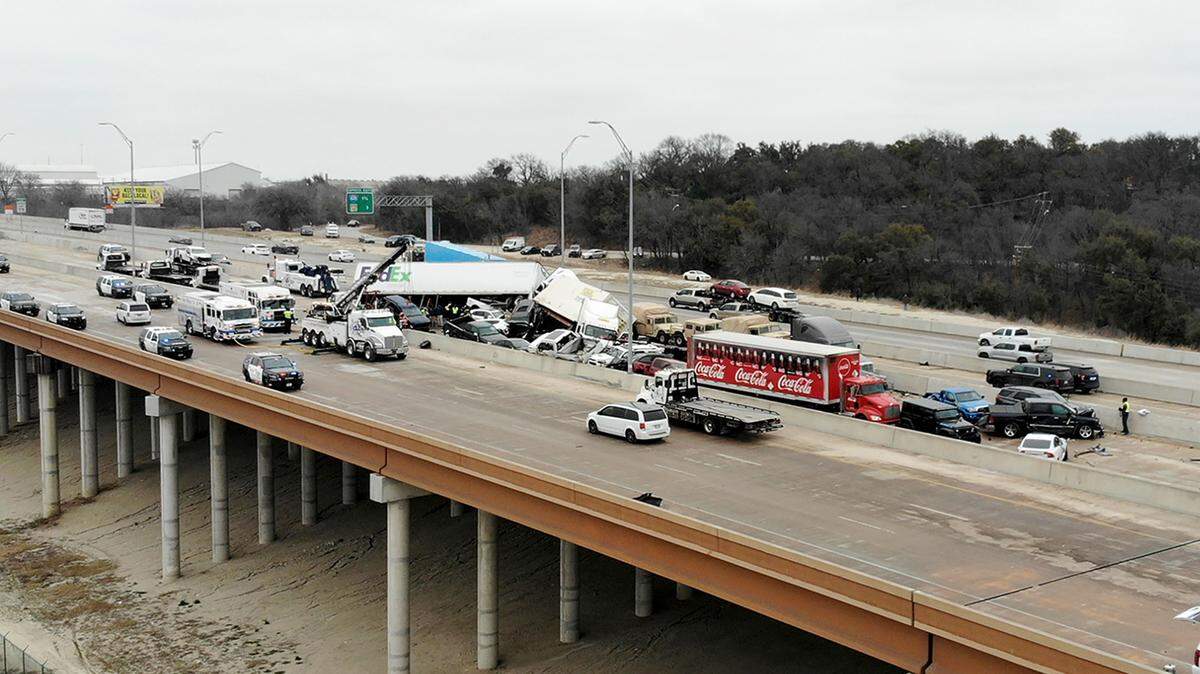
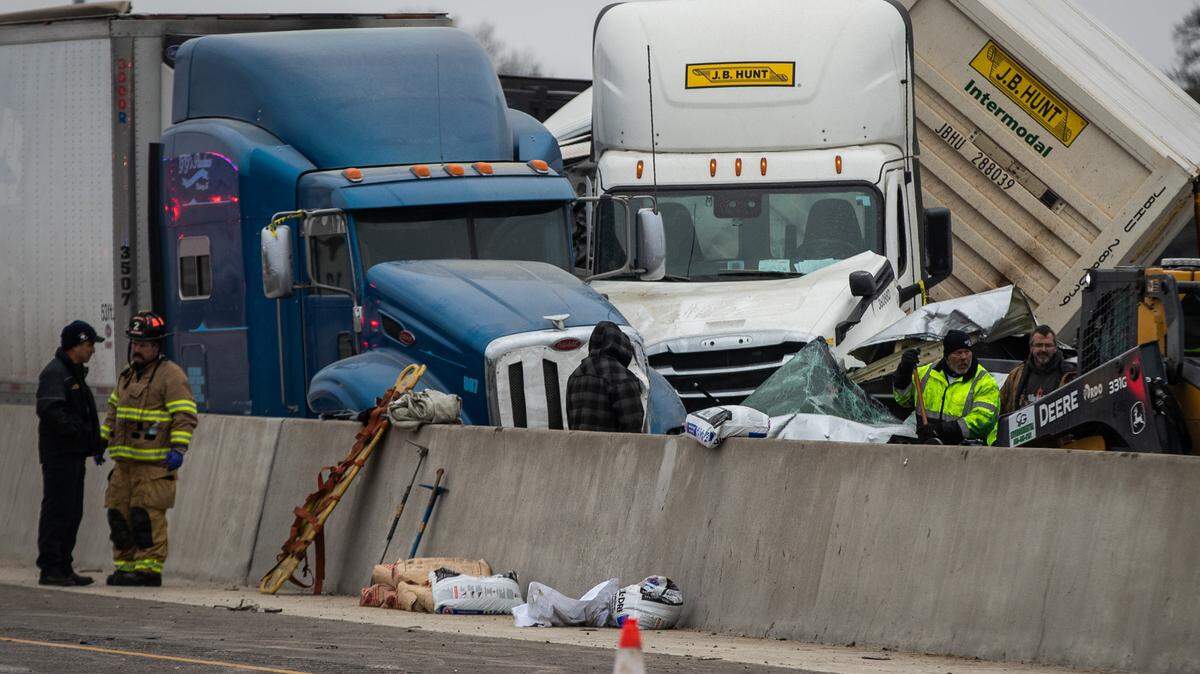
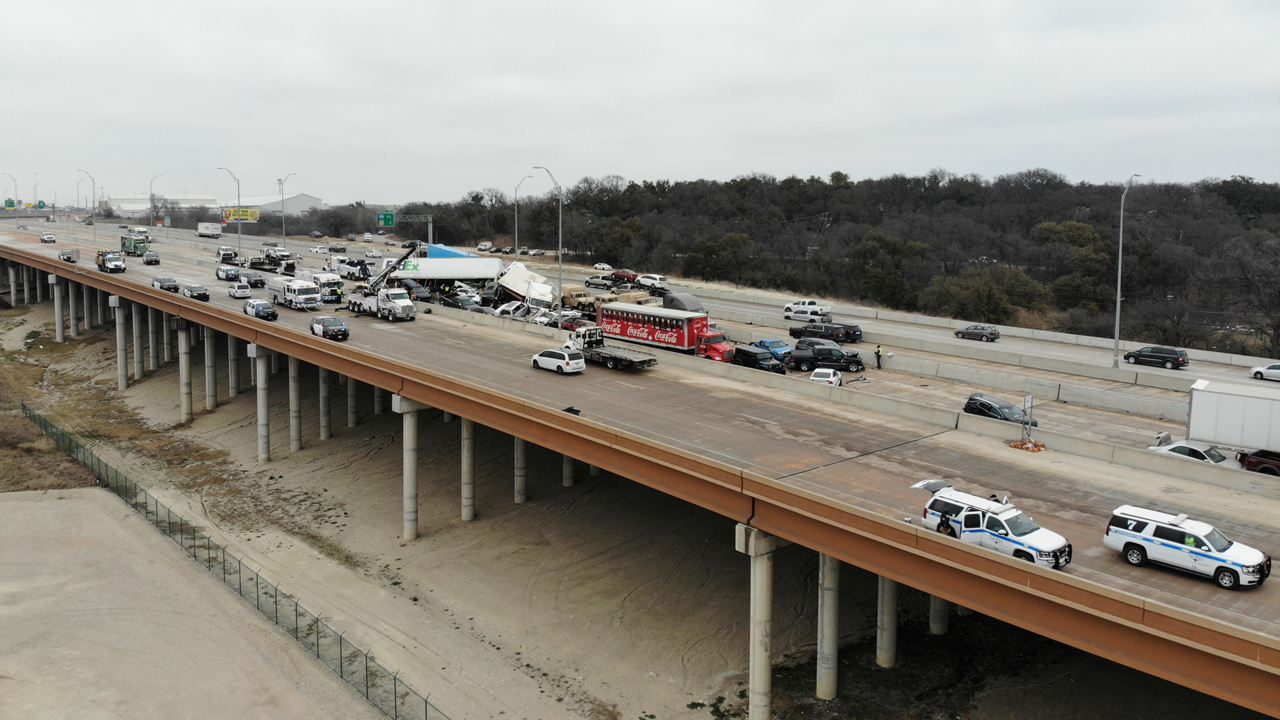
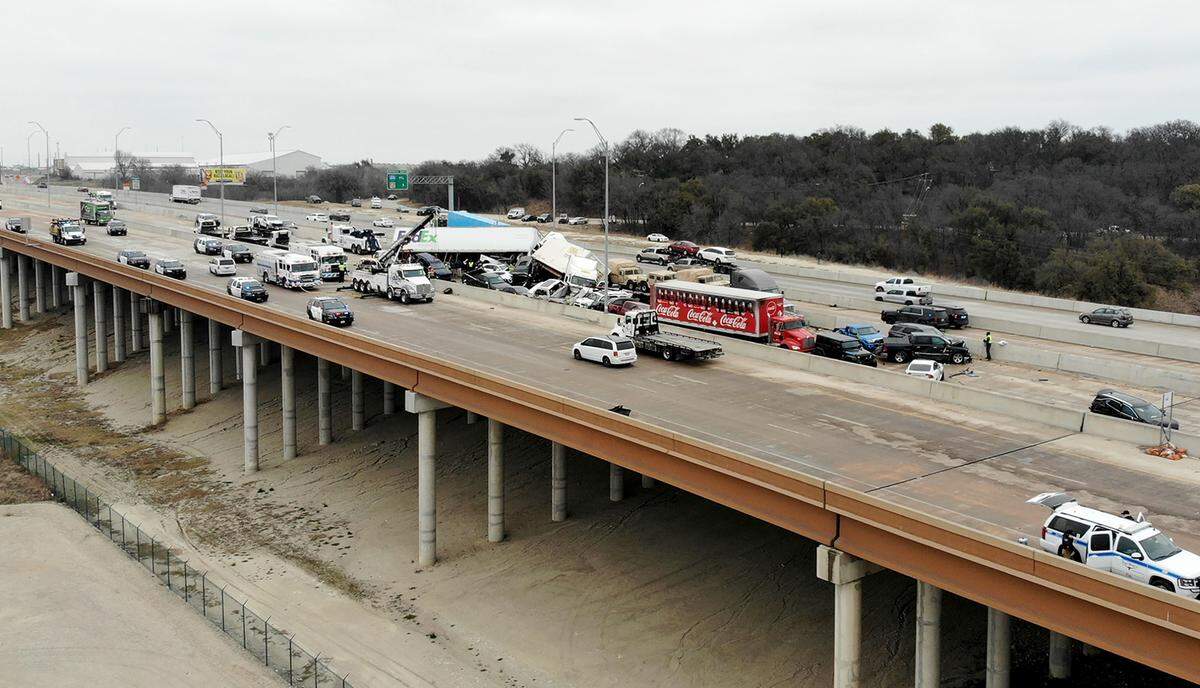
In February 2021, six people died and dozens were injured in a pileup of more than 130 vehicles on Interstate 35W north of downtown Fort Worth.
Expand All
A state lawmaker from Fort Worth is demanding that a concrete barrier be removed from the Interstate 35W toll lanes, a design that he blames for the deadly pileup a year ago.
“Any truck that jackknives completely shut that traffic down, and then it just became the trash compactor and people died because of the design,” said Rep. Ramon Romero Jr., a Democrat.
The National Transportation Safety Board issued a preliminary report about the Feb. 11, 2021, wreck in April, but the wait continues for the investigative board’s full findings. North Texas lawmakers have demanded answers and preventive measures, but the legislature has failed to act. North Tarrant Express Mobility Partners — the group of companies that built and manages the lanes — has remained largely silent.
“Texans deserve to know what went wrong here,” Texas Sen. Kelly Hancock, R-North Richland Hills, said in a statement. “Without those findings, it’s hard to know where improvements need to be made to prevent a massive pileup like this from happening ever again.”
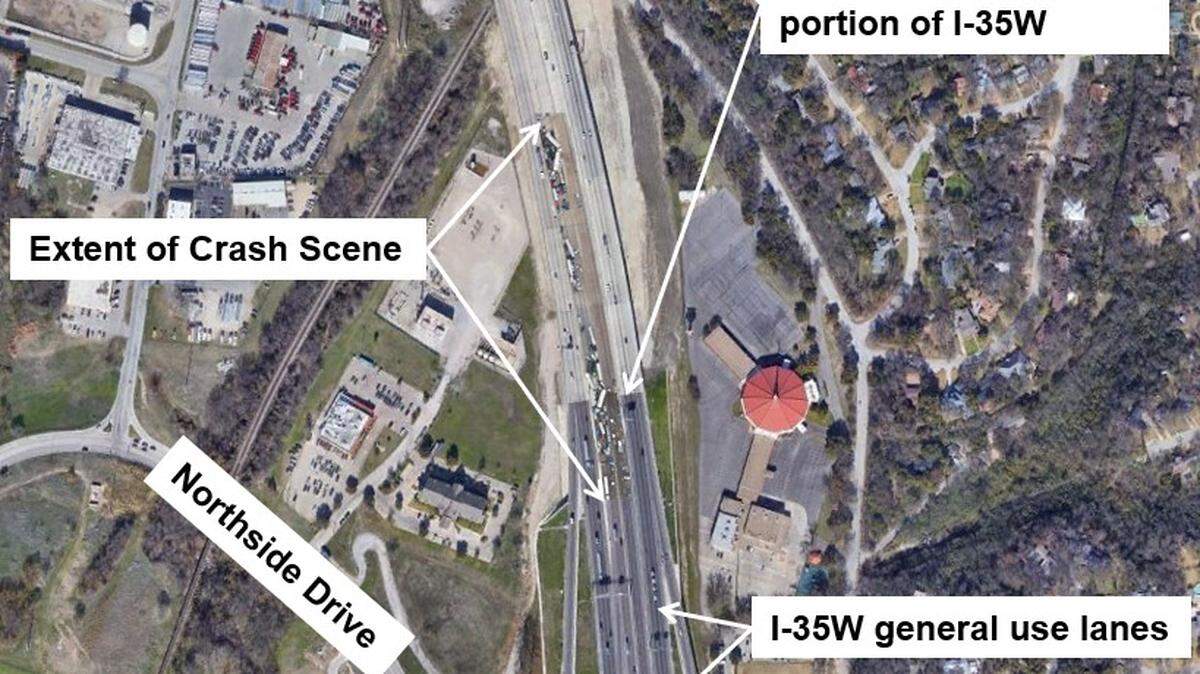
Six people were killed when more than 130 cars, pickups and tractor-trailers piled up on an icy stretch of elevated highway just after 6 a.m. near Northside Drive north of downtown Fort Worth. Concrete barriers separate the toll lanes, where the speed limit is 75 mph, and there are no shoulders.
The National Weather Service reported light freezing rain and mist at about 2 a.m. at Meacham Airport. A trace of precipitation was reported for the day.
Five miles out, prompted by a crash earlier that morning, a sign urged caution: “ICY CONDITIONS EXIST.”
The roads had been treated for ice with a brine solution two days earlier.
The board’s investigation is focused on how the road was treated, but it could expand into driving speed, road design and vehicle performance.
Romero will be satisfied only if the barrier on the right side of the road is removed and replaced with pylons that would allow drivers to exit.
“There’s nothing that you can do that will tell me this is not a dangerous condition,” he said.
Alternative to concrete barriers
Kara Kockelman, a transportation engineering professor at the University of Texas, recommended the use of bendable pylons to separate traffic.
“A nice, new innovation that we’re seeing in a lot of limited right-of-way sections like this elevated, expensive section of roadway is a bendable pylon so that vehicles can get in and out,” Kockelman said.
The pylons can also make sections of roads more accessible to emergency vehicles, she said.
Representatives from North Tarrant Express Mobility Partners did not accommodate an interview request because the investigation continues and litigation is pending.
“We can say this … we are currently operating pursuant to our winter maintenance program, and we review and revise our processes on an ongoing basis,” spokesperson Robert Hinkle said in a statement. “Safety is, and always has been, a top priority in our daily operations for the thousands of motorists that we serve every day.”
As the winter storm approached last week, managed lanes in Dallas-Fort Worth were closed in coordination with TxDOT.
Romero recently met with North Tarrant Express Mobility Partners, but said he received little information. He left the conversation wishing NTSB was done with its investigation. He is confident the company will take some action after the probe ends. He also concluded that the decision to close the lanes during the latest winter storm was influenced by last year’s collision.
Romero said Wednesday he was thankful the toll roads were closing.
“That’s the absolute minimum right now,” he said. “And that’s sort of a situational decision, right? A more long-term decision is going to be, ‘How do we address some changes to that design?’ Because we can’t have that kind of design on our system, whether it’s on a tolled lane or whether it’s a free lane.”
Is brine solution enough?
NTE Mobility Partners says it treated the lanes with an “Ice Slicer NM brine solution” at 10:12 a.m. Feb. 9, about 44 hours before the crash.
The product is made of sodium chloride and is an alternative to white salt. The solution was manufactured by Austin company Envirotx. A representative from the company has said “44 hours is well within the acceptable parameters of anti-icing application.”
NTE has stood by its treatment of the roads and its warnings for drivers.
The sign five miles out urging caution because of icy conditions was based on information from a crash just after 3 a.m. near I-35W and Western Center Boulevard, roughly five miles north of the pileup site, according to NTSB.
“In the meantime, NTE maintains that proper treatment procedures were followed, and I tell you what, that had better be the case,” said Hancock, the senator from North Richland Hills.
The weather dictates how often salt should be applied, said Thomas Teets, an associate professor of chemistry at the University of Houston. Rain can wash away salt and brine, he said.
“Brine is sort of just a thin layer that sits on top of the road, and so if we have a decent rainfall that’s going to wash that away pretty immediately in any well-drained road,” he said, adding that it’s harder to tell when brine needs to be reapplied. Salt, on the other hand, is easily visible.
Texas also lacks the equipment to prepare roads that some other states have.
“I think part of the difficulty in Texas is that, because we don’t have a lot of salt trucks here, we don’t get this type of weather a lot, they probably have to apply it early to make sure they have enough time to get it all on the roads,” Teets said.
Romero, the Fort Worth lawmaker whose district includes the crash site, questioned the effectiveness of the brine solution.
“What they say is, if you spray this down within 72 hours, it’ll prevent icy conditions from sticking,” he said. “So what does that sound like? That sounds like it’ll prevent snow from sticking to this roadway. But if rain falls on it, that then freezes; it doesn’t prevent that.”
He contended that if it rains, brine is supposed to be reapplied. Roads with elevation changes should have brine as well as sand and salt, Romero said.
“You had four hours to go to that place … spray it and sand it and they didn’t,” he said.
Is there a legislative fix?
Texas lawmakers, including Hancock, Romero and Sen. Beverly Powell, D-Burleson, were quick to call for an investigation after the wreck. They were about a month into the legislative session, so there was time to take a look at the deadly collision.
But just days later, the state experienced a power grid crisis during a historic winter storm, leaving millions without power for days. Addressing the storm took lawmakers’ attention in an already unprecedented session given the COVID-19 pandemic.
“That’s no excuse,” Romero said. “They heard plenty of other bills. There are plenty of other bills that actually made it to the floor that were probably nowhere near as urgent or life threatening as the conditions that we have here in Fort Worth.”
He and Powell filed bills in March requiring the Texas A&M Transportation Institute to investigate comprehensive development agreements like the one entered into for the toll road, but the legislation didn’t get a committee hearing in the House or Senate.
The bill said the study should analyze contract provisions related to maintenance and safety in the agreements and the maintenance and safety responsibilities of parties subject to the agreements.
“I’m going to say this as frankly to you as I can,” Powell said in an interview with the Star-Telegram. “If leadership doesn’t make it a priority, it won’t make it to committee hearing.”
Romero wanted to see an investigatory hearing like those held for the winter storm. He “begged” leadership of the House and Senate transportation committees, he said.
“Have an informational meeting. Bring these people in. Have these people on the mic before ... the transportation committee,” he said. “Ask about the design. Ask what the considerations were. Ask what was done. Make them prove it.”
Sen. Robert Nichols, R-Jacksonville, was not available for an interview. In response to written questions, he said the transportation committee plans to hold a hearing on transportation safety.
“We intend to cover a wide variety of safety issues which would include what happened during Winter Storm Uri,” he said in a statement.
Rep. Terry Canales, who chairs the House Transportation Committee, was not available for an interview. Romero said the chairman, an Edinburg Democrat, assembled two private meetings between lawmakers, NTE and TxDOT.
Asked what the state should be doing to prevent another crash like the one in Fort Worth, Gov. Greg Abbott promised TxDOT was working with other agencies and federal officials but didn’t offer specifics.
He maintained prevention strategies fall outside legislative responsibility.
“On the strategies, those are typically developed by the Texas Department of Transportation,” he said at a recent campaign stop. “What the Legislature does is to provide funding to that agency, and that agency has an abundance of funds right now.”
The state’s latest budget includes about $30 billion to TxDOT.
The House and Senate haven’t yet issued interim charges for what the Legislature will study between now and January 2023.
Powell and other senators were recently asked to share their priorities with Lt. Gov. Dan Patrick.
“We will be certain to include this again among those important priorities,” she said.
This story was originally published February 6, 2022 at 5:15 AM.