
Railroad tracks were a challenge as Fort Worth grew. Under, over, or straight across?
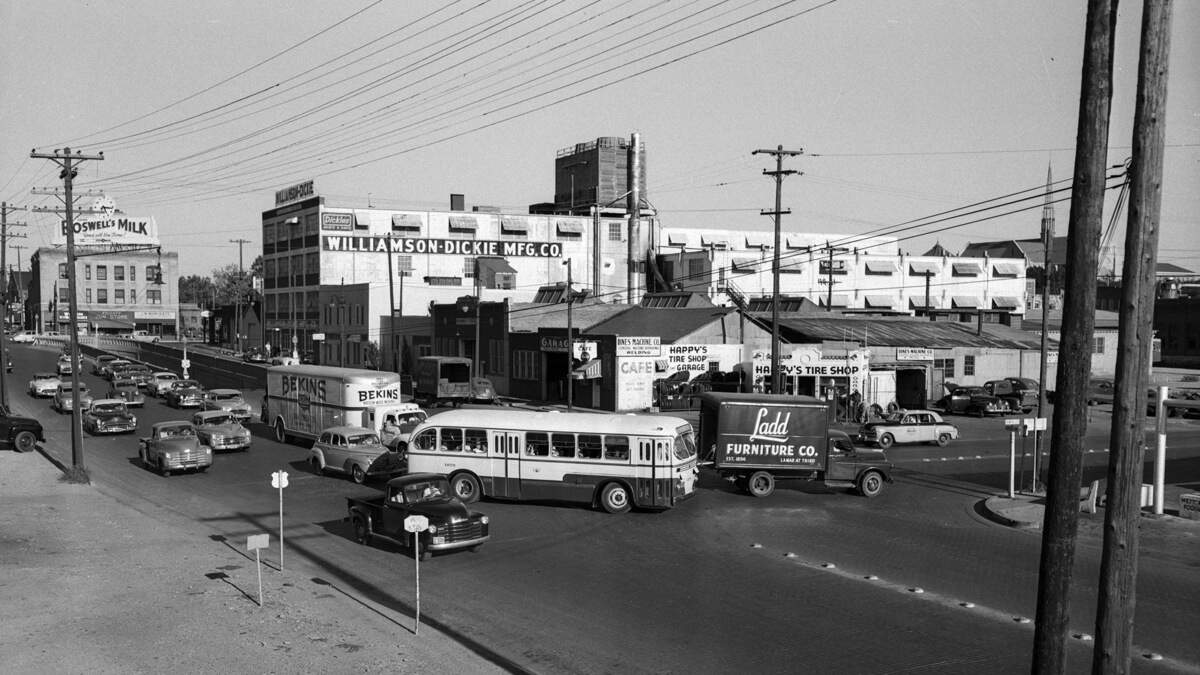
Common sense tells us all that mixing vehicular and railroad traffic can lead to disaster, as a train represents tons of metal speeding down the tracks. Even before automobiles, animals, people and wagons always got the short end of the stick.
Fort Worth’s first railroad, the Texas & Pacific Railway, arrived on July 19, 1876. When completed, the track ran east to west along the far southern edge of a sparsely built-up town. Growth mushroomed and, by the late 1870s, had “jumped the tracks” to Fort Worth’s south side. In 1889 the first and only safe crossing (with a watchman) was at Jennings Avenue. The Main Street crossing was partially blocked by the end of the T&P freight warehouse and eight sets of tracks.
As the south side boomed, the Main Street crossing was improved and a few more grade-level crossings opened. Hemphill Street, constructed in the 1880s, was then a small south side residential street. It dead-ended on the north at what is now Vickery Boulevard.
The first viaduct over the railroad tracks, completed in 1903, was at Jennings. It immediately had major structural problems because heat and smoke from locomotives idling in the shade under the bridge caused the metal supports to deteriorate. By 1916 – as there were more and more automobiles and trucks crossing the tracks – there was a move to replace “at grade” crossings in the city with bridges or underpasses. Generally, the idea went nowhere.
It wasn’t until 1929 that the City of Fort Worth and the Texas & Pacific Railway finally hammered out an agreement to replace all of the railroad crossings separating downtown and the south side with a series of viaducts and underpasses. The plan also included a new railroad station, the historic 1931 T&P station that still stands today.
The Henderson Street underpass was the first built. Completed in early 1931, it had an interesting unintended consequence, as the streetcar tracks were removed for construction and a “temporary” bus service instituted. The tracks were never replaced, even though there was a place for them in the plans, and that streetcar line disappeared.
Next came the Main Street underpass, followed by the demolition of the much maligned Jennings viaduct and its 1932-33 replacement with a multi-part underpass. At the time it was touted as Texas’ largest.
In the meantime, traffic on Hemphill increased dramatically, even though it was still a narrow residential street. Hemphill was widened during World War II to provide a better connection between the Quartermaster Depot, Carswell Air Force Base and the bomber plant on the west side – and that only compounded traffic problems.
Fast forward almost 80 years since Hemphill was widened and became a major traffic artery connecting downtown and the near south side – and the long anticipated underpass connecting Hemphill to Lamar and downtown opened on April 10, 2020. Given the focus on the coronavirus, few noticed, but a public dedication is planned post pandemic. It’s been a long time coming, but the blossoming south side is certainly glad that the newest underpass in a long series of downtown railroad crossing options is finally here.
Carol Roark is an archivist, historian, and author with a special interest in architectural and photographic history who has written several books on Fort Worth history.