
This Fort Worth landmark provided a key set for 1976 cult classic movie ‘Logan’s Run’
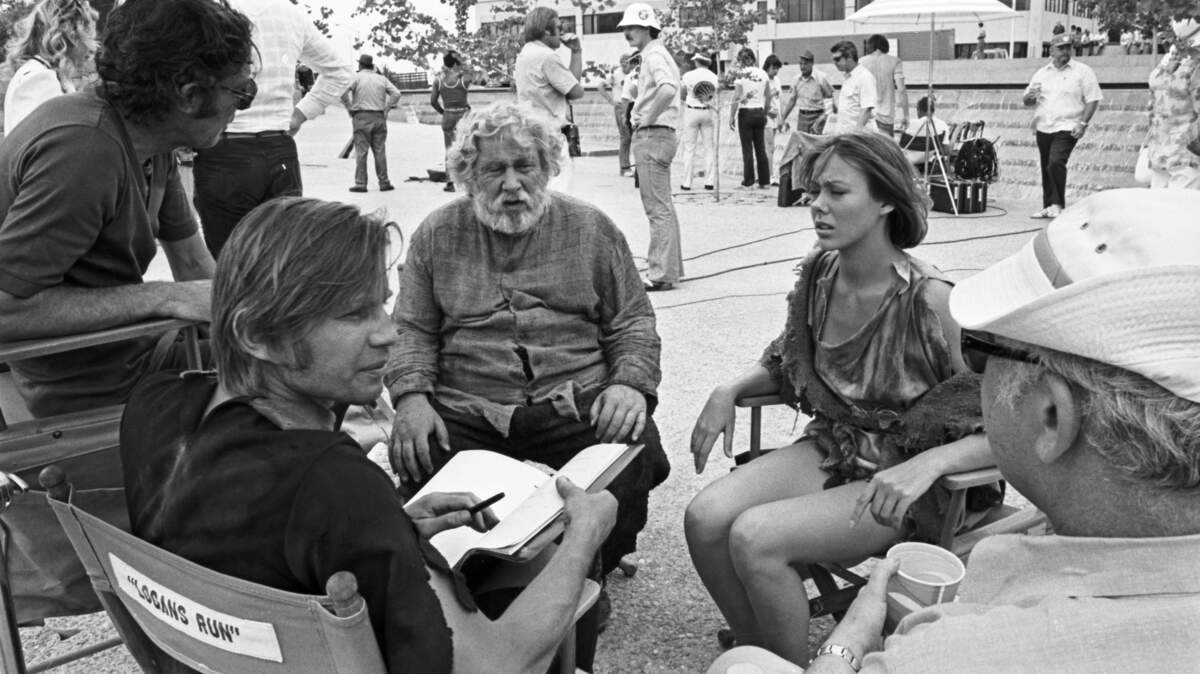
Producer Saul David said that finding the Fort Worth Water Garden as a set location for the 1976 sci-fi thriller “Logan’s Run” was like being handed the legendary Hanging Gardens of Babylon.
Ever the pragmatic financial watch dog, he noted, “Do you know what it would cost to build a set like this?”
Fort Worth was simply excited to have its newest landmark used for the dramatic ending to what is now a cult classic about the 23rd century world where life ends at age 30.
In the film, the Water Garden separates the unnamed “city” where those under 30 live a life of unrestricted pleasure from the rest of the world, which has been abandoned. Those who try to escape their demise at age 30 are called “runners.”
Michael York plays Logan, a policeman on the run. York and Jenny Agutter find Peter Ustinov’s aging character, the last living human in Washington, D. C, residing in the old United States Senate chamber with 150 cats (no, I am not making this up) and want to take him back to the “city” to prove that people can live past 30.
The Water Garden’s active pool served as the watery entrance to that city, and the actors had to jump in and swim down to “enter” the “city.” It was a perfect set – a series of platform steps lead dramatically to the swirling pool at the bottom, with the rushing water and a sense of drama and danger built in.
Only problem – Fort Worth’s skyline including the Southwestern Bell (now AT&T), convention center, and Continental Life buildings (now 714 Main), as well as the Sheraton Hotel (the old Hotel Texas – now the Hilton) didn’t look futuristic enough. The existing skyline was removed and a futuristic skyline “matted in” to the final frames of the film.
About 700 DFW residents found work as extras for $2.15 an hour. Beards, chest hair and bras were banned because the extras were playing, “beautiful people under the age of 30.”
In the final scenes of the film, York and Agutter enter the active pool to take news of Ustinov’s existence back to the “city.” Ustinov is not able to make the jump, so he waits in the abandoned world above. Logan is captured and interrogated but, fueled by his memories of the world above, manages to wreck the “city’s” controlling master computer. He and a number of other residents return to the old, natural world and reunite with Ustinov.
In 2004, the sense of danger at the active pool proved all too real when four members of a family drowned, necessitating redesign efforts that lowered the depth of the water and added safety barriers. Today, “Logan’s Run” is regarded as a cult classic appreciated for its special effects. Fort Worth’s Water Garden is chief among them – still a classic in its own right.
Carol Roark is an archivist, historian, and author with a special interest in architectural and photographic history who has written several books on Fort Worth history.