
We know it as the University of North Texas Health Science Center. Here’s how it began.
Physicians and other health professionals are in the headlines today as Covid-19 ravages the landscape of our lives.
We appreciate their knowledge and training, often without fully understanding the hard work they did to get it. The story of Fort Worth’s longest-lived medical school, now celebrating its 50th anniversary, is one that flies under the radar even if we recognize the densely packed University of North Texas Health Science Center campus while driving down Camp Bowie Boulevard.
Affectionately known as “T-COM,” (though the founders preferred T-C-O-M), the Texas College of Osteopathic Medicine came into existence because of the leadership of a few Texas osteopathic physicians who tired of seeing promising young students leave the state to pursue their medical education. Osteopathic medicine (D. O.s) is a relatively young field compared to allopathic medicine (M.D.s), and its practitioners built from the ideal that health, not disease, is the natural way of life – so the whole body should be treated. The first school of osteopathic medicine was only founded in 1892 in Kirksville, Missouri.
Osteopathic medicine has had a significant history in Fort Worth. The first osteopath, Dr. Thomas L. Ray, arrived in 1899. He was an 1898 graduate of the then-called American School of Osteopathy in Kirksville. A number of notable Fort Worth citizens, including Amon G. Carter and Sid Richardson, received their care from osteopathic physicians, and for many years the city also had the largest osteopathic hospital in Texas.
Efforts to found TCOM began in fits and starts during the early 1960s, but the school received its charter in 1966 as a private, nonprofit educational institution. C. Ray Stokes, a development officer, was the first employee hired on April 15, 1969. TCOM, however, regards its founding date as Oct. 1, 1970, when the first group of 20 students began classes.
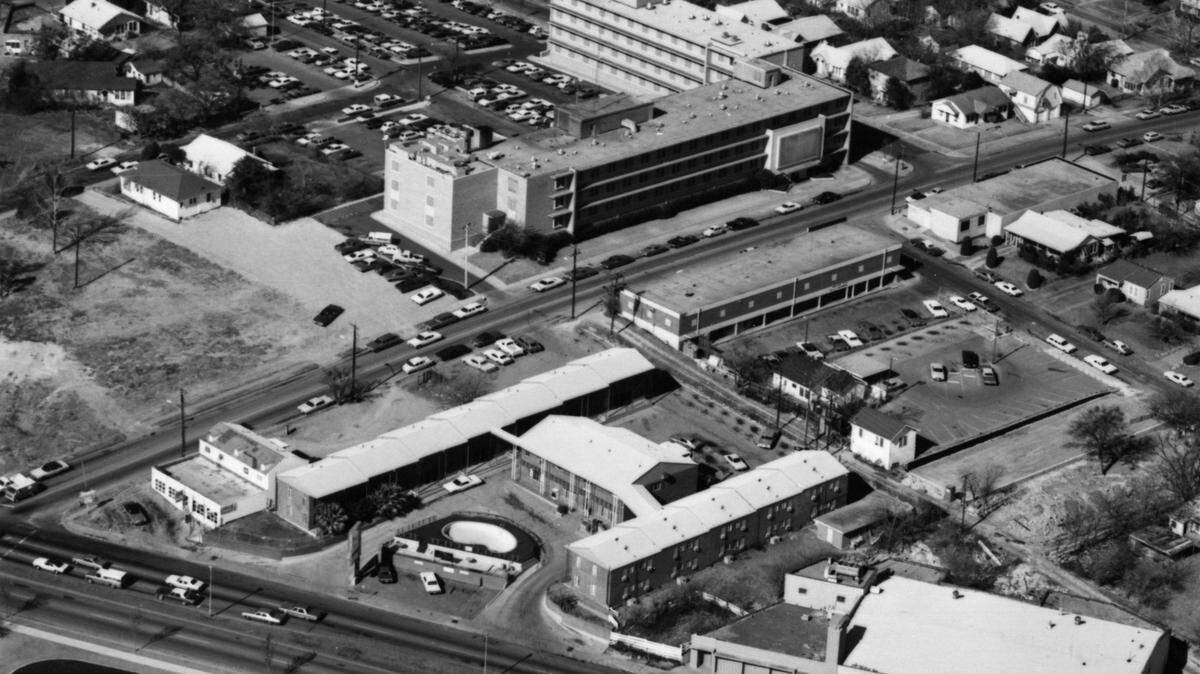
The standing joke about TCOM is that it was born in a bowling alley, but that isn’t quite true. It actually started in three different buildings – the fifth floor of what was then the Fort Worth Osteopathic Hospital and a small white house and its adjacent garage apartment across the street from the hospital.
A small basic science faculty aided by volunteer D. O.s and M. D.s taught the first classes. In addition to bowling allusions, students also demonstrated their sense of humor by dressing the anatomy skeleton with a white coat and cigar.
It wasn’t until 1971 that students, including a second entering class of 32, landed in the hastily transformed former Tavener Playdium, a 1948 bowling alley. Grants from the Amon Carter, Sid Richardson, and Mabee foundations underwrote facility improvement and additional teaching personnel.
Basic science classes moved to North Texas State University in Denton in 1973, the first test of a partnership between the two institutions. The first class graduated in 1974, paving the way for accreditation.
In 1975, TCOM joined North Texas as a separate institution operating under the auspices of the university’s president and board of regents, forming what is today the University of North Texas Health Science Center.
Osteopathic training has always produced a large number of primary care physicians, and TCOM is proud to have contributed thousands of graduates who are on the front lines caring for our health.
Carol Roark is an archivist, historian, and author with a special interest in architectural and photographic history who has written several books on Fort Worth history.