
Architect’s plan to ‘convert chaos to order’ in downtown Fort Worth was never fulfilled
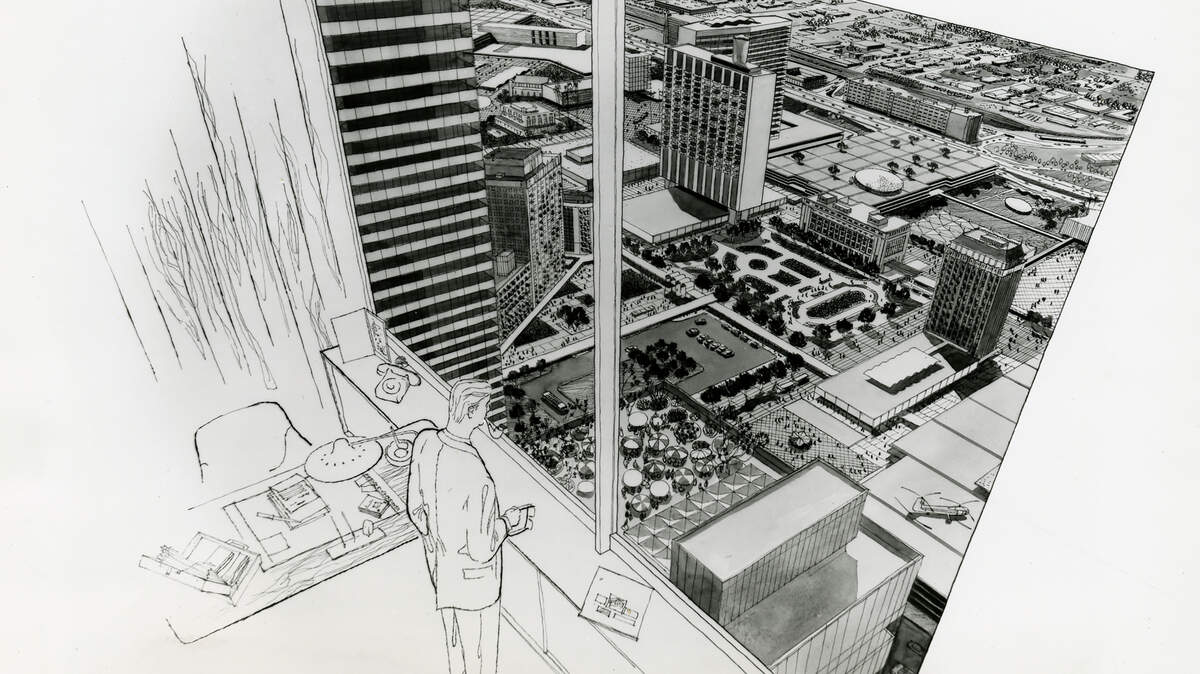
If Victor Gruen’s vision for “A Greater Fort Worth Tomorrow” had been implemented, this mid-century executive wouldn’t have parked in the garage below his office tower.
Gruen’s “imagination-stirring blueprint” for Fort Worth’s central business district called for a series of six mammoth parking garages just inside a highway ringing downtown. Our executive would have left his vehicle in one of those garages and walked a short distance to his office.
Victor Gruen (1903-1980), described as “short, stout, and unstoppable with a wild head of hair and eyebrows like unpruned hedge rows,” was a Vienna-born architect best known as a pioneer of the suburban shopping mall. He believed that the mission of architecture was to “convert chaos to order.”
That’s what Gruen did when he designed Southdale shopping center just outside Minneapolis, a heated and air conditioned enclosed space with broad pedestrian walkways, cafes, central garden court, and decorative works of art.
Downtown areas, Gruen believed, could be transformed in a similar way, giving people the things that should be part of the city’s center, “if it weren’t so noisy, dirty and chaotic.” Take out the cars he thought, and it would be much easier to restore order.
In 1955, Texas Electric Service Co. (now TU Electric) commissioned Victor Gruen Associates to draw a plan to revitalize Fort Worth’s central business district. His first step to protect downtown was a highway that enclosed the city’s center, drawing its inspiration from the rings of fortifications that had once surrounded Vienna. The highway and the parking garages that connected directly to it stopped the “enemy” – private automobiles.
People couldn’t be expected to walk everywhere downtown, particularly if they were carrying packages, so Gruen proposed a series of moving sidewalks along with electric shuttle vehicles that circulated in the pedestrian area. All service functions (delivering merchandise and supplies; taking away garbage) were handled via underground roads.
In the drawing that accompanies this column, used to publicize the plan when it was unveiled in 1956, our forward-thinking executive looks down on Gruen’s ordered central city. Several historic landmarks were retained, including the now-demolished Medical Arts Building, but new mid-century skyscrapers predominate.
Also gone are the streets, replaced by plazas and pedestrian walkways. Gruen believed that increased land values, parking fees, and the sale of some of the land previously used for streets would help underwrite the project. In the end, Fort Worth did not pursue Gruen’s plan, as fundraising efforts failed. Fort Worth citizens probably felt that it was easier to move to the suburbs than rework downtown.
Some of Gruen’s concepts were at least partially implemented here, including Sundance Square and its namesake pedestrian plaza, as well as the freeways on the south and east sides of downtown.
Other towns, often smaller ones, replaced one or more of their major business district streets with pedestrian walkways in an attempt to save their downtown. Fort Worth architect Mark Gunderson notes that the Gruen Plan’s “influence on thinking related to the automobile and the city in general has been profound, and it plays a role to this day in . . . conversations” about how cities should look and function.
Carol Roark is an archivist, historian, and author with a special interest in architectural and photographic history who has written several books on Fort Worth history.
This story was originally published February 15, 2020 at 7:00 AM.