
Monument honors a man who died saving lives in the Texas Spring Palace fire of 1890
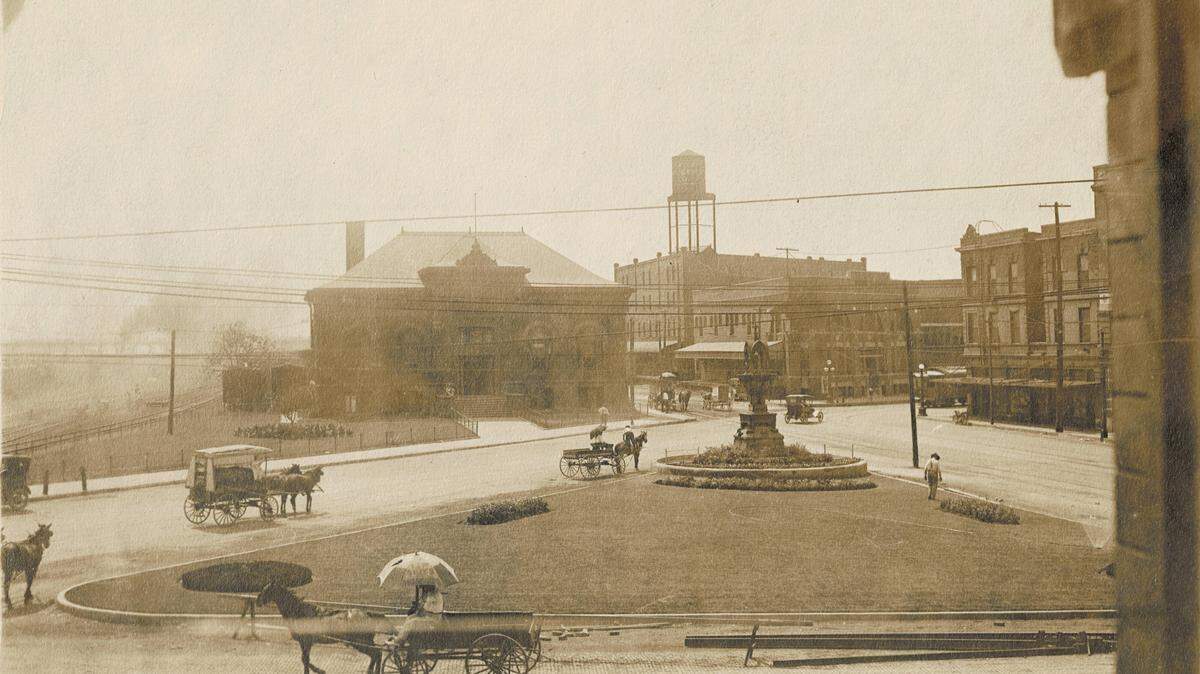
There isn’t much left that we’d recognize today, but those who frequent Lancaster Avenue along the southern edge of downtown can probably identify the Al Hayne Monument.
Built to remember the man who lost his life saving others during the 1890 Texas Spring Palace fire, the monument was erected in 1893 by the Woman’s Humane Association.
But what was intended to be a tranquil scene became a free-for-all, prompting the Fort Worth Star-Telegram to assert in an editorial in 1909 that visitors who stepped out of the Texas & Pacific station for some fresh air encountered, “a confused impression of Fort Worth” with “a riot” of traffic clogging the then-open space and called for a landscaped park to break it up.
Most of the buildings around the monument located there because they were either railroad-owned buildings or because they relied on the railroad for the success of their business. The photograph that accompanies this column was likely taken by an amateur photographer looking down from the second floor of the 1899 Texas & Pacific Railway passenger terminal.
Directly across the triangle was the T&P freight terminal, reconstructed from earlier plans following a disastrous 1908 fire. Offices were in the two-story brick portion of the building, while the metal-sided freight center (now supposedly fireproof) stretched for about 150 feet behind the office structure. The two trains on the left are parked on spur lines that served the freight depot.
The Terminal Hotel, owned and built in 1911 by Winfield Scott, is on the right side of the photograph. It hosted a never-ending parade of traveling salesmen and other passengers who wanted a room for the night close to the train station.
The other buildings along the north side of Front Street (now Lancaster Avenue) housed mercantile establishments. Lackey’s Pharmacy, located in the two-story building, used its dock along Front Street to receive railroad freight shipments.
Carter Grocery Co., a wholesale supply firm housed in the four-story structure, made even heavier use of its dock – both receiving shipments brought in by railroad and dispersing orders to local retail grocers.
It took the city a few years to get around to landscaping the triangle, in part because of discussion about how best to separate the rail lines from street traffic and the impact that might have on the entire intersection.
By May 1916, the Star-Telegram reported that the work to turn the parking spot for a scrum of wagons and vehicles into a pleasant city gateway was almost complete.
This photograph taken about that time shows the park just after the city put up curbing, laid sod, and planted flower beds. The monument was moved and reoriented a bit in 1934, and the shape of the triangle park was altered to accommodate changes in the street layout.
Today the city of Fort Worth refers to the tiny triangle as “Haynes Memorial Park,” but it still does its job of protecting the 126-year-old Al Hayne Monument and diverting traffic.
Carol Roark is an archivist, historian, and author with a special interest in architectural and photographic history who has written several books on Fort Worth history.