North Texas jury finds no hate crime in trial on anti-Israel graffiti at church
A Tarrant County jury has found a pro-Palestinian activist guilty of criminal mischief for anti-Israel graffiti spray-painted at a Euless church, but jurors rejected a hate-crime enhancement that would have carried a maximum 10-year prison sentence.
The jury began deliberations Thursday morning to decide whether the graffitiing of the nondenominational Christian church in Euless rose to the level of a hate crime. In their verdict after about three hours of deliberating, the jurors found the hate-crime enhancement false.
The defendant, Raunaq Alam, was accused of vandalizing Uncommon Church in Euless by spray-painting “(Expletive) Israel,” on an outside wall.
A second phase of Alam’s trial began Thursday afternoon and is continuing on Friday to determine his punishment, which now would be a maximum sentence of two years.
Alam was one of three people charged in the case. Defendant Julia Venzor plans to plead guilty and testified against Alam during his trial. Afsheen Khan’s trial is scheduled to start later this month.
Alam’s motivation and the cost to repair the damage are central to the case. All three defendants were initially charged with a misdemeanor, but their charges were bumped up to a felony after a repair estimate came in above the $750 threshold.
Prosecutors added a hate-crime enhancement to the charges, arguing that Alam and his co-defendants targeted Uncommon Church for flying an Israeli flag on its campus.

Defense attorneys argued that the case is about Alam’s First Amendment right to free speech.
“The question is what does the government do when they don’t like your opinions?” defense attorney Adwoa Asante asked the jury during her closing argument.
“They crush the people,” she said, pounding her desk for emphasis.
In a statement after the verdict, Tarrant County District Attorney Phil Sorrells said, “We respect the jury’s decision. The defendant was held accountable for vandalizing a place of worship, and that accountability matters.”
Asante argued Venzor was motivated to accept a plea agreement by fear of the prospect of being separated from her two young children during a prison sentence. Venzor intends to plead guilty to criminal mischief and true to the hate-crime enhancement and receive five years of deferred adjudication probation.
“She needed to save her babies,” Asante said.
Venzor testified to Alam’s involvement in the vandalism but said it was not motivated by hate.
Asante questioned the timing of the church’s cost estimate and noted that Brad Carignan, the church’s pastor, directed a maintenance employee to paint over the graffiti after learning about the vandalism.
The higher cost estimate came nearly a week before the felony indictment, which Asante said pointed to a manufactured offense by the state.
Alam is on trial because the government does not like what he believes, she said. The defendants have protested in support of Palestine and said they were criticizing the Israeli government.
Assistant District Attorney Lloyd Whelchel agreed with Asante that the case was about free speech; however, he framed his argument around the church’s free speech rights to support the state of Israel.
“The defendants will attack you for having a different opinion than them,” Whelchel said in his closing argument.
He accused the defense of trying to justify hatred of Israel and the Jewish religion as political speech.
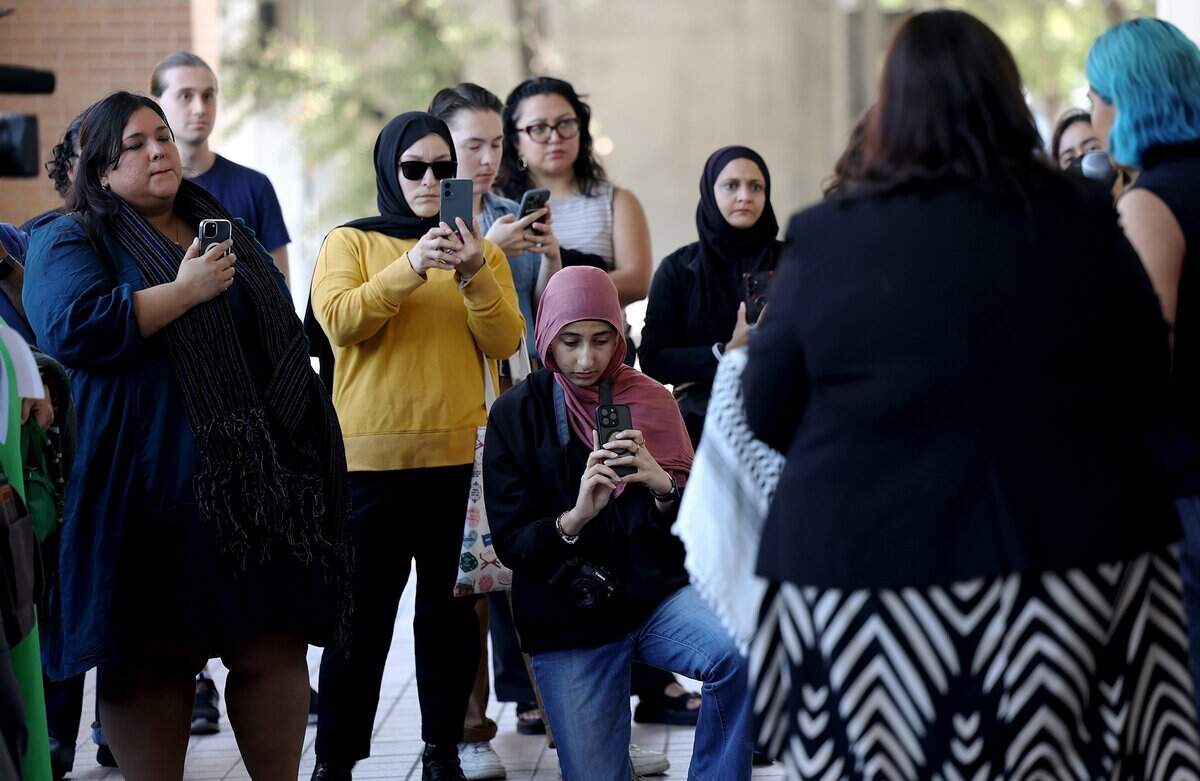
Alam attacked a church that isn’t materially involved in Israel’s war against Hamas in Gaza, Whelchel said.
“Lockheed is that way. Go over there,” he said.
Graffitiing the church over its support of the state of Israel is not civil disobedience, Whelchel said.
“This is terrorism,” he said, adding that justified hate is still hate.
Whelchel asked the jury to send a message that Alam’s actions are not acceptable in Tarrant County.
If the jury had found the hate-crime enhancement true, he could have faced up to 10 years in prison.
This story was originally published September 11, 2025 at 12:41 PM.
.jpg)