
Cotton was king in Grapevine. Now a statue pays tribute to the city’s farming roots.
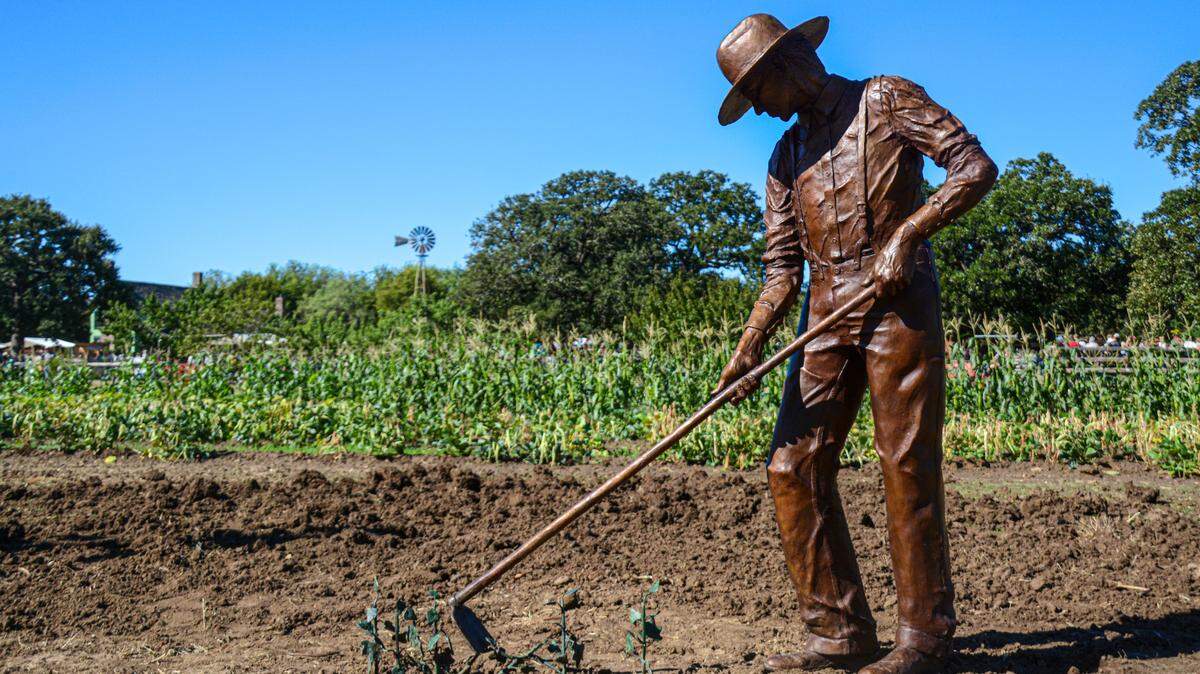
Once upon a time in Texas, cotton was king. The city of Grapevine pays homage to that time with its latest piece of art, a bronze statue titled “Choppin’ Cotton.”
The sculpture recently joined the city’s vast array of artwork. It is dedicated to the legacies of Joe Lucas Wright and Jess Michael Daniel, two of Grapevine notable citizens, said Grapevine Historical Society Director David Klempin.
The statue, sculpted by John Rule and soon to be surrounded by rows of cotton, depicts a farmer in his field, head down and focused on, well, choppin’ cotton. He’s thinning the weaker cotton growth with a hoe to ensure maximum crop production. The public artwork pays tribute to agrarian families who arduously farmed cotton on the Grape Vine Prairie to support themselves and their community.
Currently, there are little cotton plants at the base of the statue. More cotton will be planted in the spring and will grow up around the statue during the growing season.
Grapevine, founded in 1844, is the oldest settlement in Tarrant County and has a rich agrarian history.
“Choppin’ Cotton is a great addition to the community’s public art because it represents our agrarian culture and history on the Grape Vine Prairie, which provided a way of life for so many from 1844 well into the 20th century,” said Cody Jolliff, Manager of Heritage Museums & Education Programs.
Joliff also manages historic Nash Farm, which is where the statue is located. Nash Farm is a living history farm where Grapevine’s 19th century agrarian traditions are preserved. The farm includes the original 1869 farmhouse, historic barn and other structures. The farm raises heritage breed livestock, including Gulf Coast sheep, turkeys, chickens as well as heirloom field crops and produce.
The statue is also a reminder that area farmers succeeded only through hard physical labor, a subsistence lifestyle and dependence on trade. With the arrival of the railroad and the Cotton Belt Route in 1888, Grapevine’s agrarian community connected to the global trade market and the sale of cotton crops and other commodities expanded.
“Our community was founded by Scottish-Irish farmers, and for the majority of the years that followed, agriculture was the basis of our economy. It is our heritage. Growing cotton was considered the money crop,” said Grapevine Mayor William D. Tate. “The statue is a tribute to those men and women who built our community and have contributed so much to its growth and success and is a reminder to us all that farming is laborious and hard work.”