
What North Texas parents should know about the flesh-eating screwworm
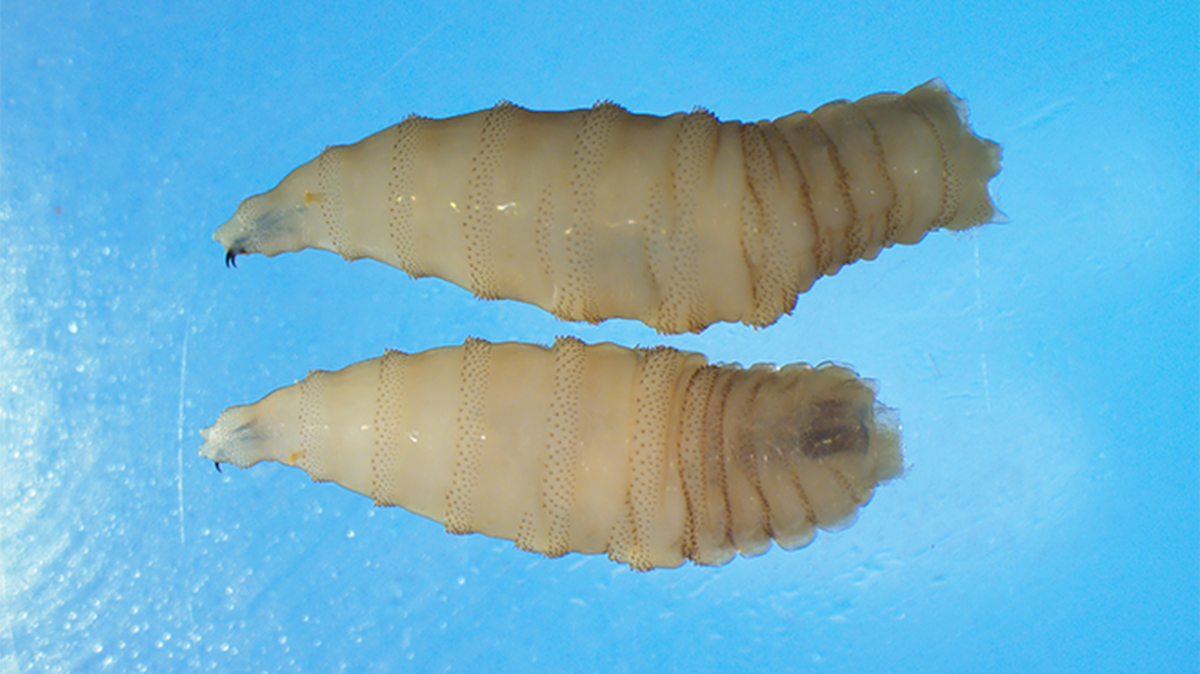
If you’ve seen the words “flesh-eating maggot” trending and started wondering whether you need to keep the kids out of the backyard, take a breath. The short answer from health officials is that the risk to people — and to your family pets here in Tarrant County — remains low. The longer answer involves a team of researchers right down the road in Arlington who are about to play a real role in keeping it that way.
Here’s what’s actually happening with the New World screwworm, what it means for North Texas families and why a project at UT Arlington could matter to the rest of the country.
What the screwworm is, in plain terms
The New World screwworm is a parasitic fly. When females lay eggs in an open wound or in a moist body cavity — the nose, ears, eyes or mouth — the larvae burrow into living tissue. It’s gruesome, and untreated infections can be fatal in animals.
“They will burrow or screw into healthy tissue and actually eat into the healthy tissue,” Dr. Varun Shetty, the chief state epidemiologist for the Department of State Health Services, said during a public health meeting. “That can cause a lot of pain and then a lot of secondary problems, secondary infections that can lead those animals to become very, very sick.”
The pest was declared eradicated from the U.S. in 1966 and stayed gone for decades. It remains endemic in South America, Cuba, Haiti and the Dominican Republic, and it has been moving north through Mexico.
How worried should Texas families actually be?
This is the part parents want first, so let’s get to it.
A case of New World screwworm was detected in La Pryor, in South Texas, and the U.S. Department of Agriculture’s dashboard has logged at least 12 animal cases in the country so far — most of them in Texas. That sounds alarming. But federal officials have been clear about what it doesn’t mean.
“There is no reason to believe that this incursion will result in any sort of establishment of the pest,” U.S. Secretary of Agriculture Brooke Rollins said at a press conference, according to the Star-Telegram.
Two specific reassurances for households:
On human risk: “The risk of human infestation remains low in the United States, and would only be localized in those areas where there are non-sterile flies,” said Dr. Paul Cantey of the U.S. Centers for Disease Control and Prevention. La Pryor sits hundreds of miles from Fort Worth, and human infestation is uncommon even in places where the fly is established.
On the food supply: officials emphasized at the same press conference that the New World screwworm poses no threat to the food supply system. The fly attacks live animals through open wounds — it isn’t something that ends up at the grocery store.
There’s another piece of good news baked into the biology. The screwworm fly is a lousy long-distance traveler.
“These flies do not fly to new areas on their own,” Rollins said. They hitch rides in infected livestock and animals, which is why officials keep asking ranchers, veterinarians and pet owners to report anything suspicious right away.
What about pets and backyard animals?
The flies are attracted to open wounds on warm-blooded animals. For families with dogs, cats, backyard chickens or horses, the practical takeaway is the one your vet probably already gives you: keep wounds clean, covered when possible and monitored. If your animal has a cut, scrape or surgical site that suddenly looks worse or seems to be drawing flies, get it checked.
The risk in North Texas right now is low. But people who spend time around livestock — including kids who visit relatives’ ranches, ride at lesson barns or wander the Stockyards on a weekend — should know what an infestation looks like and report anything unusual to a veterinarian.
How the U.S. is fighting back
The strategy is strange-sounding but well-tested: flood the zone with sterile males.
Under what’s called the sterile insect technique, the government breeds male screwworm flies that can’t reproduce, then releases them into the wild. When wild female flies mate with the sterile males, no offspring are produced, and the population collapses over time.
“Releasing sterile flies just outside of affected areas helps ensure flies traveling to new areas will only encounter sterile mates and will not be able to reproduce,” according to a USDA news release.
Right now, the government is releasing 2 million sterile flies twice a week. The flies have historically been bred at a facility in Panama, and the USDA announced a new sterile fly dispersal facility in Edinburg, Texas. Earlier this year, Mexico had 628 active animal cases out of 15,277 cumulative, plus 141 human cases.
The North Texas connection: UTA’s smart trap
This is where Arlington enters the story. The University of Texas at Arlington just received a USDA grant to help build a better way to monitor the pest, Gov. Greg Abbott announced.
UTA’s project was one of 40 funded by the USDA, which is distributing about $105 million in total. The Arlington team’s job is surveillance.
The plan is a “smart trap” with an AI camera that can tell the difference between a wild fly and a sterile one, and between males and females. That matters because females are the ones laying eggs and spreading larvae. Catching a wild female in your trap tells officials something is wrong; catching a sterile male tells them the program is working.
“Texas is no stranger to the New World screwworm threat and we are prepared to push this danger out of our state for good,” Abbott said in a statement, according to the Star-Telegram. “These grants will empower Texans on the front lines to eradicate the screwworm and protect our livestock industry.”
The project is being led out of UTA’s Smart Agriculture Research Center. Shouyi Wang, an associate professor at UTA, and Prasanna Gowda, the center’s associate director and a research professor, are co-leading the work. The center is co-directed by professors Jianzhong Su and Gautam Das. The smart trap builds on earlier research Wang did using AI to recognize fruit flies.
A prototype is expected by next spring.
The bottom line for North Texas parents
There’s no reason to change how your kids play, where you take them or what’s on the dinner table. Federal and state officials say the human risk is low, the food supply is safe and the screwworm doesn’t spread the way mosquitoes or ticks do.
Stay aware if you have pets or livestock, keep wounds clean and call your vet if something looks off. And the next time a scary screwworm headline lands in the family group chat, you can mention that some of the people working on the solution are right here in Arlington.