How officials are trying to keep this flesh-eating maggot from spreading to Texas
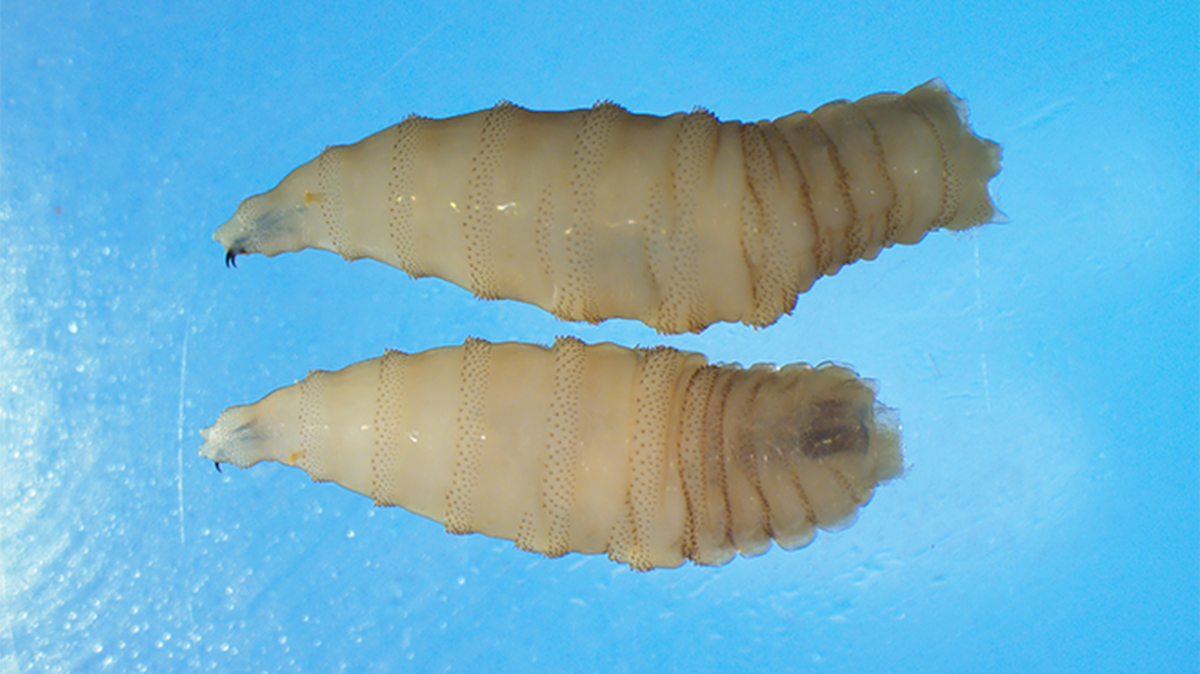
Texas is working to protect itself against New World screwworm, a flesh-eating parasite that officials are worried might travel from Mexico to Texas.
The parasite is not currently in the U.S., and the risk to the general public is low, officials said. But to keep it that way, Texas officials are taking steps to make sure the New World screwworm doesn’t travel into the state.
An infection by New World screwworm occurs when an infected fly burrows into the tissue or flesh of warm-blooded animals, and, in rare cases, people. Infected flies are attracted to, and lay eggs in, open wounds. The flies can also lay eggs in “body cavities with mucus membranes, such as the nose, ears, eyes, or mouth,” according to the U.S. Centers for Disease Control and Prevention. If left untreated, infections can be fatal.
“They will burrow or screw into healthy tissue and actually eat into the healthy tissue,” said Dr. Varun Shetty, the chief state epidemiologist for the Department of State Health Services, during a public health meeting Wednesday. “That can cause a lot of pain and then a lot of secondary problems, secondary infections that can lead those animals to become very, very sick.”
New World screwworm was eradicated from the U.S. in the 1960s, but remains endemic in South America, Cuba, Haiti and the Dominican Republic, Shetty said.
“It has now started to move up through Mexico, and we have been preparing for some time now for the possibility that it could be reintroduced into the United States,” Shetty said.
In Mexico there are currently 628 active animal cases of 15,277 cumulative cases, Shetty said. There have been a total of 141 human cases in Mexico as of Monday.
There has been one U.S. resident who was infected with New World screwworm after visiting El Salvador.
The U.S. government is using what is known as the “sterile insect technique” to prevent the spread of infected flies. Using this technique, the government is breeding sterile, non-infected, male flies at a facility in Panama. These flies are released into the environment, and when female flies mate with the sterile flies, it stops the life cycle of infected flies.
“Releasing sterile flies just outside of affected areas helps ensure flies traveling to new areas will only encounter sterile mates and will not be able to reproduce,” according to a news release from the U.S. Department of Agriculture.
“The goal is to limit the northward spread of the current outbreak,” Shetty said.
The U.S. Department of Agriculture announced a new sterile fly dispersal facility in Edinburg, Texas in February.