
Questions about red crape myrtles or bald cypress trees? Find the answers here
Over the years I’ve been asked some questions that were a bit more difficult to explain than others.
I pulled a few of those together for you in the hopes they might solve a puzzle or two that you’ve been encountering.
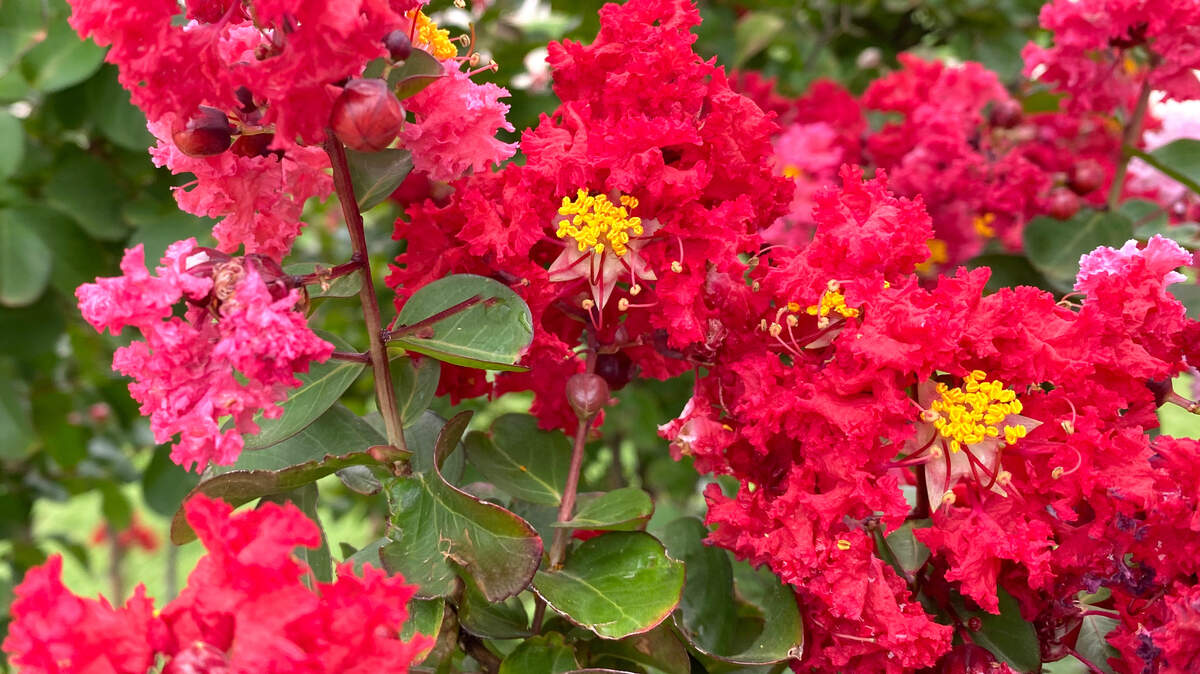
- Why are some of the petals of my red crape myrtles turning pink?
I asked this same question myself of one of America’s finest authorities on crape myrtles at the huge Texas Nursery and Landscape Association trade show in Houston years ago. Mark Byers of Byers Wholesale Nursery in Alabama showed me how the reds were turning pink there in the George Brown Convention Center by the third day of the trade show. He explained that it happens anytime a crape myrtle is shipped to an indoor event, sold from a nursery shade house or experiences several days of really cloudy weather in the landscape as its buds start to open. The colors shift to much paler shades. I’ve watched it ever since, and Mark was spot-on. It’s not a mutation, and it’s certainly nothing to worry about. (Unless you’re growing your crape myrtle in the shade!)
- What is wrong with the bald cypress trees at my workplace? Why aren’t they green? The ones down the street look terrific.
This is iron deficiency, and it’s a main reason why gardeners in the Blackland Prairie may want to think twice about planting bald cypress trees in the first place. Much of the Metroplex is underlaid with shallow, white caliche soils that are highly alkaline. Iron is almost completely insoluble under those conditions, and plants such as bald cypress, East Texas pines, dogwoods, water oaks, azaleas, fringeflowers and wisterias often show severe iron deficiency as a result. And the kicker is that it’s essentially impossible to add enough iron to correct this problem. And it’s totally impractical to try to acidify the soil by adding sulfur. While that’s conceivable with smaller shrubs and vines, it’s implausible with huge trees. In this situation, it’s time to cut the losses by replacing the trees. The trees down the street from your place of business either haven’t hit the white bedrock yet or the soil is much deeper there.
- What has eaten holes in the leaves of my plant? (In this case, a Brugmansia.)
This was done by some type of caterpillar or perhaps grasshoppers. I see no evidence of slime trails, so snails and slugs were not involved. In fact, the chewing damage doesn’t really look consistent with them. But the real clue with this photo is that the new growth is coming out unaffected. That means that the pest, whatever it was, has moved on. I would suggest just keeping an eye on the plant the balance of this season, and if the pest returns, address it immediately. Biological worm control Bacillus thuringiensis will work with caterpillars. Sevin would work on many other chewing pests.
- My tree has so many roots on the surface of the soil. I think they have choked out the grass, plus I think the soil may have eroded. Can I cover it with new soil to try to get grass to grow?
Slow down! Lack of sunlight is what caused the grass to die away. All of our lawngrasses in Texas need at least 6 hours of direct sunlight daily to survive. This area obviously receives less. And there has been no erosion here. The valve box is your clue. It’s still at the original grade. I would suggest planting a vining type of groundcover to conceal the roots and take the place of the turfgrass. Assuming water is available to the area, some of the best options would include purple wintercreeper euonymus, Asian jasmine and English ivy. You probably could even get mondograss to cover. It’s my all-time choice because it’s so easy to remove fallen leaves from it in autumn. You do not want to add soil across the surface of a tree’s root system. The new soil would risk suffocating the roots.
- What has chewed these almost perfect semi-circles in the leaves of my plants? How do I stop it?
This is the work of leaf cutter bees. The female insects use their mouthparts to cut these precise pieces of leaf tissues, then they built their nests from them in downspouts and unused faucets. I had these holes in leaves of my rose bushes years ago. One day, when I was watering, I turned on a faucet and a bunch of dried leaves blew out onto my shoes. I knew immediately what it all was. The good news is that they do no harm to you and they do no major harm to your plants. As a wise A&M entomologist once told me, you might as well just learn to brag about them. You can’t do anything to stop them.
- Is there any way to make a fruit-producing mulberry tree fruitless? Our neighbors have a fruitless type and it seems to be a handsome shade tree.
They are two different trees. Fruitless mulberries are a selection chosen because it does not bear messy fruit. They are propagated asexually (without seeds). There is no way to convert what you have into what your neighbors have. I wish I could help, but you have only two ways out: enjoy the tree including its fruit, or remove the tree.
You can hear Neil Sperry on KLIF 570AM on Saturday afternoons 1-3 pm and on WBAP 820AM Sunday mornings 8-10 am. Join him at www.neilsperry.com and follow him on Facebook.