
A touch of gold to cheer up the landscape at home
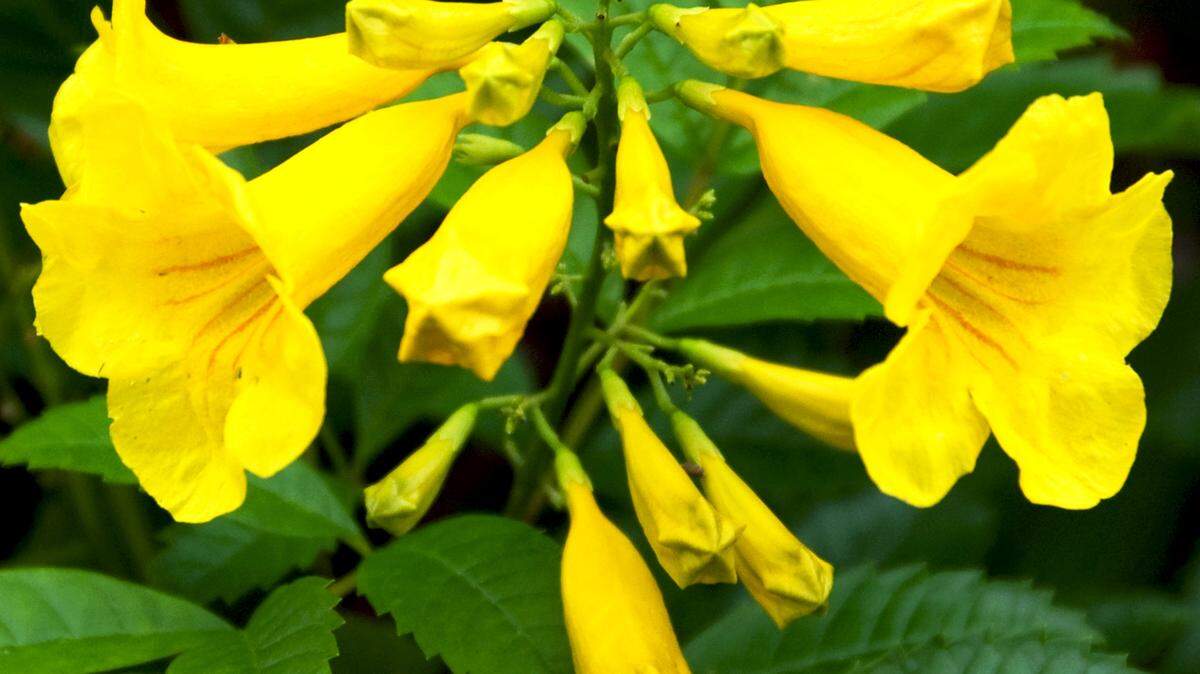
You probably won’t find me personally dressed in yellow. “Buttercup,” “primrose” and “sunshine” yellows don’t fit my style – yellows are just not a good look for me. But don’t be surprised if you find my gardens wearing those colors. It’s a great way to perk up your plantings at a time when a little “perk” is something we all could use.
Let’s look at some of the best sources.
- Brugmansia. This sub-tropical beauty is a strong grower with vivid flowers in shades of pink, white, yellow and purple. Most types produce single, trumpet-shaped blooms that hang downward. Since we’re showcasing the yellows, I thought I’d highlight one of the less common ones, a stunning double form. Some local independent nurseries handle them, but call ahead. You may have to order them from national sources online. Winter-hardy in South Texas, they’ll also come back some years in our area if you’ll mulch over their roots immediately after the first frost kills their tops to the ground.
- Variegated tapioca. No yellow-leafed plant you could find could offer any more summertime color. This thing is amazing, and it grows and grows to 5 or 6 feet tall and 3 or 4 feet wide, all in a single season. Oh, you can grow it in pots and try to save it through the winter, but it’s a lot easier just to replant it in late May or early June every year. Use it in the back of your floral garden, or behind other container plants, and position it alongside purple-leafed plants for the most dazzling displays. As examples, consider partnering it with one of the showy and sun-loving, red-leafed coleus plants, purpleheart, purple basil or purple fountaingrass. And, the tapioca’s colors will intensity as weather turns cooler in fall. Yum, yum!
- Gold Star Esperanza. Native to Southwest Texas, this is actually a selection chosen because of its early and steady blooming habit. The plant grows to 3 to 4 feet tall and wide in North Texas, and twice that in areas with warmer winters. It may come back after mild winters in North Texas, especially if it’s planted in a protected location. You can plant it directly into beds, or many of us prefer to use it in large patio pots. Its hue is clear yellow and refreshing, perhaps visually just a little more restful than some of the other plants mentioned here.
- Texas Gold columbine. This is a selection of Aquilegia chrysantha hinckleyana, a species found in remote canyons of arid West Texas where waterfalls and springs create pools of water around which cattails and ferns can colonize. Greg Grant did the pioneering work in developing the improved strain, and it may be the finest flowering perennial for shade that Texas has ever seen. It blooms in April and May, and then its blue-green foliage folds up tent and goes away for the balance of the season. It grows to be 18 or 20 inches tall when blooming, and although individual plants may only live a couple of years, they reseed freely. What a winner!
- Dahlberg daisy. This plant is like the ballplayer who retires after 22 seasons – one who was never an All Star, but always a dependable performer. The plants grow to be 10 or 12 inches tall and 12 to 15 inches wide. That means they’ll need to be at, or near the edge of the flower garden, and it also means you can use one or two around the outside of a large patio pot. Its foliage is very fine-textured, and it has an unusual (not unpleasant) fragrance. The wispy little yellow daisies are produced month-after-month.
- Lemon Coral sedum. What a great and appropriate name. This looks like some kind of growth out of tropical waters. The fact that it’s a sedum just adds to its chances to help in your gardens. After all, they’re some of our most heatproof succulent groundcovers. Use this one in small planting pockets among other perennials. Use it to line beds, or use it as a small-area groundcover. It’s also nice spilling out of large patio planters.
- Yellow hybrid purslane. You rarely see this plant sold in individual colors – usually it’s mixed in flats of assorted shades. Often, it’s sold as a patio pot or hanging basket that’s already planted with mixed colors. But, if it’s yellow you want, know that it is available, and it’s ultra-dependable. Yellow purslane grows to 5 or 6 inches tall, and it spreads to cover 15 to 20 inches of ground. It’s definitely a plant for the front edge of the floral border, and it’s equally at home spilling out of patio pots and baskets. It handles every ounce of sunlight you care to throw at it, and it quickly bounces back if you miss watering it for a day or two.
- Croton “Twist and Point.” I never met a croton that I’d turn down for my gardens, and this is one that I want, too. I found it in a botanic garden’s collection being trialed for use as a bedding plant. After all, that’s how many colorful crotons are now being used. I can’t stand to see them freeze in the fall, however, so I grow mine in pots and I take them into my greenhouse in winter. Because this one has so much white in its leaf color I would use it in a shaded location to prevent sunburning. It would provide a nice spot of foliar color clear up to first frost in the fall.
You can hear Neil Sperry on KLIF 570AM on Saturday afternoons 1-3 pm and on WBAP 820AM Sunday mornings 8-10 am. Join him at www.neilsperry.com and follow him on Facebook.