
Keep these questions in mind to make sure your tree grows strong
I’ve been staying home like I’ve been supposed to. That means I’ve been observing things in my landscape and garden that I might not otherwise have seen in all the furor of springtime.
And you can copy that a million times over for all the other local gardeners who have also been homebound these past six or seven weeks.
This has all stirred up lots of questions, many of them pertaining to shade trees. Let me address the most common among them. I’ll bet you’ll find a few familiar ones among them.
“What care do I need to give a new tree in my landscape in its first year?”
For starters, be certain that it’s completely plumb.
If its trunk isn’t exactly vertical, you need to get that taken care of as quickly as possible. I use a sharpshooter spade when the soil is very wet. I stick it into the ground on the side toward which the tree is leaning. I insert it as far as I can, and I gently lift the tree’s root ball toward me just a tiny bit while holding onto the trunk. That’s usually all I have to do to get a new, small tree put into an upright position, but then I stake and guy the tree to hold it there until it can form sturdy roots (usually a year or two).
I water the tree deeply. I also apply paper tree wrap to the trunks of many species, but more on that later, and I apply a liquid root stimulator at least once.
“What should I do if I see roots coming up to the surface of the soil near the trunks of my shade trees?”
That’s completely normal. Tree people will tell you that 90 percent of any tree’s roots will be found in the top foot of soil. As the tree gets larger, its roots grow up and out of the soil. That’s a good thing. It shows that the tree was planted at the correct depth. What you definitely do not want to see is a tree whose trunk goes straight into the ground like a pipe, with no root flare exposed. That’s a tree that’s going to run into problems on down the road.
“What kind of fertilizer should I give my shade trees, and how and when should I apply it?”
I fertilize my shade trees when I fertilize my turfgrass, and I use the very same plant food. After all, I want the same kind of reaction: leaf and stem growth. I use a high-quality, high-nitrogen fertilizer with upwards of half of that nitrogen in slow-release form.
The bag will probably give you instructions on how much to apply, but basically I just make an extra pass beneath my trees, especially out around the drip lines of the branches where the most active feeder roots are. I feed my lawn (and my trees, therefore) in early April, early June and early September.
“What is the gray growth on the trunk of my oak and pecan trees? Is it harmful? How can I eliminate it?”
Sometimes folks will refer to that as “moss.” They’re lichens, symbiotic growths of algae and funguses that nourish one another. They also exist on boulders in nature, which tells you that they’re deriving no nutrition or water from their support trees. You can basically ignore them.
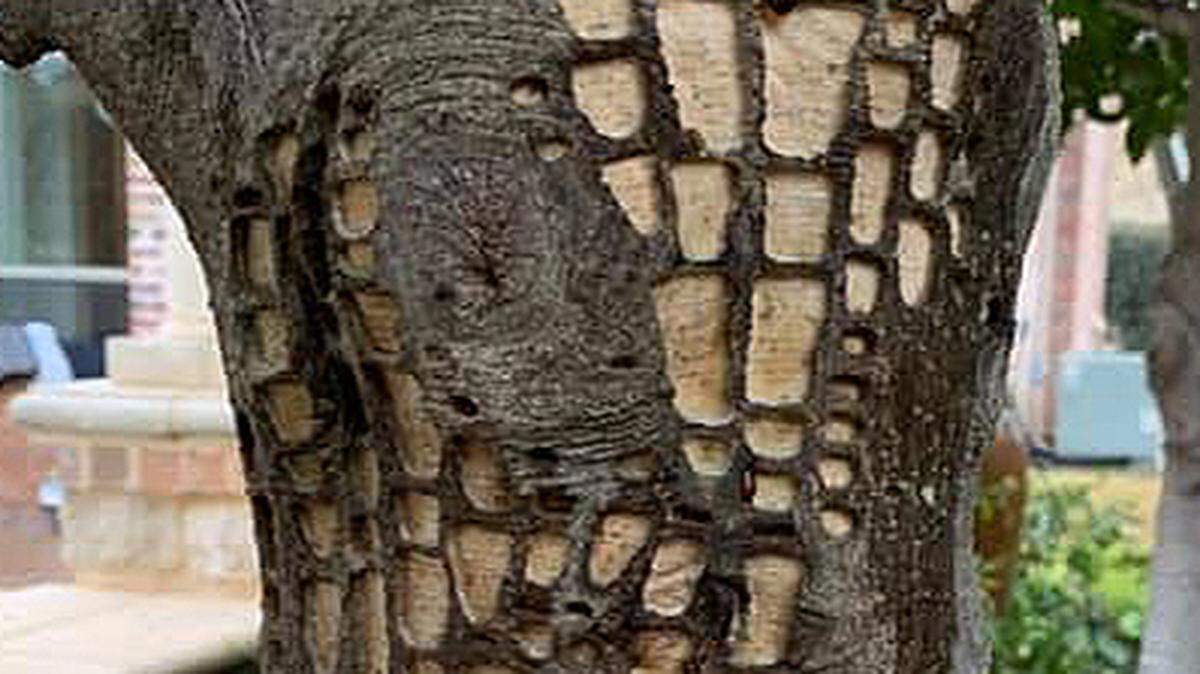
“What are the holes in the trunk of my trees? They appeared rather suddenly? They’re in rows around the trunk.”
Those are the work of woodpeckers and their relatives. They start at one level on the trunk and they work side-to-side pecking away. They do not cause any particular problem, nor do they indicate the presence of any type of insect.
They actually come back to feed on the sap that flows from the wounds. If the wounds are prevalent enough they can cause serious damage, but usually that’s not going to be the case.
In those rare times that a problem does develop, you can use a product called Tree Tanglefoot. It’s a gooey substance that birds find very unappealing. They dislike having it on their feet, so they find other trunks to bother.
“I have caterpillars on my tree. They don’t seem to be doing any damage. What type is out there right now, and do I need to spray for them?”
We’ve had two types in the past couple of weeks. Spring cankerworms hang by single threads from elms and other species. They can be present in large numbers and they can devour all the leaves from trees in a wooded area or neighborhood very quickly. But the trees bounce back rapidly and control is difficult if they’re widespread. It’s usually best just to let them run their course.
The other caterpillars I’ve seen are early forest tent caterpillars. We normally don’t notice them until they’re in their final phases, at which point they gather together in solid masses on the trunks of our trees. At that point they are very noticeable, but they’re also through with their feeding.
“My new maple tree has big splits in its bark. It looks like parts of the top are also dying. Why would that happen and what can I do to save it?”
This is sunscald. It will always be on the south or southwest side of the trunk. The tree was grown pot-to-pot in its original nursery, but when it was planted into its landscape it was suddenly exposed to full, brutal sunlight. Unfortunately, it didn’t have enough bark to protect it yet, and big cracks developed vertically in its bark. This happens to red oaks, chinquapin oaks and other types of oaks, also Chinese pistachios. All of these trees as well as new maples should be protected with paper tree wrap for their first two years in our landscapes.
You can hear Neil Sperry on KLIF 570AM on Saturday afternoons 1-3 pm and on WBAP 820AM Sunday mornings 8-10 am. Join him at www.neilsperry.com and follow him on Facebook.