
Make room in your North Texas garden for this group of flowering tropicals
In my professional lifetime I’ve watched this group of flowering tropicals go from being total unknowns to horticultural heroes. I can’t walk past the mandevillas in a garden center without reaching for my camera. On my list of our most graceful and beautiful warm-weather flowers, they’re right at the top.
Where did it all start? North Carolina State University tells us there are more than 180 identified species of the genus Mandevilla. They’re native from the Desert Southwest of the United States through Mexico and Central America to South America. However, Brazil gets credit for the largest number of those species, and the genus itself is named after British diplomat to Argentina, Henry John Mandeville (1773-1861), himself an avid gardener.
In his exhaustive three-volume set, Standard Cyclopedia of Horticulture, Liberty Hyde Bailey included only one paragraph about mandevillas in the third edition in 1935 (my dad’s copy given to me). He barely acknowledged that the plant existed. He mentioned there were a few other species but gave them no identities or space.
Jump ahead 60 years and the pink vining form was hitting the market. That’s where I first saw mandevillas — sold affixed to small stakes in nursery pots. But they soon outgrew those stakes and left us looking hastily for supports tall enough to do them justice.
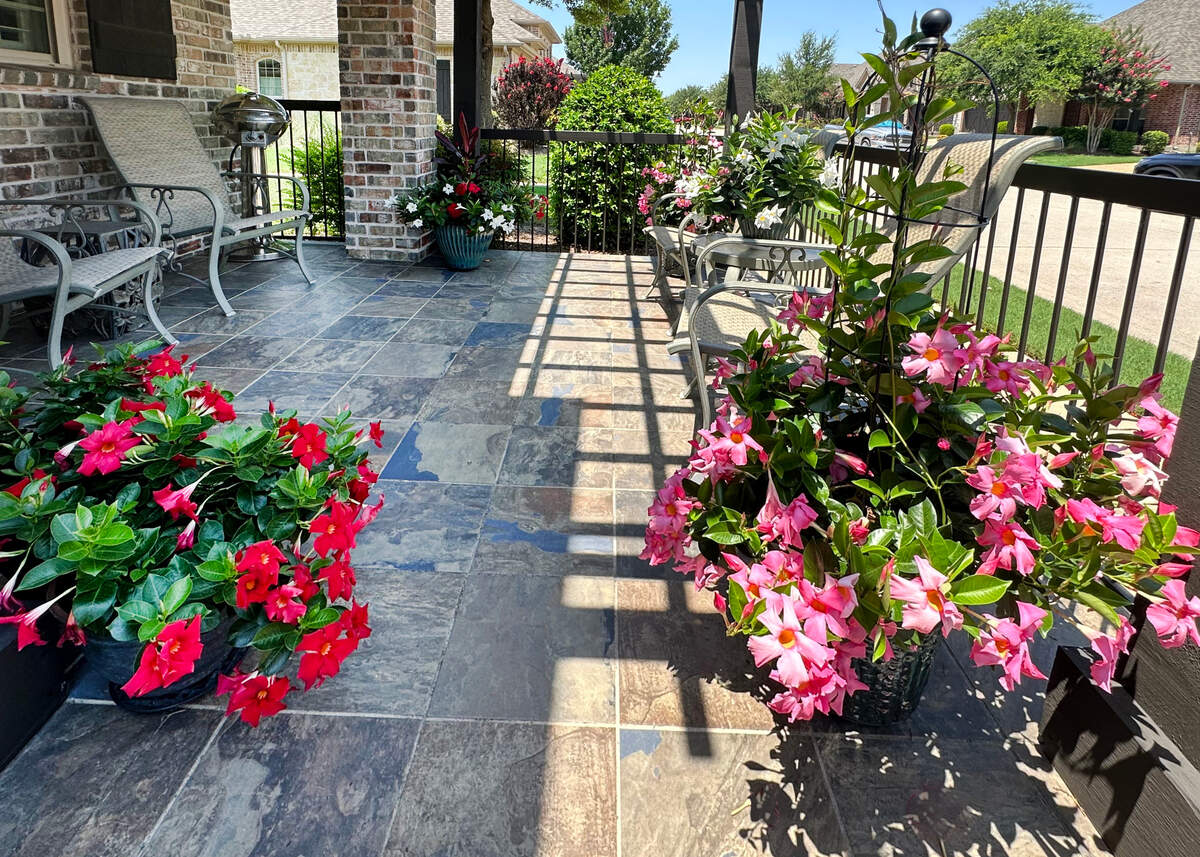
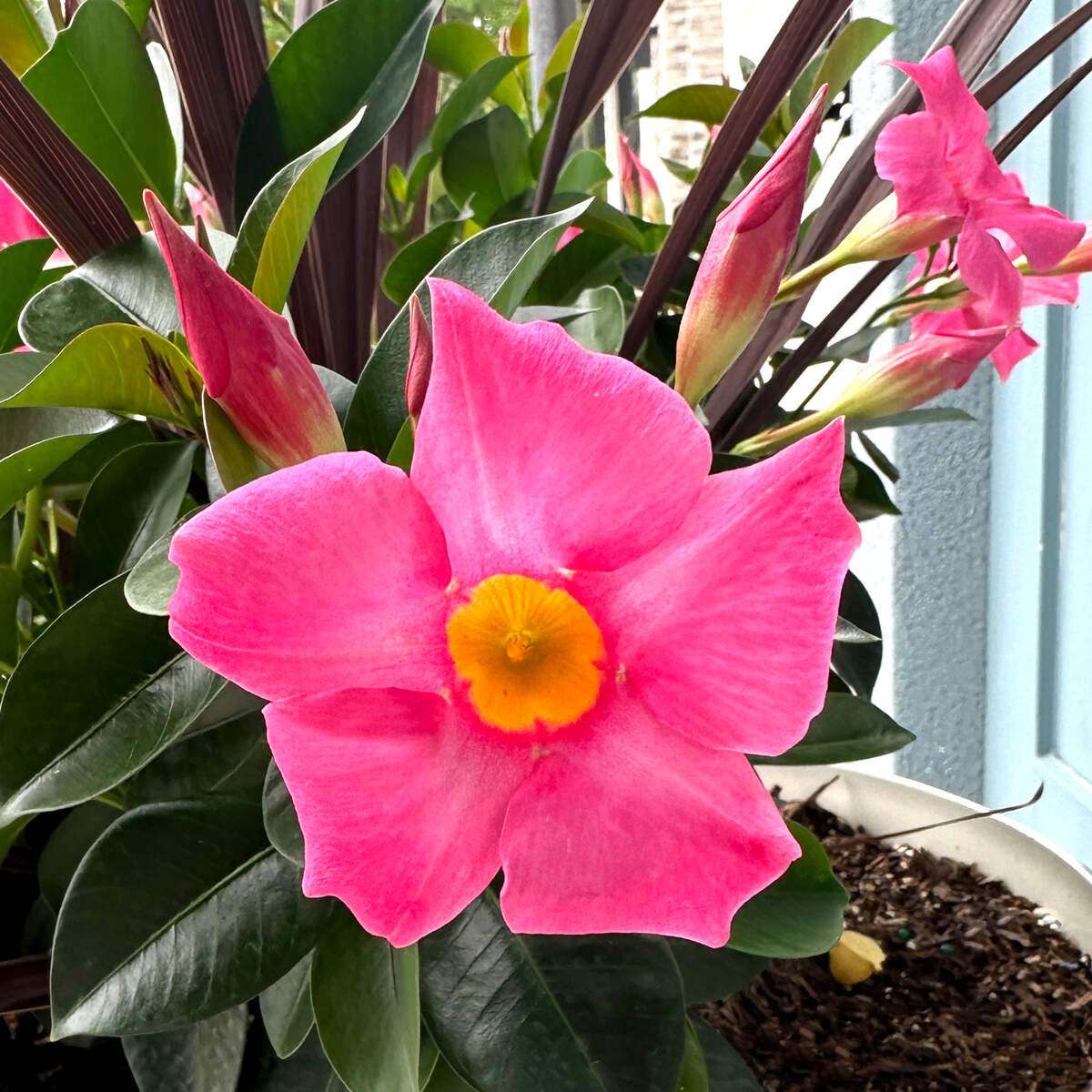
It wasn’t too long until another group of plants labeled as “Dipladenias” came into the market. They looked like mandevillas, but they were much more compact. Their leaves were smaller and a little more twisted. They had more of a gloss, and the flowers came in a wider assortment of colors. It looked like this group of flowers was on its way to something spectacular.
That was about 40 years ago, and it’s full speed ahead at this time. New varieties are being introduced every year, and all of them are hybrids of one sort or another, many involving more than one species. Oh, and along the way, botanists absorbed the genus Dipladenia into Mandevilla, so they’re all sisters and brothers now — not just distant cousins.
I was curious where the breeding work was being done so I went back to the Internet. As with most floral hybridization, it involves scientists in the United States, the Netherlands, Japan, and Australia. The most amazing introductions have come from Suntory Flowers of Japan and the U.S. They’re a gigantic mega-corporation involved in everything from food and beverage to health products, and, of course, all types of flowers. Suntory is comprised of 321 companies worldwide and more than 38,000 employees, including some of the most brilliant plant geneticists in the world. Take a look at their website to see what I mean, and look specifically at their 24 different Sun Parasol mandevillas.
What you need to know about mandevillas
Mandevillas are tropical plants. You’ll find them listed as hardy to Zone 10, meaning you can’t expect them to survive freezing temperatures.
They grow either as twining vines or short, bushy shrubs. The vining types will need supports 3 to 6 ft. tall, preferably tripod-shaped to provide extra stability for their large dense foliage. They can also be trained to twine up posts and poles, for example, the supports of a patio cover.
The shrubby types should be grown in 5- to 7-gallon pots filled with a loose, highly organic potting mix. They can be combined with an upright “thriller” plant such as ‘Red Star’ Cordyline or other tall, spike-form plants. They will require very little training as they have been bred to stay compact and mannerly.
Mandevillas do best with early-day sunlight, then bright shade from late morning on. Keep them moist at all times – never soggy but never dry to the point of wilting. Fertilize them at the time that you plant them with a timed-release, high-nitrogen plant food. It’s a good idea to supplement that every week or two with a complete-and-balanced, water-soluble fertilizer as you water your plants.
You’re unlikely to encounter pest problems with mandevillas when you grow them in the landscape during the spring, summer, and fall. It’s when you bring them indoors or into a greenhouse to protect them from freezing weather that you’re likely to run into whiteflies or mealy bugs. Otherwise, they’re about as problem-free as any plant possibly can be.
So, there you have it. I’ve shared the torch of enthusiasm of these gorgeous stars of summertime color. It’s up to you now.