
How’s your North Texas lawn looking? These tips will guide you to better grass
How’s that turfgrass looking by now? Green and gorgeous? Or weed-packed and pathetic?
Let me answer some questions that might help guide you to a better lawn quickly.
‘What’s the best fertilizer to get my lawn off to a good start? When should I apply it?’
Let’s count on soil tests run by reliable labs like to one down at Texas A&M in College Station. They consistently tell us that our Blackland Prairie clay soils have accumulated excessive amounts of phosphorus, middle number of the 3-number analysis you’ll find on any product sold as a plant food in Texas. The lab’s recommendation, then, for all crops (not just lawns, but landscapes, flowers, and vegetables) is almost always that we use an all-nitrogen fertilizer. Further, they tell us to use one that contains 30% to 40% of that nitrogen in encapsulated or coated slow-release form. Brand actually becomes secondary.
As for timing, you’re there now. Soils and air temperatures have warmed, and your grass is starting to grow rapidly. Follow the label’s directions as to amounts to apply. Put out half going east and west, then apply the other half going north and south. That will ensure even distribution. Follow the application up with a deep watering.
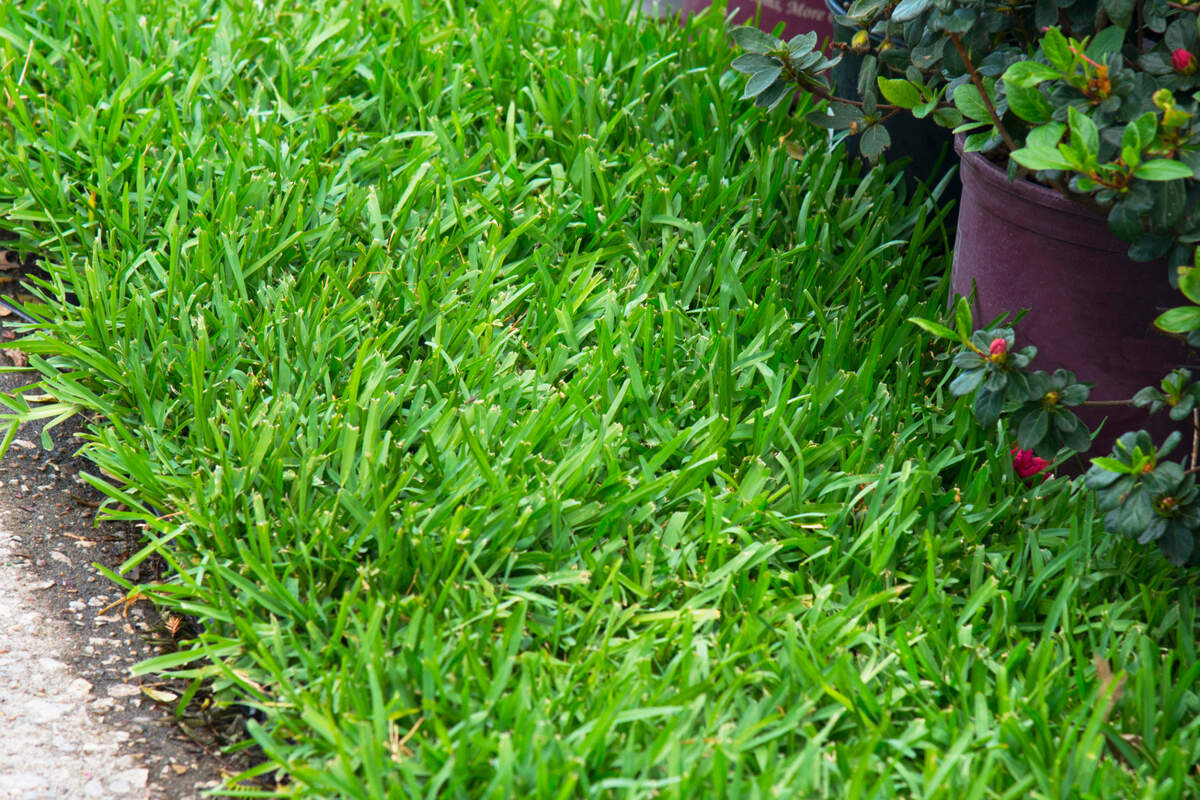
‘Why is my St. Augustine yellowed in some areas? Is that a disease?’
It may be take all root rot (TARR), a fungal disease that attacks turfgrass roots, notably St. Augustine and zoysia. It’s a comparative newcomer that’s only become common in the past 30 years. Infected grass fails to green up properly in the spring. You’ll see “washes” of yellowed turf intermingled with normal grass. When you examine the weak grass, you’ll notice that its roots are short, blackened, and stubbly. It resembles damage done by white grub worms, except you won’t find a significant number of grubs present when you dig.
TARR is most common in areas that are poorly drained, heavily shaded, and otherwise weakened. It is most prominent in cool weather of late March, April, and early May. Based on university research, we originally recommended spreading of a 1-inch layer of brown sphagnum peat moss to form an acidic layer on the top of the soil. That was known to slow the incidence of the disease, but we also found that it would recur a year or two later. Subsequent research found that the fungicide Azoxystrobin gave good results in killing the fungus, not just suppressing it. That is the current recommendation, not only for TARR, but also for gray leaf spot in the summer and brown patch in the fall.
‘Should I aerate my lawn? When?’
Aeration is seldom needed. The only time you might need to do so would be if you identified a layer of thatch between the runners and the soil, and if that thatch were preventing good flow of water and nutrients into the ground.
However, to explain the term, “aeration” refers to pulling plugs out of that layer of undecomposed organic matter (thatch) and scattering them across the surface of the soil. That allows water and air to penetrate the thatch and begin the important process of decay.
The prime times aeration would be required would be if you have allowed grass clippings to accumulate on your lawn without mulching or when you have extraordinary pedestrian traffic across the ground. Many of us have lived entire lifetimes and never felt the need to aerate our lawns. If we ever did, however, it is best done in the spring while the grass is growing most actively.
‘When can I plant new grass?’
Late April, May, and early June are your best times here in North Texas. Soils are warm, but it’s usually not beastly hot yet. The grass has a chance to get started under ideal conditions. The only exception would be to wait until May to sow bermuda from seed. For now, let’s address mainly sod and plugs.
Before you plant sod, you’ll want to rototill the ground 2 or 3 inches deep with a rear-tine tiller (tines behind the wheels). That type pulverizes the soil finely and makes it much easier to use a garden rake turned upside-down to establish a smooth grade that drains properly away from the house.
Buy your sod from a reputable vendor, preferably from a Texas-grown source. Insist that it be free of nutsedge (“nutgrass”). It’s easy to spot the dark brown, pea-sized “nuts” if you inspect the bottoms of the pieces of sod if the grass is contaminated. Refuse the delivery if you see nutsedge.
Lay the pieces of sod together tightly. Try not to leave footprints in the freshly tilled soil. Water the new grass as soon as it’s been planted and daily for the first week. Its roots will be shallow initially, so you won’t have to run the sprinklers for more than 10 or 12 minutes per area per day.
After a couple of weeks, you can gradually let the grass go longer between waterings. Mow it at 2-1/2 or 3 inches and start mowing as soon as it exceeds that range. Letting new turf grow tall weakens it.
As for plugs, they’re a great way of changing from bermuda to St. Augustine. The latter is the dominant grass, and if you plant pieces of St. Augustine checkerboard-style on 15-inch centers it will grow to cover (assuming full sun) within the first season. Garden centers have plugs available in nursery flats now.
This story was originally published April 18, 2025 at 5:50 AM.