
Groundcovers offer options for areas where it’s almost impossible to grow lawngrass
When I tell you that I was there when groundcovers made their entrance into Texas landscaping, I realize that comes with the risk of outing myself as an old guy.
But it also means that I’ve gotten to see some wonderful innovations in garden design. I wouldn’t trade for those experiences.
My interest in horticulture started just as houses were turning from pier-and-beam to solid slab foundations. Lots were getting smaller, and shrubs we were using in landscaping were shrinking proportionately.
People were getting away from tall (5-6 ft.) “foundation” plantings used to hide the unsightly skirting put in place to enclose the open undersides of our houses. Instead, we were using shorter (2-4 ft.) shrubs because all that was visible was 12 or 15 inches of concrete slab. Astute designers were using curved beds and visually interesting groupings of shrubs for a more natural look.
In the process of all that, garden planners wanted transitional plants that could be used to stairstep down from those low shrubs to the level of the lawngrass. We needed plants in the 5- to 15-inch height range. And that’s where groundcovers started to enter the picture.
Why we use groundcovers
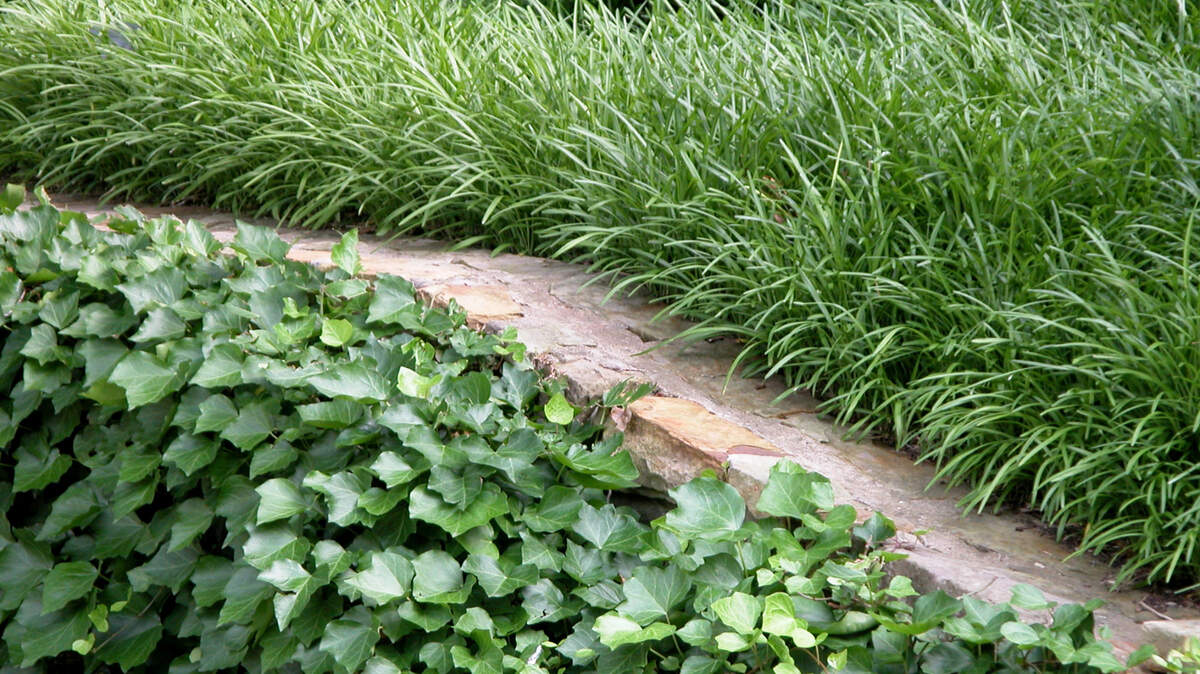
We use groundcovers when it’s impossible to get grass to grow because of excessive shading. Some groundcovers exist without any direct sunlight. So, when the shade trees do what trees are supposed to do and grow large and wide, we switch over from St. Augustine (our most shade-tolerant turfgrass) to mondograss, liriope or English ivy. For smaller areas in total shade we might consider ajuga or dwarf mondograss.
Then there are areas where it would be difficult, if not impossible, to maintain lawngrasses properly. Steep slopes come to mind, but so do long, narrow areas in alleyways and along drives beside houses. Groundcovers can come to the rescue in places like that. Again, mondograss is great at stopping erosion on slopes. Plant the mondograss clumps through landscape netting to reduce the chances of erosion even more. Or use a densely vining groundcover such as purple wintercreeper euonymus.
And finally, there are times when we don’t want more turfgrass. We’re seeking a low-growing alternative, but we don’t want more lawn. That’s the transition I was mentioning – the intermediary between low shrubs and lawn.
It’s here that I always warn people that they mustn’t expect groundcovers to be less work than lawngrasses. The most easily maintained covering of bare ground, when you have adequate sunlight and a comparatively flat surface, will always be turf. Groundcover beds require hand-weeding at the outset, and feeding and trimming are done pretty much with hand-held equipment as well. So, groundcovers aren’t necessarily less work in the long run. Quite likely they’re more. But the rewards make it all worth pursuing.
Laying out the bed
My old secret has always been to use a flexible garden hose on a warm, sunny day to lay out my new beds. I have a friend help me by standing on the hose as I configure the bed in a long, gentle curve. I let it sweep widely (10 or 12 feet or farther) around corners and across the front walk, and I bring it closer (5 to 6 feet) to the house at its narrowest. I don’t want the bed to be too small for the size of the house that I’m landscaping, and I don’t want it to be in a straight line.
Before I remove the hose, I’ll spray the turf and all existing weeds inside the garden hose boundary with one of the glyphosate-only herbicides (no other active ingredient included). That will kill the grass and weeds without contaminating the soil. I’ll give it 10-14 days to complete its work before I rototill to start preparing for planting.
Your groundcover’s success will be no greater than the bed prep you give it prior to planting. Rototill the bare ground to a depth of 10 inches using a rear-tine rototiller. That kind of tiller pulverizes the soil thoroughly leaving no clods.
Add 4-5 inches of finely ground pine bark mulch and compost, then rototill again to incorporate the organic matter into those 10 inches of topsoil. Rake to establish a smooth planting bed, combing out all roots, rocks and building debris in the process.
The closer you set your groundcover transplants into the newly mixed soil, the more quickly they will cover. That’s important if you’re on a slope and if you’re trying to prevent erosion. I frequently use mondograss for erosion control in shade or part shade, and I plant fist-sized clumps 4 to 6 inches apart, checkerboard style. Summer plantings are great because there is less chance of washing rains in summer than there will be in spring or fall.
If you start new groundcover beds now you’ll still get most of a growing season’s worth of establishment. Mondograss and liriope will pretty well cover if you plant clumps 6 or 7 inches apart.
Asian jasmine, purple wintercreeper euonymus, and to a lesser extent, English ivy, will cover the bare ground, but they won’t have started building up any depth to their beds. You’ll have runners that will need to be lifted and repositioned, and a few may need to be trimmed, but basically it won’t be until their second years that they’ll thicken and begin to look like the real groundcovers you sought.
Final note: I’ve passed over many choices in groundcovers. Do try the others, but use them in smaller spaces to be sure they’ll perform up to your expectations.
You can hear Neil Sperry on KLIF 570AM on Saturday afternoons 1-3 pm and on WBAP 820AM Sunday mornings 8-10 am. Join him at www.neilsperry.com and follow him on Facebook.