
Add that perfect little spot of color and cheer to your lawn with these plants
My little phone and I were out running errands in our town the other day.
It was one of those bright and cheerful days. We haven’t had a lot of them lately, and I was really enjoying seeing colorful gardens. I still use my phone to make calls, but that day it was my camera, and these are the images it captured – the little spots of color we encountered as we made our way down a few city streets.
Each of these plants on which I’ll report brought cheer to me that day. I thought you might like to see them in the hopes that you’ll be able to work them into some odd little spot in your garden – a place where you’d like to make people smile.
Purple oxalis (Oxalis triangularis). I love this plant. I don’t seem to be able to get enough of it. When I saw it growing in a rock garden alongside front steps that led up to the house, it just called out my name. Like other types of perennial oxalis, it’s at its showiest in the spring and the fall, and it may disappear somewhat during the heat of the summer. Its leaves are purple and its flowers are lavender-pink. You can also use this plant in hanging baskets and as an edging plant in patio pots.
Angelonias. I actually ran into these in a garden shop sitting along the main walk. It’s easy to pick up a few pots and replant them into a large patio pot for instant color at the front door or out by the pool. This plant has been with us for 20 or 25 years, and it’s become one of our favorite summertime bloomers. You can also use it in the middle of the flowerbed border. It will grow best where it has a good bit of sun, although shade in the hot mid-afternoon in the summer is certainly acceptable.
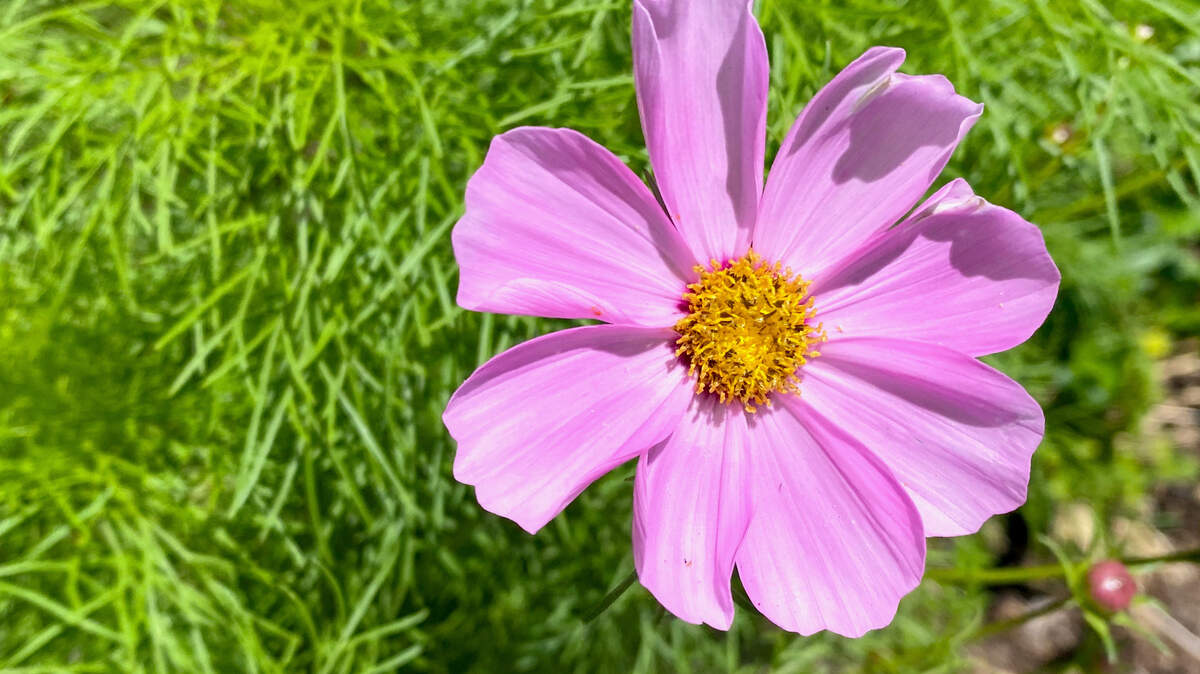
Cosmos. My phone and I will have to go back to this garden in another couple of weeks. This is one of my favorite garden annuals, but it was just starting to bloom. It comes in many bright summer colors, including yellow and orange. However, the bright pink one that I found fits in perfectly for the warm weather ahead. Cosmos grow best in full or nearly full sun, and their mature heights range from 15 to 30 inches.
Pink polkadot plants. I have to be truthful. These were in a nursery. I hope they end up in someone’s garden, probably in pots. This is a plant I knew as a kid, but back then it was only available with light pink polkadots. Hybridizers have gone nuts bringing us all of these different color combinations – and more. The mature plants don’t get much larger than softballs. You can grow six or eight of them in a hanging basket or a large patio pot, or you can grow them individually in their own pots and then position them around in your garden for accents.
Cora periwinkles (vinca). Hands-down, these are the number one flowering annuals for potted color in the summer in Texas. There aren’t any plants that hold up to the heat any better, and there aren’t any plants with flowers with brighter colors.
However, periwinkles got a reputation 15 or 20 years ago of having serious stem disease problems that limited their use in most of Texas. The collection known as Cora periwinkles was hybridized to have resistance to those diseases. Newer, improved developments in Coras are even better. Still, it’s a great idea to grow your periwinkles in pots with extremely well-draining potting soil mixes.
Sundrops. These lovely, cheerful yellow flowers are closely related to our wildflowers, the pink evening primroses, except these bloom during the daylight hours. They’re perennials, growing best in well-draining soils and in sunny locations. They bloom at this time of year for several weeks in succession. They’re outstanding in rock gardens and as a mid-sized border perennial.
Sunpatiens. We’ve grown impatiens for half a century, but these hybrid types have only come around in the last 10 or 15 years. This is a group selected and bred for its ability to withstand more sun and higher temperatures than conventional impatiens. That’s an important trait if you’re going to try to grow them in Texas. Still, it would be advisable to plant them where they will have shade from late morning on through the rest of the day.
You can hear Neil Sperry on KLIF 570AM on Saturday afternoons 1-3 pm and on WBAP 820AM Sunday mornings 8-10 am. Join him at www.neilsperry.com and follow him on Facebook.
This story was originally published May 21, 2021 at 5:30 AM with the headline "Add that perfect little spot of color and cheer to your lawn with these plants."