
In Richland Hills, it’s mass transit vs. mad citizens
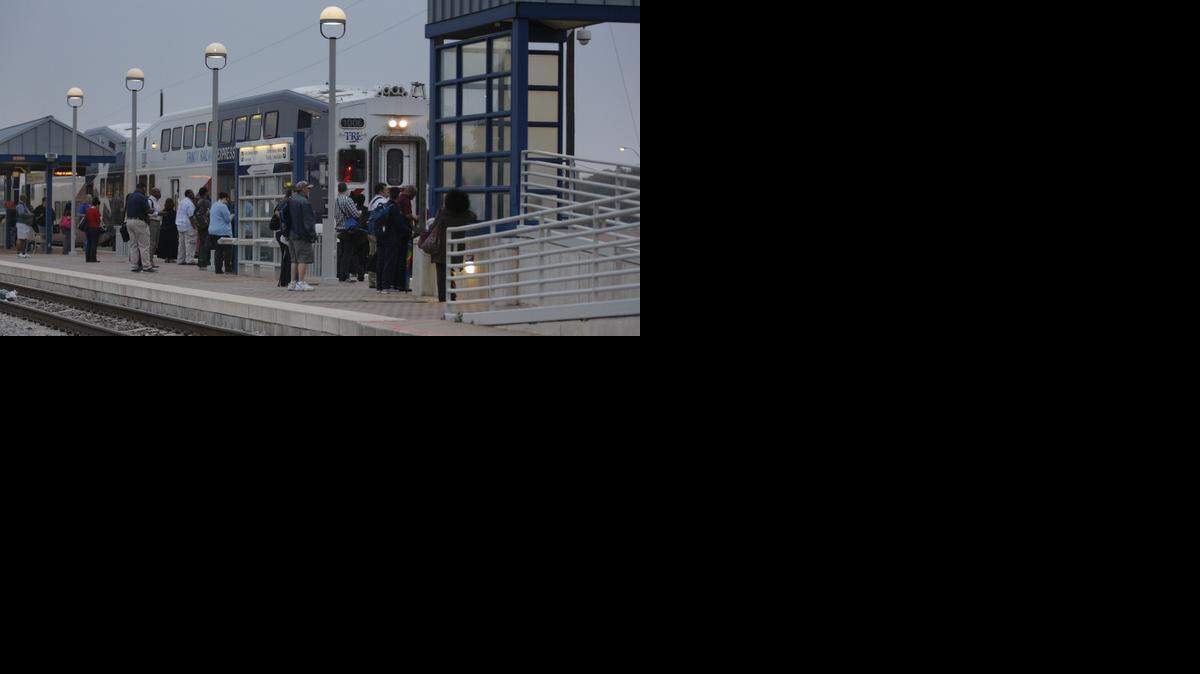
Like most people aboard the Trinity Railway Express, Ken Faulhaber just wants a safe, reliable ride to work.
“The train is so convenient. It has definitely changed how people get around in this area, compared to when I was growing up,” said Faulhaber, of North Richland Hills, who lives a couple of miles from a TRE station in neighboring Richland Hills and recently started riding most mornings to his job as a finance worker in downtown Dallas.
But Faulhaber and the roughly 700 other people who catch TRE each day from Richland Hills may soon be wondering if they’ll have to go another city to hop on a train, or perhaps quit riding altogether.
Since the city lost a seat on the Fort Worth Transportation Authority’s board of directors, Richland Hills officials say they’re dissatisfied with the agency that co-owns the commuter rail line.
Last week, the Richland Hills City Council voted unanimously to call a referendum asking voters whether they want to leave the agency, also known as the T, and cease dedicating a half-cent sales tax to transit.
The election won’t be held until May 14, 2016, because of a state transportation law requiring a one-year waiting period once such a referendum is approved.
If voters say they want out, there is no guarantee that the agency would then close the Richland Hills station on the Dallas-to-Fort Worth commuter line. On the contrary, officials who follow the T privately say they doubt the agency would dare close the station and deny public transportation for commuters from such a wide swath of cities around the region — including North Richland Hills, Haltom City and east Fort Worth.
But the last time Richland Hills voters were asked to decide whether to opt out, then-T President Dick Ruddell did say without hesitation that if the election were successful the Richland Hills station would be closed.
Fourth time a charm?
The upcoming referendum will be the fourth time in 23 years that Richland Hills residents have been asked to decide whether to have public transportation in their city — and the third time since 2004. In previous such elections, pro-transit advocates faced strong opposition from a large contingency of residents who philosophically disagreed on the appropriateness of spending the small city’s limited local tax revenues on public transportation.
But each time, pro-transit advocates won the election in the landslide.
However, the 2016 referendum promises to be different. This time, the election is being called by a mayor and council members who, despite openly advocating for public transportation in their city, have a beef with the T.
Multiple Richland Hills officials and other residents say the T has become too focused on Fort Worth’s goals. In particular, they believe the T has focused too much on opening a second commuter line — known as TEX Rail — from downtown Fort Worth to Grapevine and Dallas/Fort Worth Airport.
“I think it’s time to look at what services are critical to the city and what services aren’t,” Richland Hills Councilwoman Beverly Williams said. “Are we getting the bang for our buck?”
T officials reacted with surprise when they learned that Richland Hills had called the referendum. T President Paul Ballard, who arrived in Fort Worth almost exactly a year ago after overseeing transit in Nashville, said he knew there were some brewing concerns in Richland Hills over the city’s lack of representation on the T board but said he has never heard a complaint directly from a council member.
“I will say this. I have never heard a complaint about the quality of the many services we provide in Richland Hills. Not one,” he said.
Richland Hills’ concerns
The latest brouhaha began weeks ago, after Gerrit Spieker of Richland Hills, a longtime mass transportation advocate, began publicly posing questions to Richland Hills council members and T executives about recent political and administrative changes at the T.
Namely, Spieker wanted more information on a new nonprofit corporation formed by the nine-member T board in December. The Metropolitan Area Transit System Corp., whose membership includes Ballard and four T board members, has the ability to issue bonds and amass debt. Spieker said he objects to that because Richland Hills’ half-cent sales tax, which raises about $800,000 annually for the T, could be obligated to repay that debt even though Richland Hills has no say-so what the money would be used for.
Spieker also objected to a bill currently under consideration in the legislative session that would postpone the expansion of the T’s nine-member board to 15 members until after Fort Worth has a population of 1.1 million residents, which likely won’t occur for another decade or two.
Current law would require the T to expand its board to 15 members, including more members from suburban cities, once Fort Worth’s population surpasses 800,000 residents — a milestone that could be reached within a couple of years.
The T board is now made up of eight people appointed by the Fort Worth City Council, and one appointed by Tarrant County commissioners. The county’s current appointee is Jon Franks of Grapevine, a city teaming up with the T to pay for TEX Rail. Before appointing Franks, county officials traditionally appointed a Richland Hills resident as their representative, just to ensure that the T’s second-largest city had representation.
As far as full T membership goes, only three cities — Fort Worth, Richland Hills and Blue Mound — pay the half-cent sales tax. But the T is entering into contractual arrangements with other cities, including Grapevine, to provide specific services.
The Fort Worth way
The creation of the nonprofit corporation and the opposition to expanding the T board show that the T is too heavily influenced by Fort Worth, said Richland Hills Mayor Pro Tem Edward Lopez.
“It just seems the path that Fort Worth and the T are taking is kind of peeling us off,” Lopez said. “I don’t begrudge them for taking that path. That’s politics. It’s just that, we’re so small, it puts a disproportionate burden on our city.”
But Fort Worth leaders say Richland Hills is looking at the situation in the wrong way. Fort Worth is encouraging the T to expand its services into non-member cities in arrangements similar to Grapevine, which since 2006 has contributed a 3/8-cent sales tax — amounting to $9 million a year — to help pay for TEX Rail.
But it’s still Fort Worth’s half-cent sales tax that generates almost all the operating revenue for the T’s core services, Fort Worth Councilman Jungus Jordan said.
“All we want is the board to represent the citizens who pay the bill,” Jordan said.
T board Chairman Scott Mahaffey of Fort Worth said the nonprofit corporation was formed in case the T was presented with a development opportunity in the future — perhaps a public-private partnership — and needed to raise money.
He said there are no specific projects in mind that would require action by the corporation.
As for Richland Hills, Mahaffey said, “They’ve been a great partner. We hope they stay, but that’s their decision to make.”
Gordon Dickson, 817-390-7796
This story was originally published March 22, 2015 at 3:31 PM with the headline "In Richland Hills, it’s mass transit vs. mad citizens."