How much is Abilene Christian getting paid to play TCU football?
Few teams in the history of college football have felt the potential punishing perils, and thrilling rewards, of a non-conference football schedule like Army.
The Black Knights have been involved in two of the bigger upsets in college football, are 1-1, but very much in the black.
In its first game, Army lost at home in double overtime to Tarleton State. TSU, which is still an FCS school, received $250,000 to play that game. The next week, Army upset Kansas State in Manhattan. K-State paid Army $1.175 million.
A tidy net of $925K.
“What’s ironic is that walking into the season you’d thought they would be 1-1,” TCU director of athletics Mike Buddie said in a phone interview.
Buddie was the Army athletic director before leaving for TCU in January.
“I was involved in [scheduling] the game with Tarleton,” he said. “The president of their school has a son who is a cadet, and [Army] needed a game. I know that they aspire to go to the FBS. We knew they might have more talent, and it would be a tough game.”
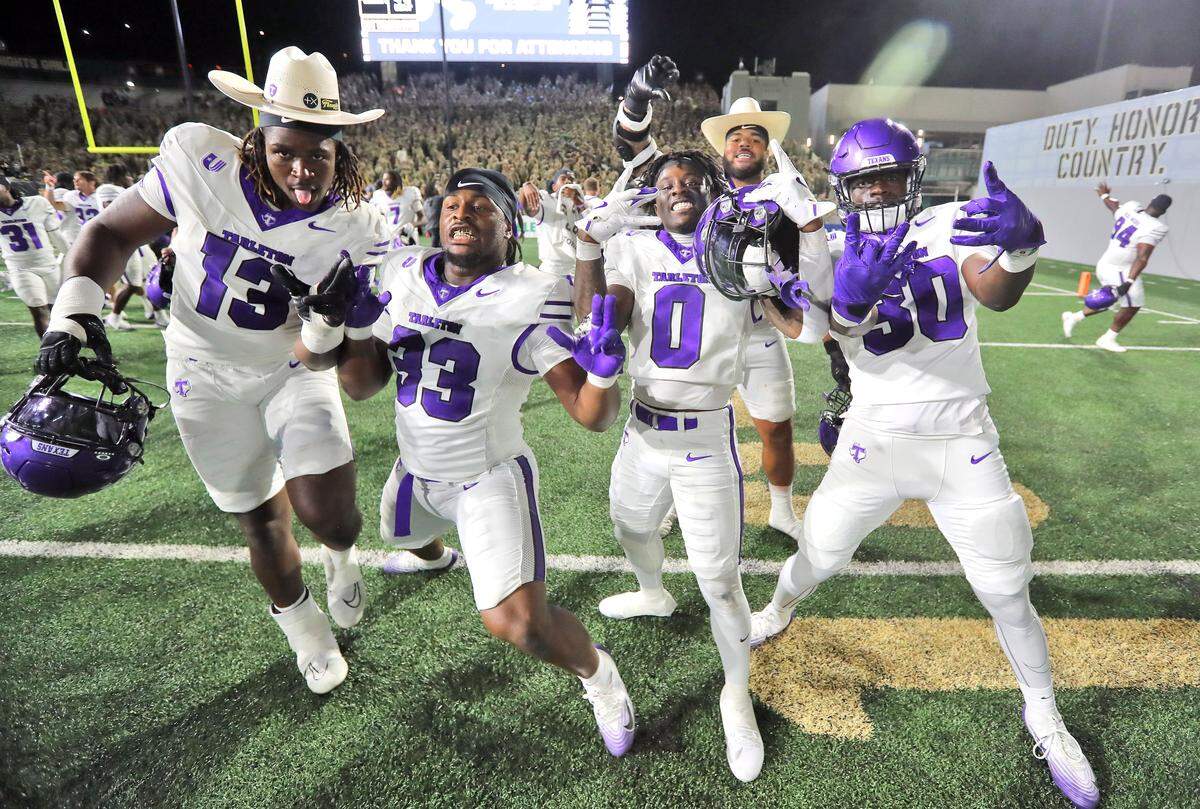
Remember App State-Michigan?
Every so often an FCS team will pop an FBS school in the mouth; take the six- or seven-figure check and leave with a win. Appalachian State’s victory at Michigan in 2007 remains the greatest example of what can happen when a good FCS team walks into your house and raids the fridge, and everything else, but leaves the dog.
App State over Michigan is the exception to the exception. The movie that you know is going to be awful but turns out to be an Academy Award winner. These are typically worthy of a Razzie.
These are games that fans (and broadcast partners) would rather avoid, because typically there is no winner. The home team buys a boring win, and anything other than that it feels like a loss. Yet these games are built into the season for both teams.
As the power conferences expand their schedules to include more conference games, it is a mild threat to schools like Tarleton State, Abilene Christian — which plays TCU on Saturday — and the other FCS schools. Their budgets are set around the “payday” games against the FBS teams.
This week, Zach Goodall of 247Sports reported that Florida canceled its future home-and-home series with N.C. State, California and Arizona State as an adjustment to the SEC’s expanded nine-game schedule, which starts in 2026.
This specific schedule alteration doesn’t involve an FCS school, but there is a trickle down. There are only so many non-conference slots to go around.
“You are talking about ‘payday games,’ and every institution has a different philosophy about those. There are several institutions that will play two to shore up their budget,” Tarleton State athletic director Steve Uryasz said this week in a phone interview. “They help us, too. We do those. We don’t necessarily mandate that we have them.”
No school hit an exacta any harder so far this season than Tarleton when it went to Army and won. Army was a 14.5 point favorite.
For a school that is growing, and eyes moving its football team to the FBS level, no collection of seasoned economists could devise a plausible equation to accurately quantify the value of Tarleton State’s win.
“It means a great deal because there is a trickle down, and it affects the student body,” Uryasz said. “Look at [TSU’s home opener]; we had the largest crowd in the history of the venue. A good portion is due to our students are behind us, but when you are on a roll., and with what we did at Army, it begins the snowball effect.
“It creates a very exciting environment. You see it. An athletics department is not the most important department at a university, but it is often the most visible one.”
And expensive one with a list of bills that never stop.
How much do FCS teams get paid?
An FCS team that plays a Power Four team will get, normally, north of $500,000 for a game. The Group of Five team that plays a road game at a Power Four school will often command more than $1 million.
“If you can stay competitive in it and have a chance to win it, that is the ultimate goal,” Buddie said. “When I was at [FCS] Furman, we played at Clemson and at Michigan State. Those games were the No. 1 driver of revenue, outside of a gift from a donor, which at an FCS-level school is rare.
“The games help with recruiting, too. You can get the kid who has the chip on their shoulder who thinks they should be at the FBS school. They dreamed of playing on that field and in that stadium, just for the other school.
“For the [home] team, I don’t want to call it a scrimmage. But when you get the second- and third-string guys on the field, that is invaluable. It keeps them engaged and develops them. It helps the starters. If the backup can get one half of game experience, it all helps.”
The rub here is they’re usually awful games, with no demand. They’re filler on a TV screen, a function of the business of college football.
For TCU’s home opener against FCS level Abilene Christian on Saturday night, tickets on the secondary market can be had for $38.
The point spread for No. 20 Indiana’s game on Friday night against FCS Indiana State, in Bloomington, is Hoosiers minus 47.5. According to the Indianapolis Star, this game is part of a non-conference schedule that will cost IU about $3 million in payouts to its opponents.
By comparison, TCU got a steal for its date with ACU; according to ACU officials, TCU is paying ACU $500,000.
Only in college football does all of this math, and money, make sense.
This story was originally published September 12, 2025 at 2:05 PM.