Dallas Cowboys Hall of Fame tackle Rayfield Wright dies at 76
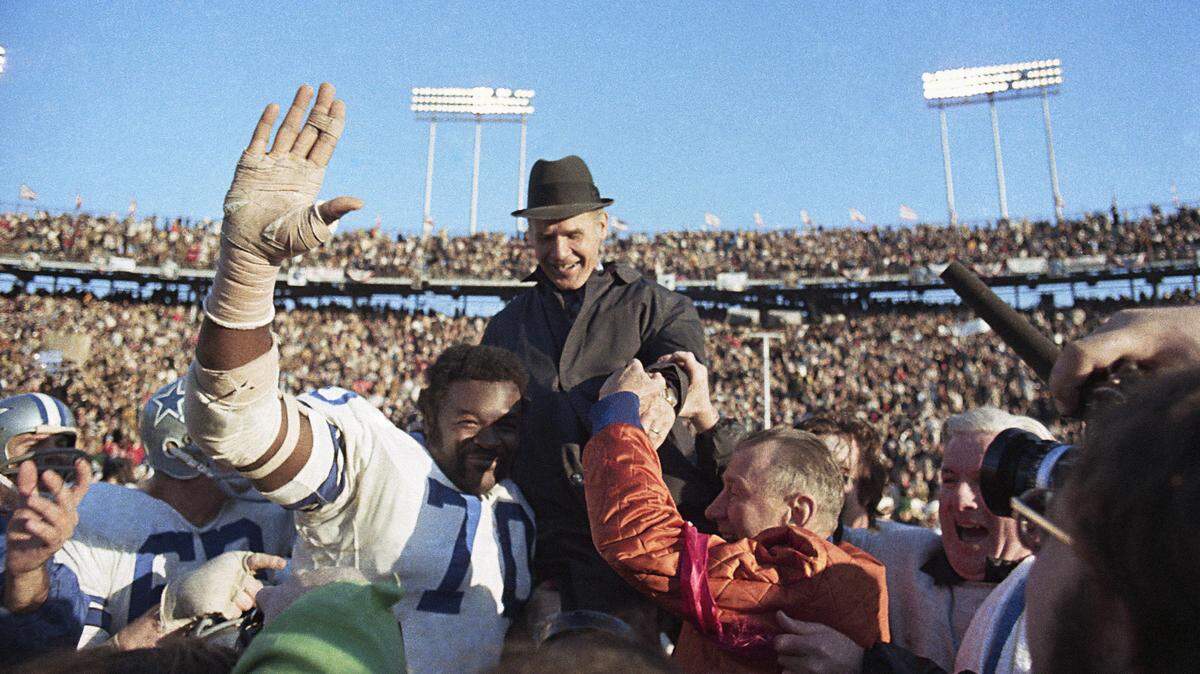
Legendary Hall of Fame football player Rayfield Wright, one of the most decorated offensive linemen in Dallas Cowboys history and a powerful motivational speaker, has died. He was 76.
Wright’s family confirmed his death Thursday to the Pro Football Hall of Fame. It came after he had had been hospitalized for more than a week following a severe seizure.
Wright played 13 years with the Cowboys. He arrived in Dallas as a seventh round tight end from Fort Valley State before converting to offensive tackle where he became a six-time Pro Bowl player, named All-Pro four times, was on two Super Bowl-winning teams in the 1970s and was a member of the All-Decade team of the 1970s.
He was remember by former teammates as much for his smile and heart as he was for his outstanding play.
“What a wonderful and kind man he was with a heart for service,” Hall of Fame receiver and Cowboys teammate Drew Pearson posted on his Facebook page. “His smile lit up every room he entered and he is going to be greatly missed.”
Said by former Cowboys defensive Ed Jones on Twitter: “I was very appalled to hear about the loss of someone I highly respected and appreciated. What a great man!”
What a great man. What a great voice. What a great testimony.
Wright was elected to the Cowboys Ring of Honor at halftime of the team’s game against the New York Giants on Oct. 10, 2004, and the Pro Football Hall of Fame in 2006. He gave emotional, crowd-raising acceptance speeches at both that were as impressive as his imposing 6-foot-7 stature.
He was elected to the Pro Football Hall of Fame with Troy Aikman, Harry Carson, Warren Moon, the late John Madden, and the late Reggie White.
“Some say that patience is a virtue. After 22 years of eligibility, God knows that I’m not a saint, but I am a Dallas Cowboy,” Wright bellowed to cheers of approval.
Wright spoke for 22 minutes. He compared his journey, from humble beginnings in Griffin, Ga., to the NFL, to Robert Frost’s poem “The Road Not Taken.” He learned the poem in the eighth grade.
He spoke of God, family, love, honor, success ... and hope.
“To every young athlete within the sound of my voice, it takes courage to dream your dream ... Take a leap of faith. Listen to your parents and respect your elders. Learn from your successes and your losses ... Be satisfied you gave the game everything that you had and remember this: Don’t be afraid to travel the road less traveled, because Larry Rayfield Wright did, and you can, too.”
Wright is also a member of the Texas Sports Hall of Fame and the Texas Black Sports Hall of Fame.
Wright’s road not taken to greatness began in 1945 in Griffin, Ga., where he was raised fatherless by his mother. He grew up playing basketball and didn’t make his high school football team until his senior year.
He played both sports at Fort Valley State, averaging more than 20 points and 20 rebounds a game in basketball, while becoming a standout tight end in football.
Wright had a chance to sign with the NBA’s Cincinnati Royals (now the Sacramento Kings) after his junior season, but he turned down the offer so he could finish school.
The NBA was still an option for him when Cowboys player personnel director Gil Brandt urged the Cowboys to take him in the seventh round in 1967.
He began as a tight end and even caught a touchdown pass in 1968, but was moved to tackle and got his first start in 1969 against the Los Angeles Rams and Hall of Fame defensive end Deacon Jones.
After getting run over on the first play, Wright went on to become the first Cowboys lineman elected to the Hall of Fame and first one inducted into the Ring of Honor.
“Looking back, my instinct was to always take the easy road,” Wright said at his Hall of Fame induction. “But the easy road never came my way.”
Nicknamed the Big Cat, consistency, drive and integrity were Wright’s trademarks. He helped paved the way for the Cowboys innovative offense that included Hall of Fame quarterback Roger Staubach and running back Tony Dorsett and former greats Calvin Hill, Duane, Thomas, Drew Pearson, the late Robert Newhouse and many others.
“He was absolutely the best,” Staubach said in 2006. “Rayfield was a big, strong guy that was able to transfer his size and strength from tight end to tackle. He also had such quick feet that he was able to deal with some of the faster defensive ends and even the linebacker blitzes. If he got beat, I don’t remember it.”
Wright retired from the Cowboys in 1980. He founded the Rayfield Wright Foundation and spent a lot of his post-career working with youths and making motivational speeches.
In a 2014 interview with The New York Times, Wright announced that he had dementia, which he attributed, in part, to the many concussions he sustained during his pro career. He said he endured so many he couldn’t count them all. He said he had hidden headaches, dizziness, irritability and forgetfulness for far too long.
Wright also joined thousands of former players to sued the league, contending the NFL misled players about the long-term dangers of concussions.
“For whatever reasons, so many things have happened that we were not aware of when we played the game,” Wright told the Star-Telegram in 2014. “All the things that have gone on behind the scenes are just coming out. I think it’s a good thing that they are coming out so that students and young kids, even in pee wee football, can really look at the game itself and show them the detrimental things about playing the game.
“It’s one of the greatest games, but when you’re out there playing and competing, you don’t even think about that, you just want to play the game.”
Few played it with as much passion, joy and appreciation as Wright.
“Rayfield Wright was the epitome of what it takes to be a Hall of Famer,” said Cowboys owner Jerry Jones in a statement released by the team Thursday night. “His grit, his agility, his passion, his charisma and his love for football, the community and his family always shined through. The original “Big Cat” helped shape the future of the Dallas Cowboys through his illustrious 13-year playing career. Rayfield was a champion on and off the field.
“He remained an important part of the Cowboys family long after his playing days ended, and he will be deeply missed. Our love and support go out to his wife, Di, and the entire Wright family.”
The Pro Football Hall of Fame released a statement Thursday evening that said, “Over the past few weeks, it has become abundantly clear the love that so many Hall of Famers and others around the NFL felt toward Rayfield, his wife, Di, and the extended Wright family.
“His gentle nature away from the game belied his commanding presence on the field. All fans, especially those of the Cowboys, will remember fondly his dominance on the offensive line in the 1970s and how he took protecting Dallas quarterbacks as his personal mission.
“We will guard his legacy in Canton with equal tenacity.
“The Hall of Fame Flag will fly at half-staff through Rayfield’s services next Friday as a tribute to the many lives he touched.”
This story was originally published April 7, 2022 at 8:56 PM.