‘Facing Nolan’ film is touching tribute to Texas Rangers legend Nolan Ryan, wife Ruth
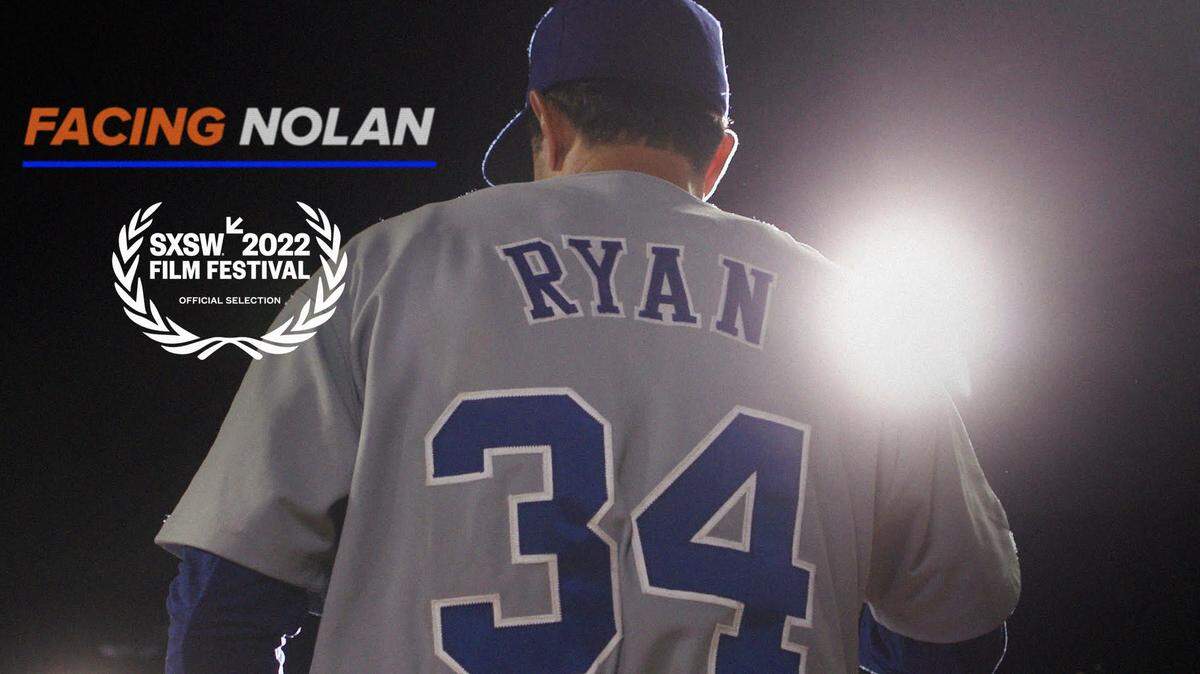
Trying to cram 27 years of historic baseball into one film seems hard enough.
But “Facing Nolan,” a new documentary about the legendary career of Nolan Ryan, pulls it off and then some.
The one-hour, 42-minute film, directed by Bradley Jackson, has a limited release and 7 p.m. showtime on May 24 at many area movie theaters.
The film traces Ryan’s life and career, from his days growing up the youngest of six kids in Alvin to his passion of cattle ranching in retirement. Jackson and his editor, Erik McMichael, elegantly weave the viewer through Ryan’s entire career, from courting his future wife Ruth in high school, to making his MLB debut with the New York Mets in 1966 at 19.
In fact, the film is as much a love story about Nolan and Ruth, who married in 1967, as it is a love letter to Ryan’s storied, almost mythical, career.
The film was shown after the Rangers’ 7-3 win over the Braves on Sunday afternoon at Globe Life Field.
When sons Reid and Reese Ryan were approached about the film, it was Ruth who had to sell Nolan on the idea.
Early in Ryan’s career, it was Ruth who talked him out of giving up when he was struggling to find his command.
Somehow Jackson was able to squeeze in all of Ryan’s monumental baseball achievements — he owns 51 MLB records — while also contrasting all of the archival footage with present-day Ryan: having a large family dinner, fishing with grandchildren on the ranch, or sifting cattle to be sold.
Meanwhile, the heavy hitters who help give voice to “Facing Nolan” include Hall of Famers George Brett, Rod Carew and Dave Winfield. Former teammates from his days with the Mets, Angels, Astros, and Rangers are abundant, including former Rangers manager Bobby Valentine, Tom Grieve, Steve Buechele, Pudge Rodriguez, and Bobby Witt.
Former President George W. Bush, who was the managing general partner of the Rangers organization from April 1989 to December 1994, when he was elected Texas governor, reminisces about first learning of the young, hard-throwing Texan pitching for the Mets, a team originally owned in part by Bush’s great uncle. One of the highlights of the film is Bush reacting to footage of Ryan recording his 5,000th strikeout in August 1989.
Wisely, Jackson keeps the focus on Ryan’s legendary playing days and his off-the-field family life. His time working in the Rangers front office and as an Astros adviser are not mentioned.
All of the historic moments are covered in depth, with thrilling footage and audio and put in context from those involved. Mets catcher Jerry Grote, for example, is convinced Ryan was throwing closer to 107 mph Ryan was still trying to find his command.
We learn how much Ryan doubted his abilities early on. And how his career began to turn around after being traded to the Angels in 1972.
“I had no clue whether I belonged or not,” said Ryan, who was installing air conditioners in the offseason to supplement his income. He thought of pursuing a career as a veterinarian, thinking his life in baseball would be limited.
Angels pitching coach Tom Morgan helped refine Ryan’s delivery, however, and the mythical moments started coming at a rapid pace. Four no-hitters, including two in 1973 in which he recorded a record 383 strikeouts. The story about Norm Cash taking a table leg to the plate during Ryan’s no-hitter against the Tigers in ‘73? Sounds like folklore, right? It happened and it’s in the documentary.
Throughout the film, an actor portrays Ryan on the mound at pivotal moments in an attempt to draw the viewer in deeper. It’s not a distraction, but perhaps unnecessary. More scintillating are players such as Brett, Pete Rose and Craig Biggio, who caught Ryan as an Astros rookie in 1988, describing the sound of a Nolan Ryan fastball. You could hear it sizzling as it came to the plate before popping in the catcher’s mitt.
After eight seasons with the Astros, Ryan signed with the Rangers, wanting to prove that he still had something left in the tank. The Yankees and Angels expressed interest, as did a team in Japan. But when the Rangers were on board, that was the perfect fit for Ryan, who liked the idea of staying in Texas.
“I’m proud to be a Texan. There’s a mystique about it,” Ryan says.
His move north to Arlington proved to be genius. Not only was he still productive, but at times he was also dominating players half his age. He threw his record sixth and seventh no-hitters, struck out Ricky Henderson for No. 5,000, and added to his legend pitching through a bloody busted lip and putting Robin Ventura in a headlock during a brawl at age 46 on Aug. 4, 1993.
“Texans just love that,” Bush says with a laugh of the Ventura fight.
“One of the scariest moments of my life,” said Ryan, who fell to the turf under a pile of brawling players before Bo Jackson pulled him up.
The film moves back and forth in time, which keeps the pacing swift while also helping to put moments in perspective. The Ventura brawl, for example, is shown in contrast to what had happened 13 years earlier to the day (eerily) when the Padres’ Dave Winfield charged Ryan after an inside pitch.
“He wasn’t fully committed,” Winfield joked, referring to Ventura’s hesitation as he approached Ryan on the mound.
The film succeeds at capturing Ryan’s legend but also helps humanize him. Some of the best moments are of Ryan enjoying time with his grandkids, many of whom never saw him play.
Former Star-Telegram columnist Randy Galloway tries to sum up Ryan’s legacy near the end of the film.
“Everything about Nolan Ryan is rather mythical,” Galloway said. “And I think always will be. Long after us, he’ll still be mythical.”