A Democratic wave has formed. Can it reach Texas next year? | Opinion

AI-generated summary reviewed by our newsroom.
- Democrats gained ground in off-year races thanks to high turnout and anti-Trump voting.
- Texas remains GOP-leaning, but competitive House districts could flip in 2026.
- A Tarrant County state Senate race shows voter dissatisfaction could lead to surprises.
The question “Can Texas turn blue this time?” is a worn-out trope.
Even after Tuesday’s extensive Democratic success on the East Coast — and their surprising strength in a Tarrant County special election — the answer is no. But that doesn’t mean they can’t make serious gains in next year’s state and congressional races.
It’s dangerous to assign too much meaning to a handful of off-year races and special elections. These results, however, reveal some unmistakable trends: Voters remain unhappy over the country’s direction. President Donald Trump is not as popular in many places as some Republicans think. There are more Democrats determined to register a vote against him than there are Republicans motivated to show their support. And the GOP has a deep and persistent problem getting people to the polls in elections beyond the presidency.
It’s not often we can find similarities between elections in Tarrant County and New York City. But both had surprisingly high turnout that helped elevate candidates who would have been dismissed not long ago as long shots.
That’s not to say that Texas Senate candidate Taylor Rehmet will approach anything like the success of New York’s mayor-elect, Zohran Mamdani. The Fort Worth aerospace mechanic took 48% of the vote in a district designed to handily elect a Republican.
Yes, the GOP vote was divided between two candidates, Leigh Wambsganss and John Huffman. Yes, Wambsganss has all the advantages in a runoff and is likely to win it.
Rehmet came within 2,900 votes of winning outright, though. Attention must be paid.
Could Texas see a repeat of 2018 Democratic gains?
Every trend has its limits. Republicans will probably win all statewide offices next year. They’ll maintain big majorities in the Legislature. Texas will still send far more Republicans than Democrats to Washington.
But if the 2026 midterm resembles the 2018 elections, when a backlash to Trump drove Democratic turnout, U.S. House seats could be up for grabs. Republicans have diluted their majorities in several areas to create more GOP-leaning districts out of former strongholds. If Democrats can recruit good candidates and raise money, those races are much more competitive in the context of a national blue wave.
Republicans should ask themselves how Democrats swept in Virginia and New Jersey just a year after those states moved closer to Trump. Both parties should wonder why the electorate is constantly frustrated and generally takes it out on the party in power.
A year ago, Trump won every battleground state, and the vast majority of counties in the country trended rightward compared to the 2020 election. If the nation swings back to Democrats in just two years, it’s a sign that politicians aren’t correctly diagnosing and addressing voters’ concerns.
One big factor is polarization. When a party gains power, it caters to the demands of its base, trying to get as much done in as short a time as possible. But less-interested partisans and, more importantly, independent voters want bigger solutions on concerns such as inflation and healthcare.
Wambsganss and Huffman battled as if this was a Republican primary. Their biggest disagreement was on casino gambling, as if one of 31 state senators will be a deciding vote on that. Neither candidate offered voters much on making necessities such as housing and health coverage more affordable, improving our struggling public schools or reducing crime.
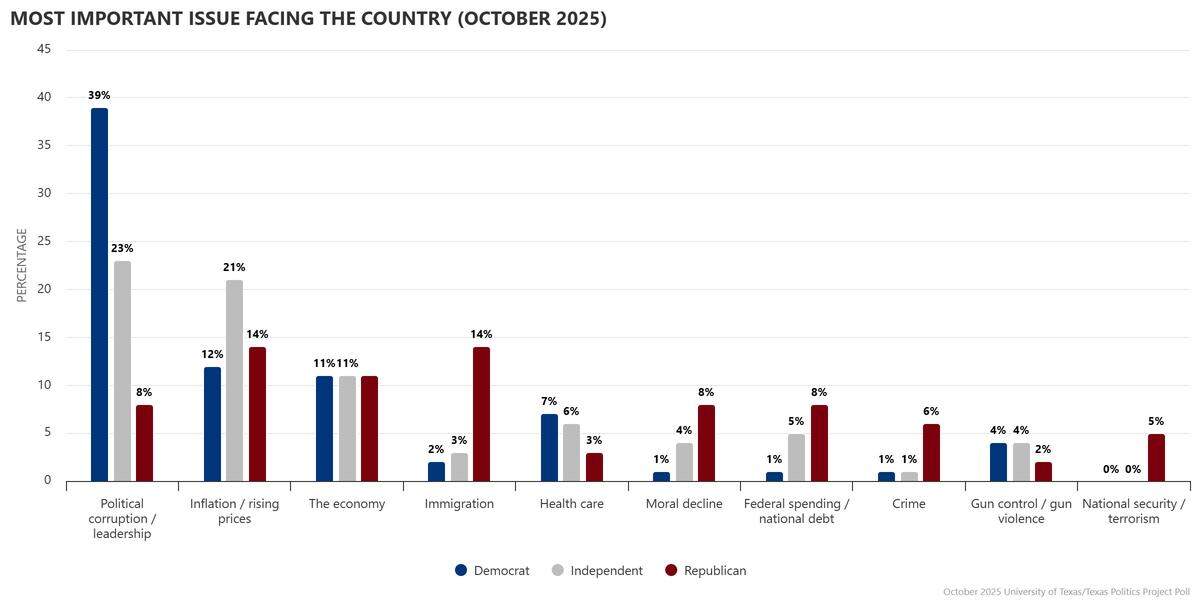
Traffic? Crime? The strength of the economy? Nothing. And then there’s this: In a recent poll by the University of Texas at Austin’s Texas Politics Project, the No. 1 concern listed by respondents was political leadership and corruption. That’s vague enough to encompass many specific issues, but it also suggests a general unhappiness with elected officials.
Throw the bums out? We’re not quite there yet. But incumbents should take note.
Democrats’ brand is struggling along with Trump’s
Nationwide, Democrats’ brand is just as tainted as Trump’s, if not more so. Republicans will comfort themselves that Virginia, New Jersey and New York are blue at heart and simply returned to their natural state.
And that’s true, to an extent. Elections are complicated, but there’s usually a through line. Texas Republicans will have to figure out what that is. Their hard-core activists spend more time on internal purity tests, hunting heretics and pleasing Trump than responding to the concerns of the broadest section of the state’s electorate.
That electorate remains firmly in the center-right, but there may be enough voters who want more than the rigid party platform to create an opening for savvy Democrats in selected races.
Rehmet’s impressive showing may turn out to be an anomaly, but it’s the kind of radar blip that good generals check out, for safety’s sake.
To do that, leaders in the Texas GOP will have to pull themselves away from the internal firing squad first.