Trump finds way to prevent flag burning, still protect free speech | Opinion
My history with flag-burning as a topic has taken a winding path. As President Donald Trump signed an executive order Monday to address such behavior, it was an occasion to revisit the journey and evaluate where we are.
As an American, I am repelled by the very prospect of such a noxious act. Note that I do not say “as a conservative,” because citizens of every political stripe should recoil at this appalling display. The flag is not our personal totem to use as a plaything to reflect our ideological passions. That is why athletes should never have knelt for the national anthem in a push for policing reform, and to be bipartisan about it, nor should the wife of Supreme Court Justice Samuel Alito have flown the flag upside down at their home in a skirmish of gestures with anti-Trump neighbors.
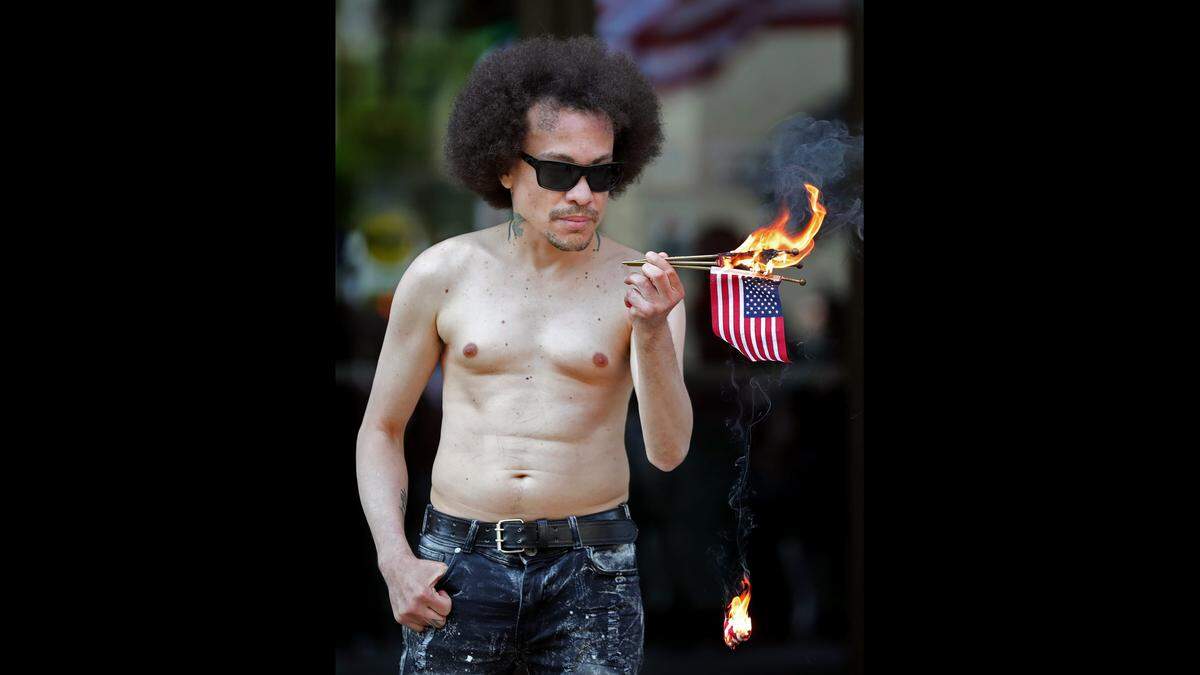
Bottom line: Leave the flag alone. But that does not mean I signed onto the activism that arose after the Supreme Court’s 1989 Texas v. Johnson Court ruling which, with the help of conservative hero Justice Antonin Scalia, identified the free speech aspects of such protests.
I am a free-speech absolutist. Short of the usual guardrails of slander, libel and encouragement of a criminal act, I have spent my life defending the right of people to express views that I find abhorrent, knowing that the same First Amendment will also protect me when I share a provocative thought. Popular speech requires no constitutional protection.
But the instinct that followed in the early 1990s — that we need a constitutional amendment to ban flag burning — instantly struck me as unworkable and misguided. First, our flirtation with Prohibition teaches that our founding document should not be turned into a list of forbidden personal behaviors.
Second, more practically, how would this genius amendment be written? What is a U.S. flag? Fifty stars with 13 stripes? Anarchists would have flocked to buy countless 40-star, 10-stripe flags that would be hawked as prosecution-proof. And don’t even think about a vague law that says in essence, “Well, you can’t burn something that looks like a flag.” This idea was a non-starter.
So while I understood and appreciated a Supreme Court ruling that sought to curtail the beginning of a list of expressions we were going to forbid, I always attached the qualifier that flag-burning is not a speech or a pamphlet or even a shocking sign at a rally; it is an act that goes substantially further, an act of rage that clearly seeks to enrage others by setting fire to something in public.
I have thus always wondered: Is there a way to curtail flag-burning, not by making it a forbidden expression but by addressing various other ways in which it can be legally proscribed?
Are we allowed to set fire to things — any things — on the courthouse steps, or anywhere in public? Don’t we have existing laws about disorderly conduct? And isn’t flag-burning figuratively as well as literally inflammatory? Defining incitement to riot can be a challenge, but torching a flag seems to be a reliable way to start one.
For about 30 years, flag-burning as an issue has faded from prominence because so few people have been doing it. But incendiary street protests in recent years have brought the practice back into the headlines, onto TV screens and to the front of Trump’s mind.
In keeping with Trump’s uncanny ability to focus on problems that stick in the craw of middle America, his executive order slaps a one-year jail term on burning the American flag, an act of elegant simplicity sure to draw instant legal challenges. We will see if the courts accept the argument that the order does not criminalize any belief or the right to express it, but instead one specific behavior with aspects that are already illegal.
Trump’s enemies recoiled on cue, but so did some conservatives who felt their libertarian feathers ruffle before they read the order. It specifically limits prosecutions to flag desecration that violates “applicable content-neutral laws, while causing harm unrelated to expression consistent with the First Amendment.”
We may have found a way to curtail a public behavior that poses demonstrable danger without silencing the view that compels it. There are countless ways for the America-haters to spread their rhetorical poison. If the courts approve of the Trump order, which they should, only one of their options is lost.
Mark Davis hosts a morning radio show in Dallas-Fort Worth on 660-AM and at 660amtheanswer.com. Follow him on X: @markdavis.