
Jim Lovell never walked the moon, but astronaut was a true trail blazer | Opinion
It is proper that the moon was full Saturday, the day the headlines recorded the passing of Jim Lovell. It offered the opportunity for us to see the full face of the place where he never got the chance to walk, the place that had captured his imagination throughout his storied astronaut career.
He never walked on the moon because the spacecraft that took him there in 1970 exploded as it approached, setting the stage for the Apollo 13 rescue drama that is in its own way as remarkable as America’s six successful moon landing missions.
While the first lunar steps of Neil Armstrong in 1969 are the historical benchmark, Jim Lovell and his Apollo 8 crewmates were the first to visit that other world in 1968, as they tested the hardware by flying to the moon, orbiting it and returning.
I had just turned 11, and like the rest of Earth, I was glued to watching Lovell, Frank Borman and Bill Anders send TV pictures from 70 miles above a lunar surface I could only see from a quarter million miles away, with a Sears telescope in my back yard. During that Christmas Eve telecast, as the world anticipated the observance of Jesus’ birth, the crew read the creation story from the Bible. Lovell’s portion began with Genesis 1:5: “and God called the light day, and the darkness he called night. And the evening and morning were the first day.”
Borman completed the reading by adding: “From the crew of Apollo 8, we close with good night, good luck, a merry Christmas — and God bless all of you — all of you on the good Earth.”
Every moment of a space mission is documented in a flight plan. Lovell kept the page containing the script of that night, and he donated it to the Adler Planetarium in Chicago. In 2018, on the 50th anniversary of that remarkable voyage, it was displayed in the National Cathedral in Washington.
Sixteen months after Apollo 8, it was fitting that Lovell would command his own mission, scheduled as the third to land on the moon. He and lunar module pilot Fred Haise would walk on the Fra Mauro highlands, a more rugged terrain between the flatter landing sites of the prior missions.
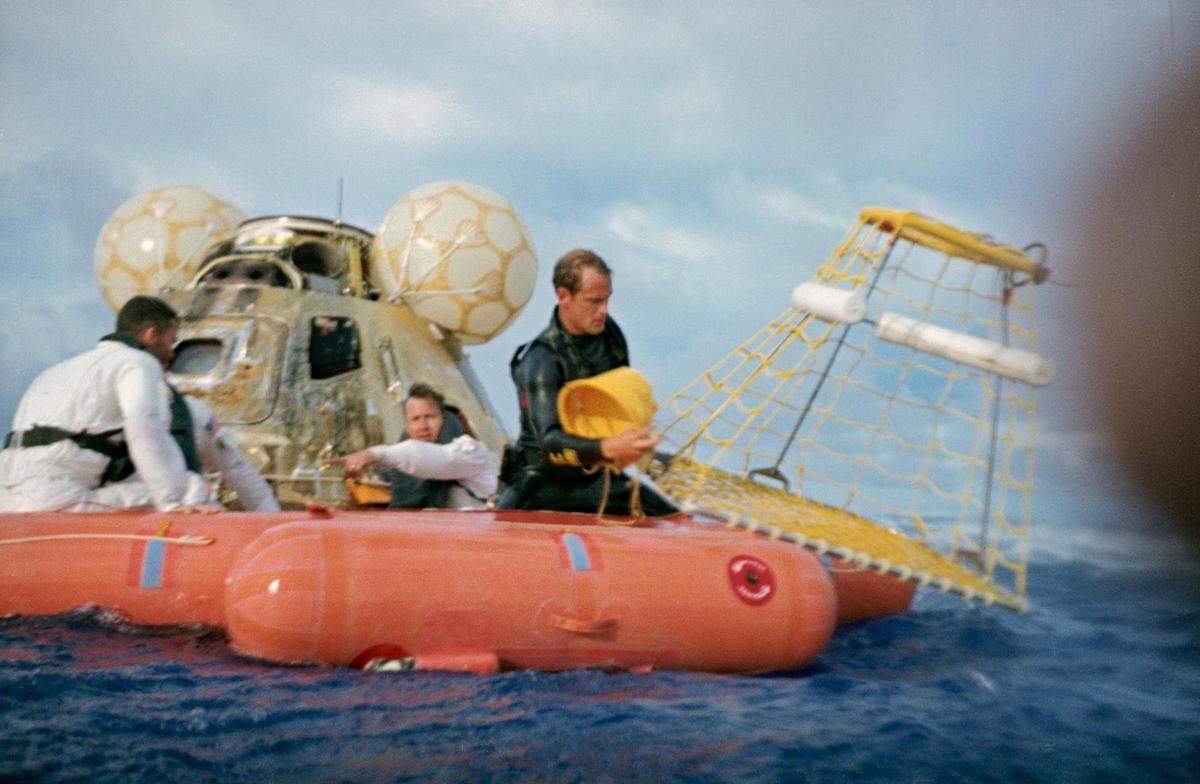
But the April 13, 1970, deep-space explosion in an oxygen tank turned a moon landing mission into history’s most remarkable rescue mission. Reproduced beautifully in Ron Howard’s 1995 film (with Tom Hanks as Lovell), the following four days united the planet in prayer that Lovell, Haise and Jack Swigert would not die in the black vacuum of space.
Miraculous ingenuity from the crew and NASA helped them return to a hero’s welcome like no other. While it was not a celebration of mission accomplished, it was a celebration of three lives saved against the steepest of odds.

I don’t know what the chances are that one kid consumed with our race to the moon 60 years ago would someday meet and share time with the heroes who made it happen, but I am that kid. On radio and in print, I have tried to keep alive the wonder felt by people of all ages as America reached for such lofty goals. In the process, I’ve had the chance to participate in events with this remarkable generation of explorers, including multiple occasions at the Frontiers of Flight Museum in Dallas, where I hosted a panel in 2017 attended by Neil Armstrong, Buzz Aldrin, Bill Anders, Apollo 13 Flight Director Gene (“Failure is not an option”) Kranz and Fort Worth’s own Alan Bean, who walked on the moon during Apollo 12 in November 1969.
The following year, the museum allowed me to host Lovell and Haise for an extended onstage reminiscence about the full scope of the Apollo 13 drama and the remarkable feat that enabled them to be sitting there that night.
But having forgotten nothing of my pre-adolescent deep-dives into manned space flight, I had to ask Lovell about another indelible feat. “Imagine a road trip in a small car,” I told the audience. “Every few hours, you just have to get out to avoid going stir crazy. Well, in December 1965, our guest Jim Lovell and his future Apollo 8 partner Frank Borman climbed into the two-man Gemini 7 capsule and orbited the Earth in a vehicle with an interior like a Volkswagen Beetle.” I paused for effect. “And they did it for two weeks.”
A combined gasp and chuckle came from the crowd, and Lovell smiled as I peppered him with the kind of questions I would have asked if I were still in sixth grade. “How did you handle, you know, the hygienic challenges?” His description of personal wipes and the zero-gravity acrobatics of bodily necessities added to an evening of riveting recollections. “You came to dread having to open the storage bins,” he explained.
In 1966, Lovell and Aldrin would pilot the ambitious final Gemini mission that would set the stage for the Apollo journeys that would put us on the moon. He blazed that trail in those Gemini missions. He blazed that trail on the Apollo 8 voyage that showed that humans could truly leave the Earth. In his Apollo 13 heroism and the way he shared his stories and lived his life for the half-century after, he inspired generations, reminding us of the best qualities Americans—and all people — can display. He will be buried at the United States Naval Academy next to Marilyn, his wife of more than 70 years, who passed away two years ago.
In the lower right quadrant of the full moon, along the edge of the gray, bone-dry Sea of Fertility, there is a triangular mountain he named for her in 1968 as he sailed above the lunar landscape he thought he might land on one day.
Jim Lovell never walked on the moon. But his path through American history, and the legacy he leaves among humanity’s greatest explorers, is a journey never to be forgotten.
Mark Davis hosts a morning radio show in Dallas-Fort Worth on 660-AM and at 660amtheanswer.com. Follow him on X: @markdavis.

This story was originally published August 11, 2025 at 4:55 AM.