
Star-Telegram endorsement: Democrats face uphill battle in Tarrant precinct
The deck is stacked against Democrats in the newly drawn Tarrant County Commissioners Court Precinct 2, thanks to Republican redistricting. But they still drew three good candidates.
We give Jared Williams a slight edge over opponents Amanda Arizola and Gabe Rivas. Each has what it takes to serve the sprawling precinct’s divergent priorities. But Williams brings useful electoral and governing experience.
The 36-year-old nonprofit leader served two terms on the Fort Worth City Council, representing Wedgwood and other southwestern neighborhoods. That was a good training ground for the area’s needs and getting things done in a big bureaucracy.
It also gave Williams, who still lives in the area, needed exposure in an uphill campaign. In 2021, he knocked off council member Jungus Jordan in an upset. Williams will need to draw on that experience to have a chance in this race, and should he win, his time as an outnumbered progressive on the council will help him be effective in a likely Democratic minority on the Commissioners Court.
In our interview with the candidates, Williams displayed a focus on the economic challenges facing Tarrant County residents, especially working-class young families: healthcare, child care and housing.
Arizola, 45, brings a wealth of community experience, particularly as a member of the JPS Health System’s Board of Managers. She noted the need for improved health services in the precinct, including mental health treatment for young people. Arizola, a nonprofit executive and consultant who lives in Arlington, would be the first Latina on the Commissioners Court.
Rivas, 37, of Arlington would be in position to hit the ground running, given his recent time as director of community outreach for Commissioner Alisa Simmons, who is leaving the seat to run for county judge. He demonstrated knowledge of needs sometimes overlooked by candidates, such as improved infrastructure in the rural portions of the precinct.
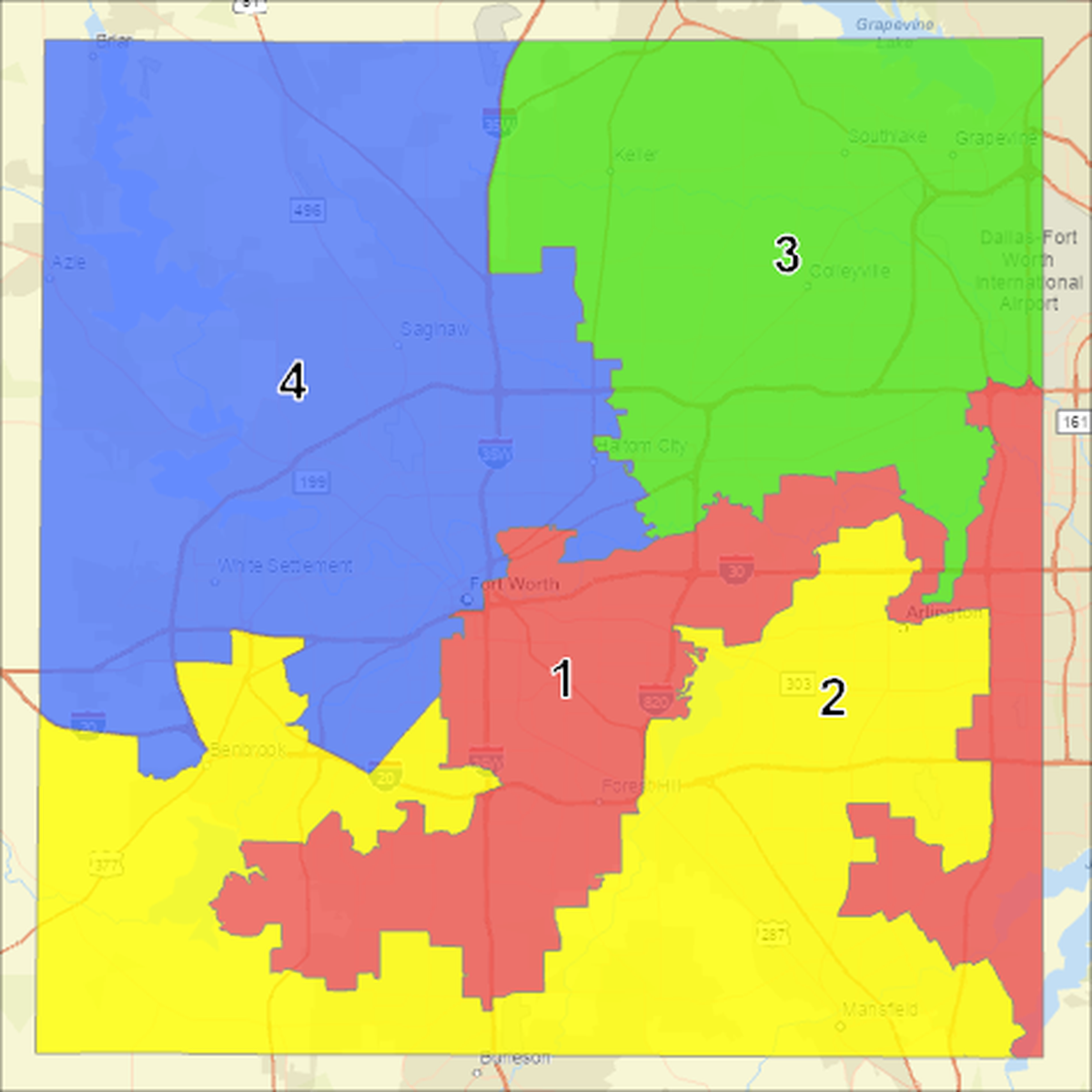
The precinct’s boundaries were significantly overhauled in a rare mid-decade redistricting, which Republican commissioners undertook in hopes of boosting the GOP majority on the court to 4-1. It now spans the entire southern portion of the county, sweeping together parts of Fort Worth, Arlington, Mansfield, Crowley, Burleson and more.
Early voting begins Feb. 17 and ends Feb. 27. Election Day is March 3. Registered voters can cast ballots at any county polling location.
If no candidate receives a majority of the primary vote, the top two finishers will compete in a May 26 runoff. In the fall, the nominee will face one of two Republicans competing in that party’s primary. Commissioners serve four-year terms.
A note about the Democratic county judge primary
County Commissioner Alisa Simmons is the overwhelming favorite to win the party’s county judge nomination over Millennium Anton C. Woods Jr. U.S. Rep. Marc Veasey is also on the ballot but ended his candidacy soon after filing for the race. The Editorial Board is not endorsing in either party’s primary for county judge but will do so in the general election.
_fitted.jpeg "JLW FWD6 Headshot (2)_fitted.jpeg")
ABOUT OUR CAMPAIGN ENDORSEMENTS
BEHIND THE STORY
MOREHey, who is behind these endorsements?
Members of the Editorial Board, which serves as the Fort Worth Star-Telegram’s institutional voice, decide candidates and positions to recommend to voters. The members of the board are: Cynthia M. Allen, columnist; Steve Coffman, editor and president; Bud Kennedy, columnist; and Ryan J. Rusak, opinion editor.
Read more by clicking the arrow in the upper right.
How does the process work?
The Editorial Board interviews candidates, asking about positions on issues, experience and qualifications, and how they would approach holding the office for which they are running. Board members do additional research on candidates’ backgrounds and the issues at hand. After that, members discuss the candidates and generally aim to arrive at a consensus, though not necessarily unanimity. All members contribute observations and ideas, so the resulting editorials represent the board’s view, not a particular writer.
How do partisanship and ideology factor in?
We’re not tied to one party or the other, and our positions on issues range across the ideological spectrum. We tend to prefer candidates who align with our previously stated positions, but qualifications, temperament and experience are important, too.
This story was originally published February 6, 2026 at 4:47 AM.