
Wanted: Tarrant appraisers who can read charts, not botch elections | Opinion
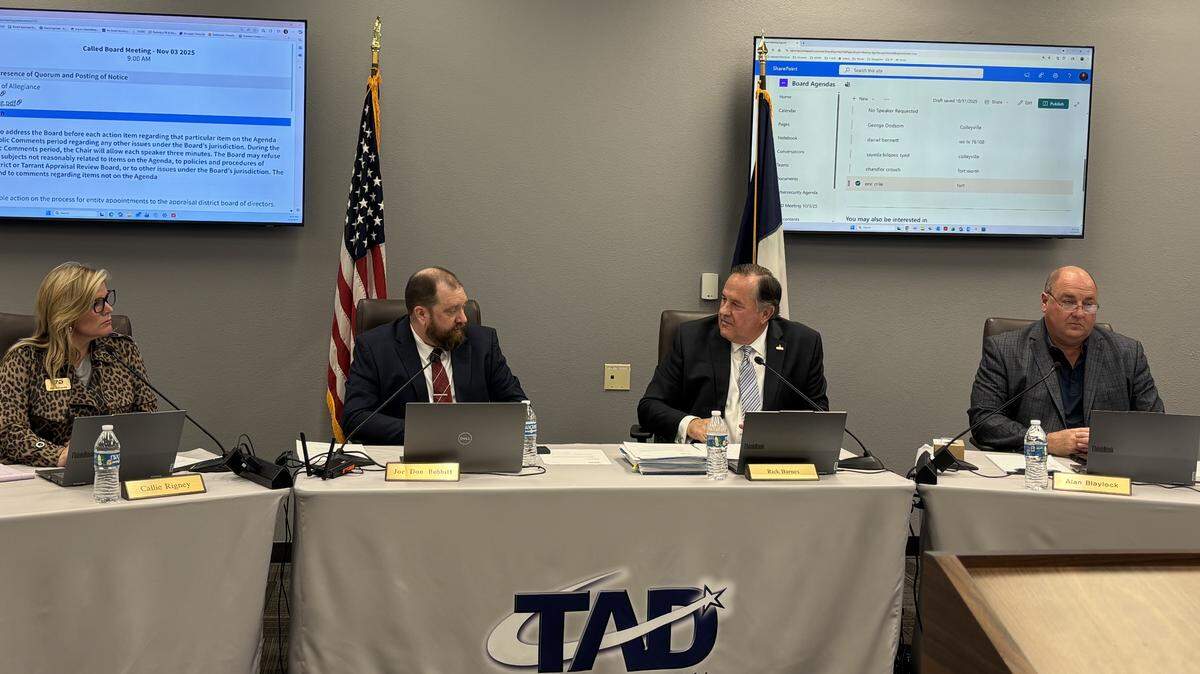
The skills required for many jobs at the Tarrant County Appraisal District apparently need to specify a few that should be obvious: simple math, how to use spreadsheets and the commitment to double-check your work.
The district revealed recently that a crucial tabulation for its 2024 election was botched. Most of the seats on the board are voted upon by the taxing entities — your city and school district, the county, etc. — who rely on the appraisal district’s data. Votes are distributed to those entities based upon the total taxes they collect. The larger the government, the more votes it has.
For 2024, when five of the nine directors were chosen, the number of votes allocated to the Tarrant County College District increased by more than half. It appears that the calculation was done wrong because someone applied the Tarrant County Hospital District’s share of tax collections — listed next to the college district — to the college. As a result, TCC had 505 votes to cast when it typically gets around 300.
Chief appraiser Joe Don Bobbitt took responsibility in a Nov. 3 board meeting. He acknowledged that he did not check the allocation “as closely as I should have.”
It’s unlikely that the results of the election might have been changed. But the incompetence is stupefying. Did no one double-check the calculations? Did no one compare the previous year’s list and see the anomaly of the college district’s vote total? Did no one think, “Gee, tax collections don’t change that much year to year?”
College district inquired about Tarrant Appraisal District vote numbers
And here’s, perhaps, the worst part: College district officials inquired about the change with the district and were told it was correct, a spokesman told the Editorial Board.
We’re dumbfounded that someone suggested that there might be an error and no one bothered to retrace the work (or perhaps repeated the mistake). After all, the college district stood to lose clout by flagging the mistake. When someone approaches you with that kind of honesty, you might want to bust out the calculator and check your work again.
Needless to say, when the people who are responsible for assessing your home’s value, and thus the taxes you must pay, fall short in the basics, concerns arise about the appraisals they must do each year.
When it involves an election and the vital question of who oversees the organization, it’s even more alarming. We hear a lot about election integrity and preventing fraud. While this debacle so far seems attributable to an error rather than a deliberate manipulation, we’d like to hear county leaders who indulge fantasies about attempts to steal elections demand full accountability for this mistake.
And coming on the heels of so many previous problems at a district that must be a tight, transparent operation, it’s a sign that reforms haven’t gone far enough.
It’s been just two years since the district suffered a significant technological meltdown that affected people trying to protest their home appraisals. A staffer was heard on tape suggesting that officials lie about the problem, compounding the initial incompetence by violating basic requirements of public transparency. It prompted significant changes, including the resignation of Chief Appraiser Jeff Law.
Not long after, the Legislature endorsed and voters approved a measure to require public elections for three appraisal district board seats. One of those who won the inaugural round of elections in 2024, Callie Rigney of Colleyville, was the lone director to seek Bobbitt’s resignation at the Nov. 3 meeting. Instead, the board voted to demand a third-party investigation, as Chairman Rick Barnes, the county tax assessor-collector, initially demanded. Once it’s done, directors must follow through and demand accountability.
Tarrant Appraisal District kept board, public in dark about election error
Bobbitt said he was first alerted to the problem by Eric Crile, a former candidate for one of the publicly elected seats, in June. The board and the public were kept in the dark for months, a major blemish for a body that has frequently been criticized for a lack of transparency.
Specific procedural changes are needed to ensure this doesn’t happen again. Just as there are redundancies and confirmations built into the counting of votes in public elections, TAD must take multiple steps to ensure accuracy.
The seats on the board that voters can decide won’t be on the ballot again until November 2026. But voters can weigh in indirectly with their elected officials. In the next few weeks, taxing entities will decide who will fill two TAD board seats. Every one of them should factor in this incident and back candidates who will take it seriously and work to get it fixed.
After all, if this involved a regular election, we’d be hearing from the county judge, the attorney general and perhaps even the governor about the importance of election integrity. Perhaps this incident won’t be as useful politically as would scary charges about immigrants improperly voting or mail ballots being corrupted. But it deserves just as much attention and determination to fix it.
BEHIND THE STORY
MOREHey, who writes these editorials?
Editorials are the positions of the Editorial Board, which serves as the Fort Worth Star-Telegram’s institutional voice. The members of the board are: Cynthia M. Allen, columnist; Steve Coffman, editor and president; Bradford William Davis, columnist and editorial writer; Bud Kennedy, columnist; and Ryan J. Rusak, opinion editor. Most editorials are written by Rusak or Davis. Editorials are unsigned because they represent the board’s consensus positions, not necessarily the views of individual writers.
Read more by clicking the arrow in the upper right.
How are topics and positions chosen?
The Editorial Board meets regularly to discuss issues in the news and what points should be made in editorials. We strive to build a consensus to produce the strongest editorials possible, but when we differ, we put matters to a vote.
The board aims to be consistent with stances it has taken in the past but usually engages in a fresh discussion based on new developments and different perspectives.
We focus on local and state news, though we will also weigh in on national issues with an eye toward their impact on Texas or the Dallas-Fort Worth area.
How are these different from news articles or signed columns?
News reporters strive to keep their opinions out of what they write. They have no input on the Editorial Board’s stances. The board consults their reporting and expertise but does its own research for editorials.
Signed columns by writers such as Allen, Kennedy and Rusak contain the writer’s personal opinions.
How can I respond to an editorial, suggest a topic or ask a question?
We invite readers to write letters to be considered for publication. The preferred method is an email to letters@star-telegram.com. To suggest a topic or ask a question, please email Rusak directly at rrusak@star-telegram.com.
This story was originally published November 7, 2025 at 4:44 AM.