
Texas knew for years power grid was at risk but did little about it. Unbelievable.
Once again, Texans are suffering because of a failure of disaster planning and investment to prepare for the worst.
First, it was the pandemic. Texas’ public health infrastructure has been shown for a year to be lacking, at both local and state levels. Leaders tried to craft a plan in 2015 to prepare for the inevitable, but it was stopped over political issues.
This time, it’s an unprecedented — but, importantly, not unpredictable — stretch of cold weather and storms blanketing the entire state. Public and private sector leaders may try to say there’s no way they could have been prepared for this. That’s a line of bull that no Texan should accept.
After 2011’s epic winter storm — known around here as the one that ruined the Super Bowl in Arlington — agencies at all levels offered recommendations to address the very problems that contributed to this outage, too.
There must be accountability. People must be fired. Companies must be fined and required to do better. Winterization of power plants must be a priority.
The immediate focus, of course, is on getting power back up as quickly as possible. We’re in for days more of this, and lives are at stake. If more electricity can’t be generated, blackouts must be rotated to offer relief to Texans who’ve been without power for a day or more.
Power companies and the Electric Reliability Council of Texas, or ERCOT, as every Texan now knows, have compounded the problem with miserably poor communication and broken promises. The promise of rotating outages flopped, and no one can explain why in plain English.
Once the crisis is over, laws must change. A thorough investigation of both the public and private actors is necessary. Gov. Greg Abbott’s declaration that ERCOT reform is an emergency priority for the Legislature is a start, but only that. Generators must be required to do a better job of winter preparation, even if the state or consumers must ultimately help pay the bill.
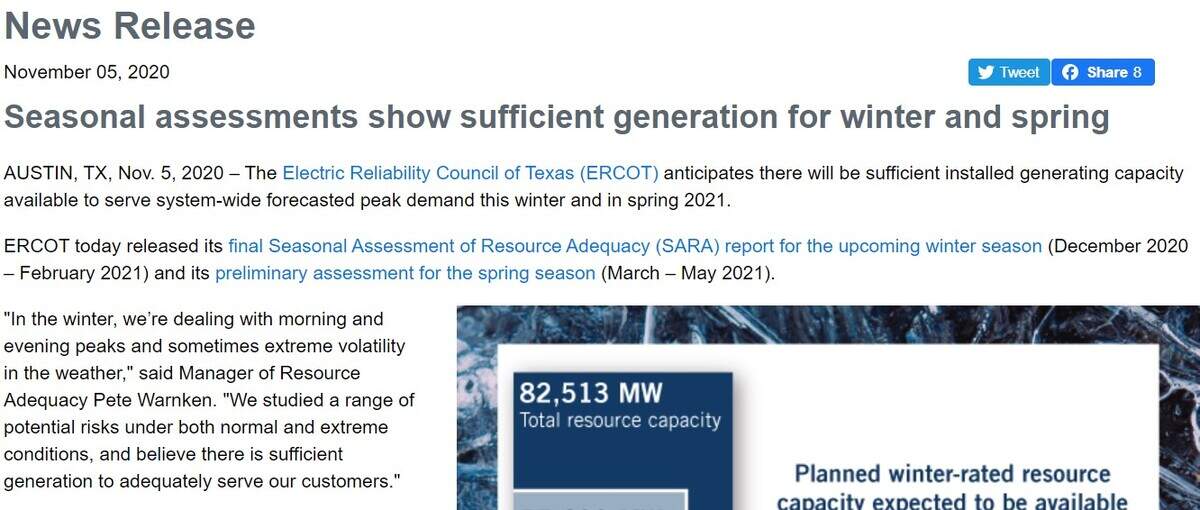
The failures here are spectacular and obvious. In November, ERCOT proudly announced that the state had sufficient energy supply for the winter. The excuse will likely be that no one could have predicted this storm. But it’s been evident for more than a week that a brutal cold was coming, and ERCOT officials were saying as late as Thursday that the system was ready. How can they have been so stupefyingly wrong?
But these cold snaps are not that rare. After the 2011 debacle, a thorough federal review found that parts of the Southwest have suffered these events at least every five years.
Texas is an energy giant. This shouldn’t happen here. We have a large and diverse energy supply. The culprit here is a clear failure of preparation, period.
The blame game is already falling into predictable narratives. On the right, the problem is too much reliance on renewable energy. On the left, it’s privatization, Republican leadership and a failure to anticipate the effects of climate change. There’s some truth in most of it, but the focus needs to be on specific actions that were not taken, who’s responsible for them and how to prevent them from happening again. Solve specific problems rather than railing at huge ones.
It seems apparent that power generators haven’t done enough to winterize their plants, so shutdowns and failures kicked in just when the power was needed most. That extends to renewables, too, as wind turbines froze over. Natural gas transmission has been a problem as well.
These are big, but fixable, problems. The Legislature must dig in to identify the specifics and then act accordingly. A law enacted in 2011 gave the Public Utility Commission power to require generators to report on their abnormal weather preparations and file an emergency plan. Has that been done, and if preparations were inadequate, why didn’t anyone step in? Perhaps regulators need more enforcement teeth. That’s always a tough sell in Texas, but it’s clear these companies need a nudge, and perhaps help paying the bills.
It’ll be all too easy to forget this dreadful week when spring arrives. But it’s not just the occasional winter storm. Every summer, our power supply and grid are stressed by the extensive heat. We haven’t seen this level of failure yet during a summer, but it’s coming.
When it does, Texans must be able to look back and see that everything possible was done to prepare. Lives depend on it.
BEHIND THE STORY
MOREHey, who writes these editorials?
Editorials are the positions of the Editorial Board, which serves as the Fort Worth Star-Telegram’s institutional voice. The members of the board are: Cynthia M. Allen, columnist; Steve Coffman, editor and president; Bud Kennedy, columnist; Ryan J. Rusak, opinion editor; and Nicole Russell, editorial writer and columnist. Most editorials are written by Rusak or Russell. Editorials are unsigned because they represent the board’s consensus positions, not the views of individual writers.
Read more by clicking the arrow in the upper right.
How are topics and positions chosen?
The Editorial Board meets regularly to discuss issues in the news and what points should be made in editorials. We strive to build a consensus to produce the strongest editorials possible, but when we differ, we put matters to a vote.
The board aims to be consistent with stances it has taken in the past but usually engages in a fresh discussion based on new developments and different perspectives.
We focus on local and state news, though we will also weigh in on national issues with an eye toward their impact on Texas or the Dallas-Fort Worth area.
How are these different from news articles or signed columns?
News reporters strive to keep their opinions out of what they write. They have no input on the Editorial Board’s stances. The board consults their reporting and expertise but does its own research for editorials.
Signed columns by writers such as Allen, Kennedy and Rusak contain the writer’s personal opinions.
How can I respond to an editorial, suggest a topic or ask a question?
We invite readers to write letters to be considered for publication. The preferred method is an email to letters@star-telegram.com. To suggest a topic or ask a question, please email Rusak directly at rrusak@star-telegram.com.