Fort Worth-area event reveals how some conservative activists see Black history, culture | Opinion
“There’s nothing normal about homosexuality. Nothing. Okay? They can kill each other, but they can’t procreate. And that’s just a reality.”
I know what you’re thinking — this isn’t your typical Black History Month gathering. That’s exactly Eugene Ralph Sr.’s point.
Ralph, is an activist, a political consultant and the father of Dallas City Council District 8 candidate Eugene Ralph (junior) who got his start in politics opposing a New Orleans ordinance that gave health insurance benefits to the same-sex partners of city employees. He eventually lost the decade-long case, Ralph v. City of New Orleans — and gay couples in New Orleans preserved their ability to do something besides “kill each other” — but Ralph’s war was far from over. Even better, it had new sponsors.
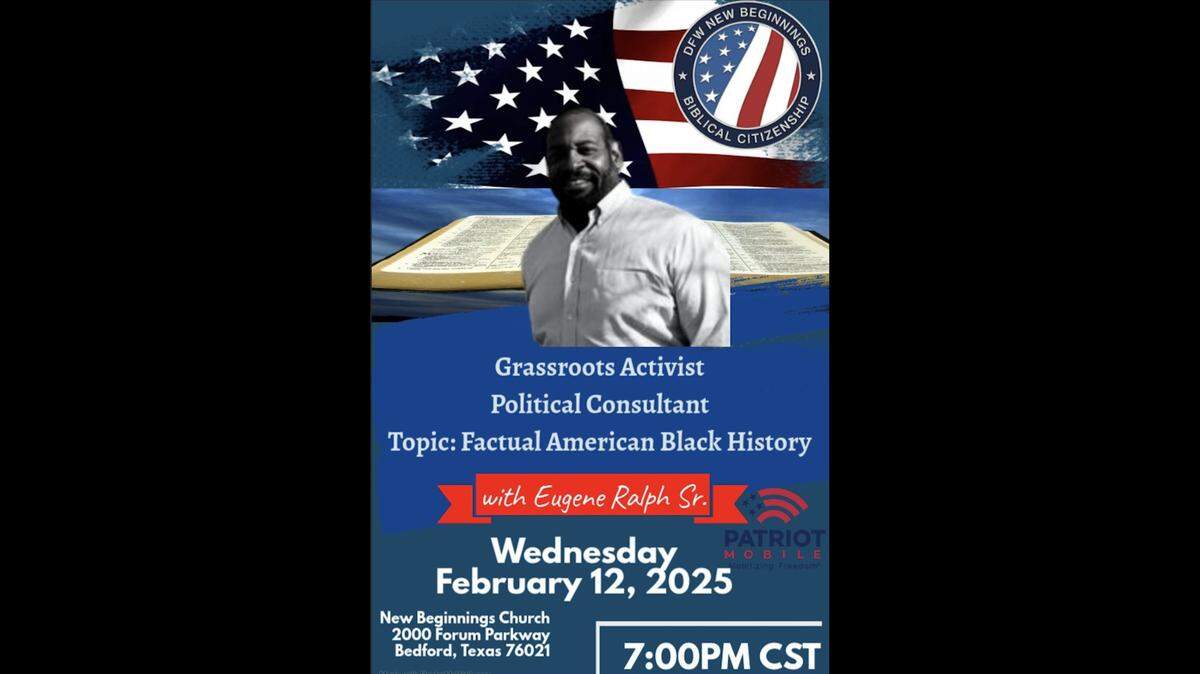
On a recent Wednesday night, he was in Bedford leading a discussion titled “Factual American Black History.” The event was sponsored by Patriot Mobile, a Grapevine-headquartered “Christian Conservative Wireless Provider” whose side hustle has successfully elected school board representatives pushing book bans — many of them involving books with queer characters or frank depictions of ethnic bigotry — in schools across North Texas suburbs. In Keller, Patriot Mobile-backed board members have tried to quietly facilitate a split of Keller ISD across proposed lines that just so happen to divide the school community by Black and white.
Considering how much Patriot Mobile has influenced what Tarrant County’s kids can read and where they could go to school, I felt like knowing where Patriot Mobile spends its money is worth my time. And the more Ralph spoke, the more it became clear the event was primarily about conversion, not education. As Ralph explained to me after the meeting: “My intent, in part, for this, is to help whites understand how to transmit, translate what we know to Blacks who are willing to listen. Because we need Black people to wake up and see what’s going on.”
Not only was I listening, I even stayed awake.
Each person he mentioned was given a two-sentence summary rivaling a first-grade homework assignment and lasted about eight minutes in total. (Better simple than false, I guess.) It was held at New Beginnings Church in Bedford during the regular Wednesday night gathering, and the worship was longer than the history lesson.
Either way, Ralph told me the history portion was simple because he doubted it would stick with his audience, which, to my eye, was about 30 people. “I didn’t want to dig too deep into the whole history thing,” he told me. “Because I’m like, ‘You not gon’ remember it anyway.’ This is to make a point.”
When I sidebarred with Ralph, he suggested I read David Barton, an activist often criticized by historians for writing books that deny the separation of church and state, portrayed Jefferson as a reluctant owner of his 200 enslaved Africans and slammed Minnesota Attorney General Keith Ellison, then America’s first Muslim congressperson, for using a Quran to take his oath of office.
Ralph instructed attendees to “enhance your communication skills, know your audience, listen to the arguments of the other side, and develop a greater understanding of minority culture.”
This was an interesting commendation. It presumes that his listeners supposedly evangelizing to Black people are not from Black culture. And Ralph who is Black, didn’t seem to have a high view of the culture “minorities” are creating. Especially when it comes to hip-hop.
“Gangster rap” — which Ralph incorrectly claimed was an entity outside of hip hop — “got a bad rap, because they were putting out all this bad stuff,” he says, alluding to the often violent and hypersexual themes popularized and commercialized throughout the 1990s within the dominant form of Black entertainment. “We had Blacks and whites fighting to keep this stuff down.” But, Ralph explained, the cross-cultural opposition “lost because Bill Clinton was a … straight-up reprobate in the White House.” Clinton’s covert promotion of rap music, Ralph argued, led to the continued destruction of Black America.
I get it. While I firmly believe in artistic expression, I wouldn’t advise any parents to play “Gin and Juice” at a child’s birthday party. And besides, any adult who really wanted to hear from Snoop Dogg could have followed him to Washington so he could perform his discography at last month’s inauguration events.
Of course, Bill Clinton wasn’t celebrating an inauguration — Donald Trump was. Over the last few months, Trump has also walked out to 50 Cent’s Many Men (Wish Death) before an interview with Gen-Z streamer Adin Ross and scheduled one-on-one time with Icewear Vezzo and Peezy while campaigning in Michigan. And on Thursday, Trump hosted Kodak Black — the chart-topping rapper who also pleaded guilty to the sexual assault of a high school girl — at the White House for his nontraditional Black History Month event. In 2021, Trump commuted the rap star’s four-year sentence for making a false statement to purchase a gun.
Trump and Ralph have something in common: They are engaged in the uphill battle of recruiting Black people to a cause that isn’t typically supported with Black votes. But Trump is actively courting Black voters by leveraging a type of Black rap star making Black “history” that few Black people are particularly proud to remember. Meanwhile, Ralph believes the rappers Trump — again, not Clinton, not Barack Obama, but Trump — embraces have created the Black dysfunction that his event was trying to remedy.
So, I pressed Ralph on the apparent contradiction.
“Politics, as far as I’m concerned, is a tool that I use to advance the agenda that I believe in,” Ralph said. “Whoever can serve that purpose best.”
“I accept the reality that there’s going to be some gangster rappers involved in certain things that I prefer not to have them be a part of. That don’t mean I have to be a part of it.”
Ultimately, even though I was the type of Black person he was training his listeners on how to convince, I appreciated the honesty of his pragmatism. Ralph weaves disparate elements of Black history, electoral politics, activism and even his explanation of street rap into a unified thesis about the country we have to build, the country he wants. And he’ll advance it even if it means begrudging acceptance of people he believes are destroying his community. Winning fixes everything, and in November, his coalition of rappers and preachers just won big.
Ralph closed his presentation with an expectation that the winning will continue. “I tell all Christian parents: Raise your children as an army. We need help,” he said. He ended by touting a fundraiser on the church stage for Ralph Jr’s Dallas City Council campaign. Senior included a QR code for donations to his son’s crowded battle for the open seat.
Ralph was ready to make Black history. With a little help, he might get there.
This story was originally published February 27, 2025 at 5:28 AM with the headline "Fort Worth-area event reveals how some conservative activists see Black history, culture | Opinion."