Words mean things. Even empty ones from Trump about nonsense like renaming the gulf | Opinion
President Donald Trump has performed, as of writing, 89 executive actions in just three weeks of reclaiming the Oval Office. One friend, I think, was politely trying to tell me that I probably know of too many of them.
“My approach has been paying as little attention to what he says as possible,” the friend said. “It’s too much to keep up with, and so many of his words are empty.“
I was briefly aghast at his presumption and its implications — Me? Too Online? Preposterous! — But the last part, the assertion of empty words, stuck with me. I get it, but it’s not that simple.

Now, because I was not born three weeks ago. I can remember plenty of words from our leaders that belong at the bottom of a Stockyard bullpen. Just in January, America shipped $8 billion worth of firearms to a place where it had worked “tirelessly” for a cease-fire. Some redefined “Bidenomics” as a self-affirmation instead of a slur. Cleaning the mess up should be a bipartisan effort.
But even with the intensity with which Trump fires his words, it’s basically impossible to get a dense, calorie-rich meal from most of them. Many of his executive actions will fail because they are expressly illegal. Some of the early Trump targets are deeply consequential. The patient who took her last breath because the severely defunded USAID cut off her oxygen comes to mind. But those of us who could not point to Myanmar on a map don’t yet feel the ripple. However, all of us, especially those reading this publication, could point to the Gulf of Mexico on a map. Well, not a Google Map.
Until those gums flap again, renaming the Gulf of Mexico to the Gulf of — c’mon man, I’m not doing this — are Trump’s emptiest words yet.
The body of water itself doesn’t materially change. The gulf’s waves are still warm on an idling Galveston night, and while the president can do plenty to make it warmer, a name alone won’t boil the gulf. Renaming the body of water unilaterally appears to violate International law. Mexican President Claudia Sheinbaum may lawyer up to Google over the change, showing that even the pettiest provocations of her favorite trade partner carry some weight.
Sheinbaum fights because she knows what we should: The name change represents the idea that truth is controlled by Pennsylvania Avenue, alone. Preferably in front of the camera so the world can gawk. It’s drawn from the same sort of rhetoric that treats Canada as a nation waiting to be annexed into the 51st state. Note how Trump’s not just trolling outgoing head of state Justin Trudeau by calling him “governor instead of “prime minister,” but also, according to Trudeau and his officials, planning privately on how to “dominate Canada or take it outright.” The jokes are hollow. But they aren’t quite empty.
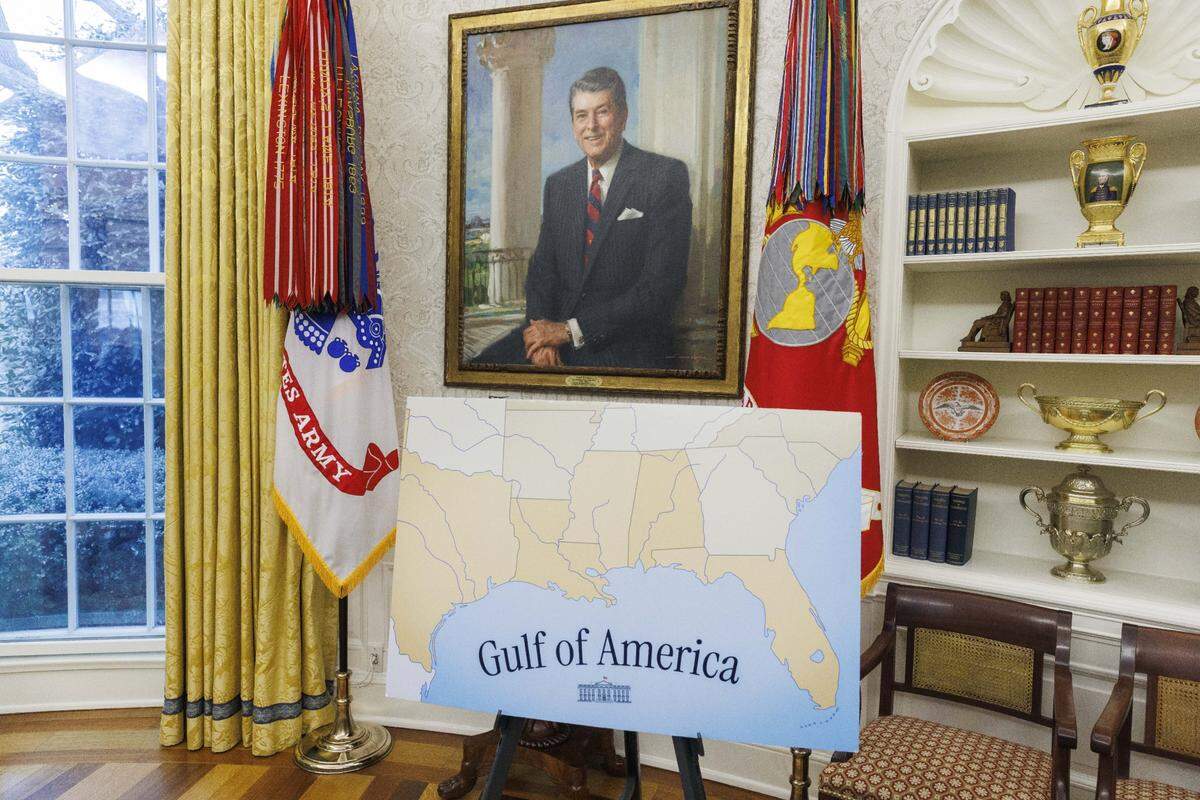
The Associated Press is in the business of words. Its approach to journalism — clear, efficient and matter-of-fact reporting from around the world — is intrinsically tied to its revenue model of licensing its news content to other media entities. Publications across the world, with a diversity of ideological leanings, license AP content because the reputation is so strong.
So, when the AP decides that no, its won’t change immediately change the style guide on the president’s whims, it’s to maintain its reputation as a service that delivers the truth. The White House responded by barring AP staffers indefinitely from areas such as the Oval Office. The AP says the decisions “were plainly intended to punish the AP for the content of its speech” and argues that its a First Amendment violation. White House Press Secretary Karoline Leavitt contests that “It is a fact that it is now the Gulf of America” — a statement that, in so many words, is simply untrue.
Words, to this administration, mean things. Even when they’re empty. Maybe especially.
This story was originally published February 15, 2025 at 5:27 AM with the headline "Words mean things. Even empty ones from Trump about nonsense like renaming the gulf | Opinion."